Summarize Content With:
Quick Summary
In this featured article, we are going to discuss what is AI call center and how AI call centers work. Moreover, we will also deep dive into the core technology that ties AI call centers together and real world applications of the same. Furthermore, the benefits and challenges of AI call centers that you might come across with.
Introduction
The world of customer service has been undergoing a major shift, and the driving force that’s majorly involved in these transformations in Artificial Intelligence(AI). If you’ve recently come across a company’s support line or chatted with a brand online, you might have even unknowingly interacted with AI. It might have been through voice recognition, chatbots, or virtual assistants, AI-powered solutions are now integrated into customer service systems across different industries. What do you think powers these systems? And how do they even work behind the scenes?
What is AI Call Center?
To put it simply, an AI call centre is a customer support system that effectively uses artificial intelligence to manage client interactions. These systems also involve anything from automated voice responses and chatbots to sophisticated virtual assistants. Instead of relying solely on human agents to respond to customer inquiries, AI systems are designed to manage a vast range of queries autonomously.
Thinking about the key advantages? It’s obviously efficient, cost-effective, and enhanced customer experience. The goal is never to replace humans but augment their capabilities by working side by side. Automating repetitive tasks ensures that human resources are solely focused on complex or/and emotional interactions.
How AI Call Centers Work: Core Technologies Explained
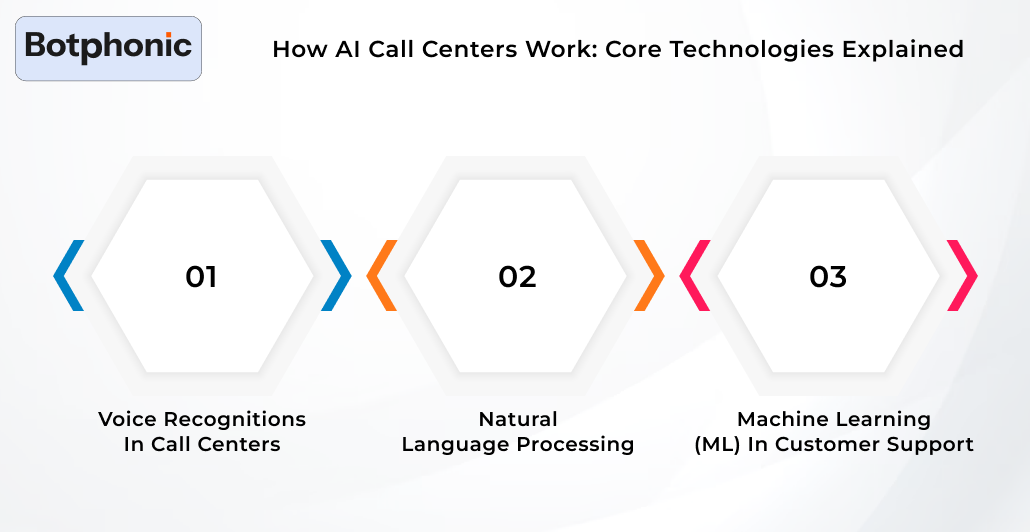
AI-powered call centers are a result of not just one but various cutting-edge technologies. To appreciate how these systems are working, let’s deep dive into the primary technologies play:
1. Voice Recognitions In Call Centers
The first step in an AI-powered call center’s process in the capability of understanding human speech. This is majorly possible with the help of voice recognition technology. In this context, voice recognition enables the system to decode the words spoken by a customer. Whether you are requesting account information, making a payment, or just inquiring about products, the AI system needs to know your request before getting into action.
With natural language processing and machine learning, these systems are even able to break down speech into text and analyze the intent behind the request. For instance, Just think you are calling an airline to check status of your flight. As soon as you say “Flight status,” the system recognizes it and routes the caller to relevant information or service, it can be either automated update or escalated to a human agent.
2. Natural Language Processing
NLP is undeniably one of the most essential components of AI in call centers. It enables the system to understand not just words but the intent behind it, the meaning the user wants to convey. To make it simple, NLP allows AI to understand context, sarcasm, emotions, and even regional dialects. This is where AI-powered call centers differ from traditional interactive voice response (IVR) systems, which often struggle with understanding more complex or nuanced speech.
For example, let’s say a customer has called a retail company saying, “I ordered a pair of socks a week ago, and they haven’t arrived yet.” With NLP, AI call assistant can easily grasp that it’s a complaint, will extract the order number from the sentence, and assists them by providing real-time information about the shipment status. Without NLP, this request will get harder for even a basic IVR system to handle.
3. Machine Learning (ML) in Customer Support
Machine learning is the main component that makes AI in call centers get smarter over time. Through continuous learning from previous interactions, AI can refine its ability to interpret queries and even improve its responses. As more data is flowing through the system, AI can use those patterns to predict and offer solutions while making each customer interaction more efficient than ever.
For example, a call center system notices that there are many customers with the same query related to a specific product or service. The system can easily offer them solutions or might escalate them to specific human agents who are better equipped with resources to help them. Moreover, this makes AI-powered customer support creatively adaptive and capable of solving problems before they even escalate.
 NOTE
NOTE
A Quick Glance Of How AI Call Center Works
How an AI Call Center Works Step-by-Step
- Voice input captured via AI voice bot
- Speech converted using voice recognition technology
- Intent analyzed with NLP
- Response generated using machine learning
- Escalation to human agent if required
Advantages of an AI call center
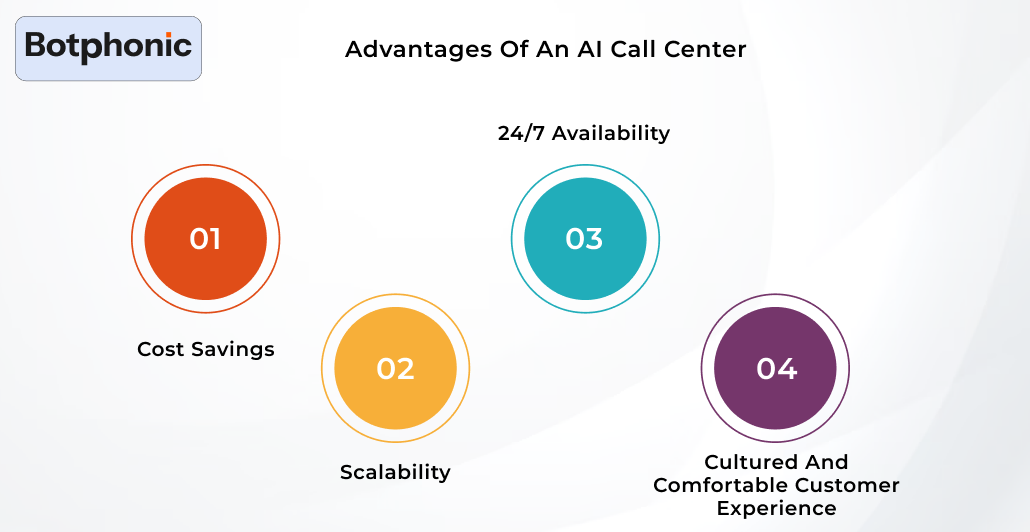
AI call centers have brought many smart benefits for companies and clients alike. Moreover, as Gorgias reports stated, AI-powered tools have also led to about 37% reduction in first response times. Here are some of the leading benefits:
1. Cost Savings
Cost savings remain the foremost reason for AI acceptance. By automating some repetitive tasks like answering basic questions, AI call centers automatically assist companies in reducing their staffing costs. AI systems can handle the same grueling volume at a mere fraction of costs instead of hiring dozens of customer service representatives.
2. Scalability
AI call centers can easily scale up during seasonal peaks, whether in holidays or the launching of new products, without having to build new resource capacity even. This further ensures businesses can handle increased demand without actually compromising on the quality of service given.
3. 24/7 Availability
Another important advantage of AI call receptionists is their availability round the clock. Traditional call centers would operate within the business-time boundary, unlike AI systems. These offer their support 24/7 for the convenience of their customers, an experience dictated by demands regardless of time zone.
4. Cultured and Comfortable Customer Experience
AI systems provide personalized support. They analyze customer data to make pertinent decisions, anticipate problems, and even provide customized solutions. Such AI-centered customer service leads to greater customer satisfaction and loyalty.
 PRO TIP
Advantages vs Challenges of AI Call Centers
| Category | Aspect | Description | Business Impact |
| Advantage | Cost Savings | Automates repetitive and high-volume inquiries, reducing dependency on large human support teams. | Lower operational costs and improved margins, finance will smile. |
| Advantage | Scalability | Seamlessly handles call spikes during peak seasons or product launches without adding infrastructure or headcount. | Supports business growth without operational bottlenecks. |
| Advantage | 24/7 Availability | Provides uninterrupted customer support across time zones and outside business hours. | Higher customer satisfaction and global service continuity. |
| Advantage | Personalized Customer Experience | Uses customer data and interaction history to deliver real-time, tailored responses. | Stronger customer loyalty and improved brand perception. |
| Challenge | Handling Complex Queries | Struggles with emotionally sensitive, nuanced, or highly complex customer issues. | Requires human escalation to avoid customer frustration. |
| Challenge | Data Security & Compliance | Collects and processes large volumes of sensitive customer data. | Increased responsibility for cybersecurity and regulatory compliance. |
| Challenge | AI Training & Data Quality | Performance depends entirely on the quality, diversity, and freshness of training data. | Poor training leads to inaccurate responses and degraded customer experience. |
Challenges of AI Call Centers
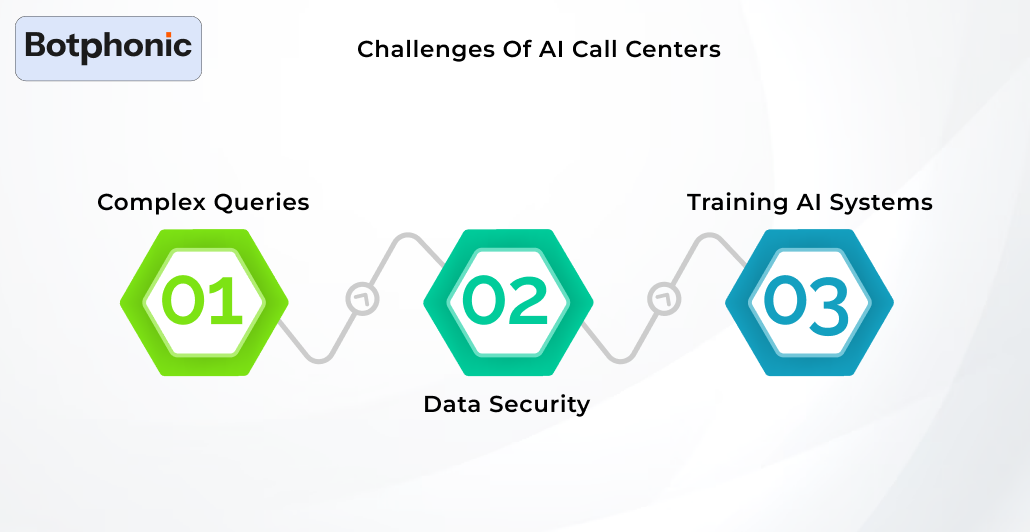
But like with all other things, there are merits and demerits concerning AI-driven customer service:
1. Complex Queries
While AI is probably the most intelligent employee for performing routine tasks, such as dealing with low-complexity tasks or requests, it has little value in resolving more complex or emotional inquiry types. Frustration may arise for customers looking for empathic support or assistance with more complex issues given the limitations of AI.
2. Data Security
AI call centers continuously collect vast amounts of customer data for storage. Companies must ensure compliance with data protection laws, and teams handling such systems often benefit from a cyber security course to better safeguard sensitive information.
3. Training AI Systems
AI will perform effectively solely when it is supported with well-structured and clean data. It will operate solely on the basis of data that it has been practiced with. If the system was not trained with a variety of datasets or edge cases, it could very well fail to grasp certain queries from your customers thus heightening chances of a bad experience.
Let AI Call Centre Take Over Your Repetitive Calls!!
Try Botphonic Demo Now!!Conclusion
As we have explored what is an AI call center and how they are actively working towards shaping the future of customer service. Making it more efficient and personalized and even scalable than ever expected. Whether it’s a business you want to improve or a customer who is interacting with an AI-powered support tool, the possibilities are endless. While challenges are still present, the potential of AI to facilitate operations and refine service delivery is crystal clear.
Knowing how AI call centers work makes every industry known to the basics of AI so they can just start working with it.