Summarize Content With:
Summary
In this blog, we detail why AI voice automation is far more than a technology upgrade; it’s about trust. As AI-fueled calls proliferate in the U.S., it’s a reminder of why honesty, consent, privacy and accountability matter and how businesses using AI can develop better relationships with customers rather than take a chance on undermining credibility.
Introduction
Your phone rings. It is placid, professorial, human-but-not-quite. You respond to questions, you add facts, gossip, and opinion, and occasionally, if you are lucky, you feel like it has been heard. And then you realise: You had not been talking to a person.
With the dash of automation in U.S. customer service, health care systems, finance and political outreach that is AI-voice splashing onto those fields now, it’s more than just a technical upgrade; this is an ethical crossroad. The ethics of AI voice automation in the USA is what the FCC and FTC are now grappling to figure out, regulate, not interrupt how these voices might speak, listen or act to earn our trust, influence our choices and even potentially impact people’s rights. That’s why AI voice ethics are not an issue of the future; they’re a responsibility now.
As adoption accelerates, keeping pace with AI call automation trends USA is becoming essential for organizations that want to innovate responsibly without compromising user trust.
Understanding AI Voice Automation
AI voice automation is the use of AI to emulate human speech in phone or voice app conversations. These systems employ technologies such as natural language processing (NLP), speech recognition and text-to-speech (TTS) models for understanding users and responding to them in real-time.
This evolution is also a defining pillar of digital transformation in the USA, where businesses are rethinking how voice, automation, and ethics intersect at scale.
As efficient and cost-effective as they are, these robots that are becoming more human-like every day muddy the waters between machine and person, bringing up important considerations around the ethics of AI voice automation, USA core values (truth/fairness/control) in human-AI interaction.
Key Ethical Principles Behind AI Call Assistants
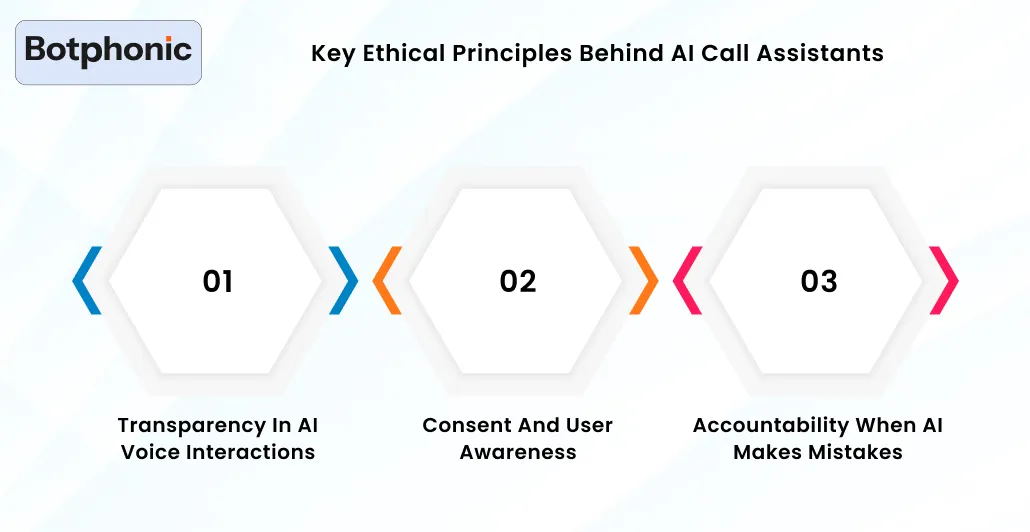
1. Transparency in AI Voice Interactions
Transparency is the basis of ethical AI voice use. It should be obvious to them when they are dealing with an AI system and not a natural agent. In the United States, tricking someone into thinking that an AI is human could erode trust and violate consumer protection laws.
AI voice systems that aim to be ethical should acknowledge they are machines at the outset of any interaction, and steer clear of pretending to have human emotions or personalities in deceitful ways.
People are better equipped to decide what information to disclose and how to communicate when there is transparency.
2. Consent and User Awareness
Consent is more than an information provision, but a matter of informed user consciousness. It is important that people know how their voice data is being collected, stored, and possibly used to train AI models. This is particularly important in confidential industries such as healthcare or finance, where the discussions might involve private or regulated information.
A responsible rollout entails giving people the opportunity to opt out, ask to speak to a human, or restrict data use. In a country that’s becoming ever more leery of digital privacy, following the rules of consent is not only right, but it’s crucial for long-term adoption.
3. Accountability When AI Makes Mistakes
If an AI voice assistant provides incorrect information, executes a request wrongly or causes harm, we can’t blame the machine. Responsibility still belongs with the entities that implement and maintain these systems.
For responsible AI voice automation, there needs to be visibility of what is happening inside the black box, ongoing monitoring and levers for human intervention. Companies need to be ready to defend AI-driven decisions and fix mistakes fast. In the U.S. regulatory climate, accountability is the key to deploying AI in a way that can make services better without shaking society’s trust in those services.
Data Privacy and Security Challenges in AI Voice Automation
The more these AI voice systems become a part of commonplace communication, the more sensitive data they’re processing. In the U.S., we now face one of the most significant ethical challenges in the age of AI voice automation, data privacy and security.
1. How AI Call Assistants Collect Voice Data
Call assistants in AI automatically collect voice data by recording conversations, the text of speech-to-text, and logs of interaction. Frequently,y these recordings are also used for tuning accuracy, model training and user behaviour analysis. Most of the time, data is saved on cloud servers and processed by third-party vendors, which adds yet more layers to how and where information travels.
Aspects of these efforts contribute to enhancing performance, but also increase the burden of managing personal and biometric voice data with care and transparency.
2. Risks of Data Misuse and Breaches
Voice data is particularly personal; it can betray a person’s identity, emotions and health or financial status. It is a critical target, for when deployed improperly, many cyberattacks can be possible and unauthorised access attempts made. AI voice system breaches can result in identity theft, fraud and loss of consumer confidence.
Secure Environment: Fair use of AI demands strong encryption, minimal data restoration, restricted access and frequent security audits. These shields are illegal (and a privacy trade-off is made) if efficiency gains are achieved without them.
U.S. Laws and Regulations Governing AI Voice Automation
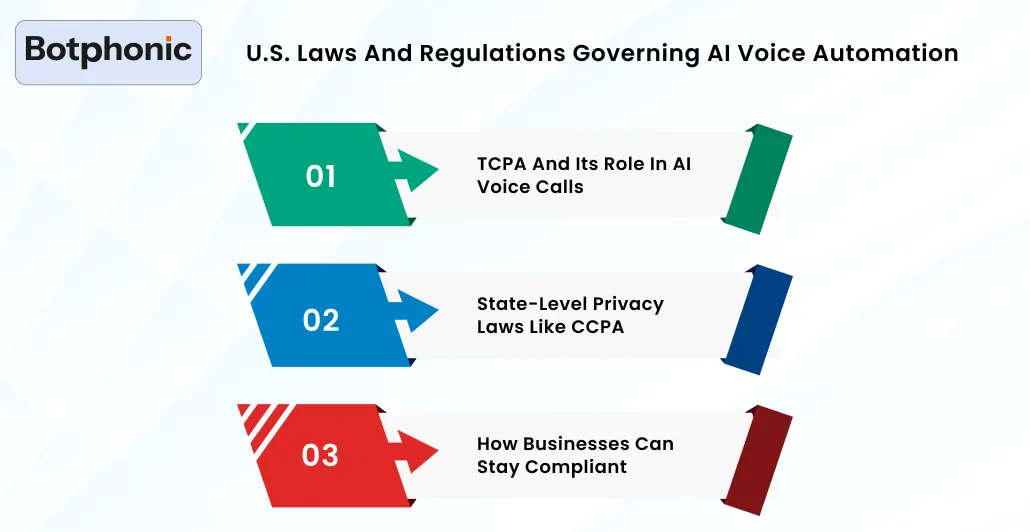
The regulatory environment in the U.S. is adapting to AI voice automation, but several laws are already extremely influential in determining how these systems can be used responsibly and legally.
1. TCPA and Its Role in AI Voice Calls
The most significant US law pertaining to AI voice calls is the Telephone Consumer Protection Act (TCPA). It restricts prerecorded and autodialed calls without prior affirmative agreement, particularly for marketing purposes.
AI call assistant for outreach, reminders or sales must ensure compliance with TCPA requirements, such as consent management, calling time rules and opt-out processes. Non-compliance can result in stiff fines and litigation.
2. State-Level Privacy Laws Like CCPA
On the state-law front, statutes such as the California Consumer Privacy Act (CCPA) provide a similar “right to know,” which would grant consumers new data rights over voice recordings. These directives comprise the rights to access, erasure, and limitation on processing of the data being stored.
More states are moving forward with privacy measures, and companies using such AI voice automation would be subject to a hodgepodge of regulations centred on issues of transparency and individual rights related to user data.
3. How Businesses Can Stay Compliant
To stay on the right side of the rules, businesses need to implement transparent consent processes and capture detailed records of user permissions, while ensuring their collection and storage practices for AI voice data are reviewed all the time. Collaborating closely with legal functions and performing compliance audits, selecting vendors that focus on privacy can drastically minimise regulatory risk.
Complying with the law isn’t just about avoiding costly fines; it’s about showing respect for consumer rights.
 NOTE
NOTE
Transparency in AI Voice Automation
Transparency is not only an ethical stance but also a viable strategy for fostering sustainable trust between businesses and users.
1. Should AI Always Disclose Its Identity?
The majority of ethical frameworks advocate for AI voice systems to always self-identify that they are not human at the beginning of an interaction. When users don’t realise they are talking to AI, it can feel deceptive, particularly in delicate conversations like those around money, health or legal issues.
Disclosure gives people the choice to push through or opt instead for a human alternative.
2. Building Trust Through Honest AI Communication
Honest communication goes beyond disclosure. AI should explicitly state what they are designed for, what they are not good at and where the next steps lie. By steering clear of too human-like manipulation and emotional cues, it’s kept from users not feeling duped.
With transparency at the top of mind, AI voice automation becomes an aid to your support team, not a weapon you’ll do anything to use.
Ethical Use Cases of AI Call Assistants in the USA
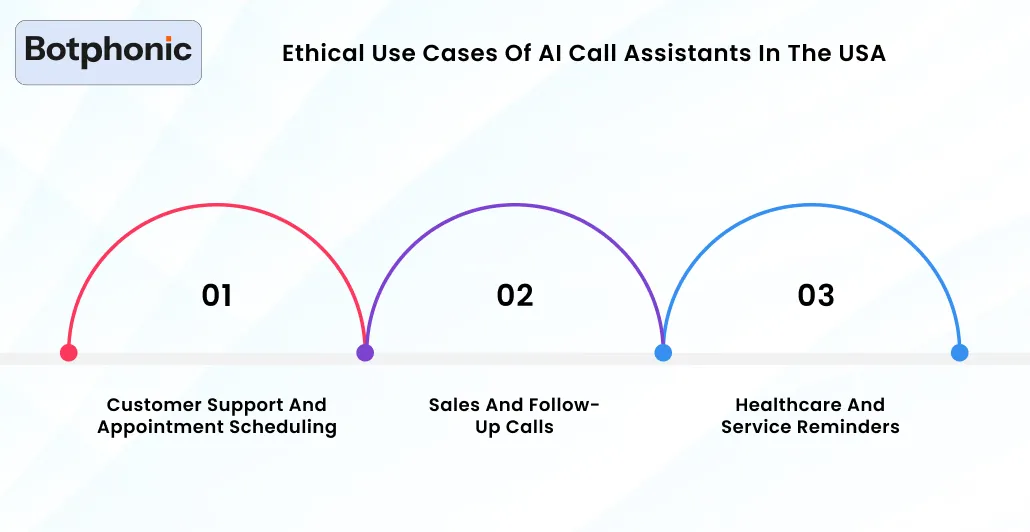
Done ethically, however, AI call assistants can offer genuine value.
1. Customer Support and Appointment Scheduling
AI voice assistants work well in managing rote customer service requests and booking appointments through AI appointment booking. These implementations are low-risk, performance-oriented, and simple to reveal transparently and are also some of the most ethical forms of voice AI.
2. Sales and Follow-Up Calls
In sales and follow-up situations, ethical use is predominantly a function of consent and truthfulness. When users have consented and know that they are chatting with AI, these systems can offer people prompt information without venturing into manipulation or spam.
3. Healthcare and Service Reminders
They are excellent uses for ethical AI voice automation, such as healthcare appointments, medication or follow-up reminders. AI voice systems can improve patient outcomes when privacy is ensured and explicit consent is obtained, as well as reduce administrative burden.
Unethical Practices Businesses Must Avoid
With the increasing sophistication of AI voice automation, it is easy to cross the border between helpful automation and harmful manipulation. Companies need to be on the lookout for any practices that can cause loss of trust on the part of users and the breaking of ethical standards.
1. Misleading Voice Scripts
Unethical use of AI voices includes pressuring users through the exploitation of their emotions or faking the empathy of a human to influence their decisions. Any kind of scripts that will generate urgency, fear, or false authority, especially in cases of sales, debt collections, or political calls, will mislead users and eventually hurt the credibility of the company.
2. Secret Call Recordings
Recording a phone conversation without clear disclosure and/or consent is not only an ethical issue but also a violation of the law. Voice data contains very personal information. So, extracting it without the knowledge of the users destroys the trust between them and the company, besides exposing the business to the risk of regulatory penalties under the U.S. privacy laws.
3. Completely Automating Customer Service without Human Help
Leaving your customer service in the hands of AI voice systems only and not even giving the customers the opportunity to talk to a human agent can be a reason for the customers’ frustration, and the situation may worsen.
Ethical AI also implies human intervention, especially at those times when the issues are complicated, people are emotionally affected, or situations are of extremely high stakes.
NOTE
How Botphonic Approaches Ethical AI Voice Automation
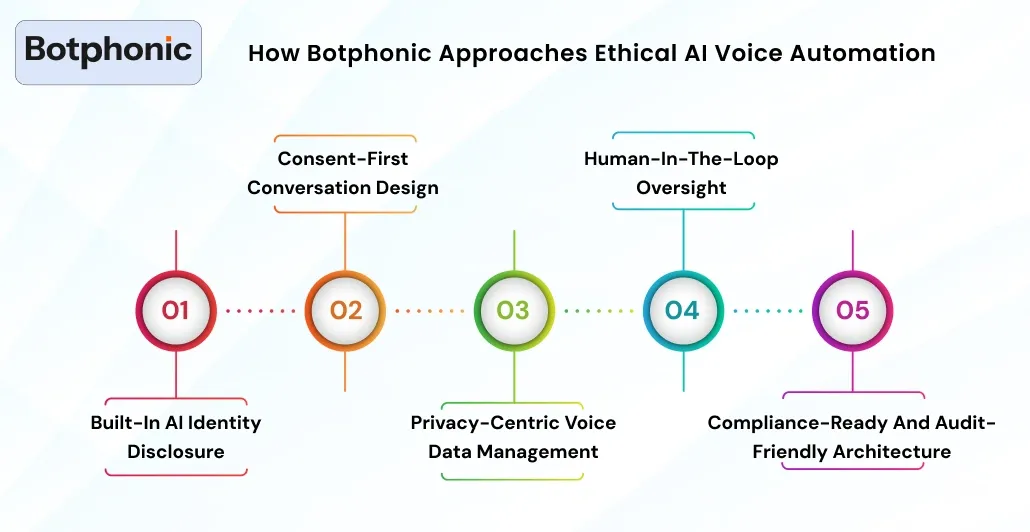
Botphonic is the human-first, ethics-by-design way to AI voice automation. Instead of prioritising efficiency or scale, the platform is design to ensure that every AI-fueled conversation is transparent, compliant and respectful of user rights, particularly in the U.S. regulatory climate.
The following is a more detailed explainer on how Botphonic conducts ethical AI voice automation in practice:
1. Built-In AI Identity Disclosure
Every AI call is clearly initiated, right at the start of the conversation, by an animated voice assistant that introduces itself as a voicebot from Botphonic. This is to avoid trickery and be transparent with its users. The system doesn’t try too hard to ape human manipulation, so users never feel like they’re being deceived into thinking that the people—or robots—they’re talking to are anything other than artificial.
2. Consent-First Conversation Design
Ethical consent is integrated into the call flows of Botphonic. Prior to gathering information, a call recording , or any further automated messages, the user is clearly given the purpose of their call and clear options. Opt-out features and human handoff paths are instantly available in keeping with both ethical guidelines and U.S. regulations such as TCPA.
3. Privacy-Centric Voice Data Management
Botphonic has taken the position that voice data is sensitive personal information. All recordings and transcripts are store in an encrypted, initialised fashion and accessed through strict control measures for no more time than is necessary. The platform limits data collection and facilitates privacy rights requests like access to, and deletion of personal data, which is necessary in order for the businesses to comply with laws (including CCPA).
4. Human-in-the-Loop Oversight
Botphonic is not a complete replacement for humans, but rather an augmentation of them. Once these conversations become complicated, emotional or over the set command-control limit, ts the AI elegantly escalates the call to a trained moderator. This leads to accuracy, empathy and integrity in these high-stakes situations.”
5. Compliance-Ready and Audit-Friendly Architecture
Botphonic is designed to be regulatory compliant. The platform keeps comprehensive logs, consents and call history for access when it’s time to audit or testify. Frequent updates maintain compliance with changing U.S. federal and state regulations, so businesses can grow AI voice automation safely.
Power your AI voice calls with Botphonic, built for transparency, compliance, and trust from the very first conversation.
Try It Today!Conclusion
AI voice automation is changing the way companies communicate, but the manner in which it’s being use matters just as much as what it can do. In the US, responsible voice and AI practices are critical for preserving user rights and compliance with law, as well as establishing trust over time.
As we continue to learn about the ethics of AI voice automation in the USA, companies that work with transparency and consent in everything they do, as well as a focus on accountability, data privacy and responsibility, will not only mitigate risk but shape the future of ethical and sustainable AI communication.
As organizations embrace digital transformation voice USA, those that priorities ethical AI voice automation will not only meet regulatory expectations but also build lasting trust in an increasingly automated communication landscape.