
Summarize Content With:
Quick Summary
In this post, we will explore why conversational AI in call centres is fast becoming the most valuable asset and how it is transforming customer experience. We’ll also see how including it in your strategy is an important step towards following sustainable growth.
Introduction
While businesses are waiting for an opportunity to go ahead in the competitive U.S. landscape, customer experience (CX) has become one of most essential differentiators. The advancements in technology have made traditional customer service models obsolete, and these are, indeed, among all the smart innovations, the main one on the list: conversational AI in call centres. This is nothing but an undeniable shift reflecting the change that already takes shape in the future.
By taking advantage of natural language processing, conversational AI call centre are changing the scenarios of call center workflows. Effectively enhancing not just operational efficiency but also by providing valuable insights that enables companies to enhance their service and maintain customer satisfaction.
What is Conversational AI?
Essentially, conversational AI in call centers refers to artificial intelligence systems that simulate how human beings would usually talk when conversing with a customer. Think virtual agents, chatbots, and intelligent voice assistants. These AI systems apply natural language processing to understand and process as well as respond to queries through multiple communication channels.
Unlike rigid rules and scripts used by classical automation, conversational AI learns actively from every interaction, giving increasingly accurate and efficient on-the-spot responses. It is not a smart chatbot only, but rather an intelligent solution that improves the entire journey of the client, right from inquiry to resolution.
Learn more: What Is an AI Call Center? A Beginner’s Guide
Biggest Changes in Call Center by Conversational AI
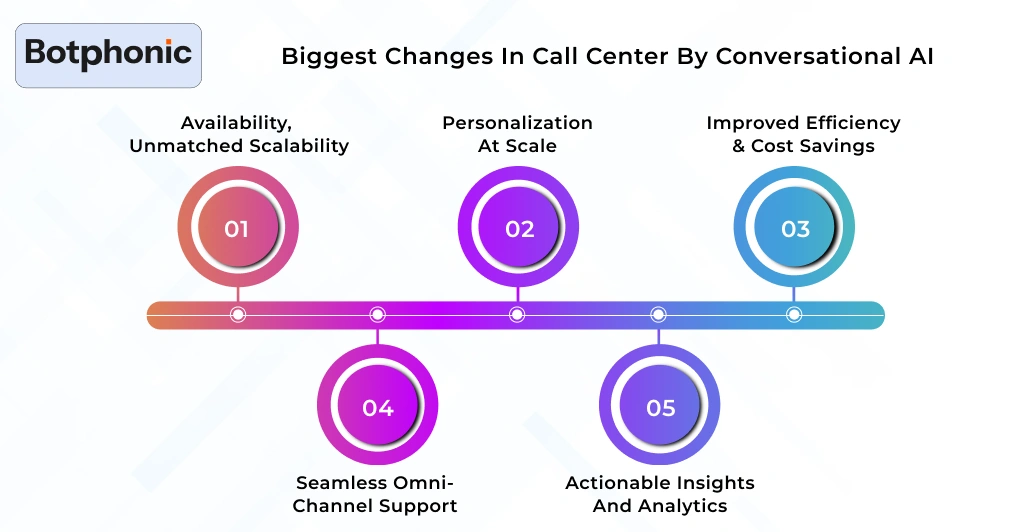
1. Availability, Unmatched Scalability
In an age where instant satisfaction is being sought by customers, it is an opportunity to have your availability across all hours. By way of this provision, a customer can expect an instantaneous response from their end on the time channel of reaching the centre. Customers are spared from waiting long and going through the agony of frustration. That is what makes the difference. Through the automation of routine inquiries and ticketing, conversational AI in call centers frees up human agents for complicated issues, hence an increase in customer satisfaction and operational efficiency.
It scales without blinking. When a particular business increases call loads, it would not affect service quality.
2. Personalization at Scale
When people think about personalization within contact centers, they probably associate this concept with huge-scale personalization, at least among traditional call centers, where personalization is almost close to impossible when the amount of incoming customers hits high numbers. But this is where the platform of conversational AI kicks in, so that with true conversational AI, the business can provide personalized interactions at scale and with relevant messaging depending on client data and past interactions.
The AI call assistant can even pull up a client’s purchase history or previous issues, even preferences, making each interaction seem relevant and just for that client. This personal touch does not apply only to high-value customers or VIP customers but is also scalable for each customer thus providing an overall seamless experience.
3. Improved Efficiency & Cost Savings
For each second customer spends time on hold, it increases the likelihood of dissatisfaction. Traditional call centers with their long wait times and understaffing are costly both in terms of customer loyalty and operational expenses. AI call center trends in this era, helps alleviate this pain by handling common and basic inquiries, troubleshooting issues, and even upselling products, all without even tying up valuable human resources.
By automating routine tasks, businesses can easily lower operational costs. All while improving response time. With conversational AI, repetitive work is given to machines, enabling human agents to manage useful and revenue-driving tasks.
4. Seamless Omni-Channel Support
Modern consumers aren’t tied to just one channel of communication, they might even start inquiring on a website, then continue via social media, and complete it on the phone. Conversational AI bridges these gaps and offers a unified experience across all the channels. Whether a customer reaches via chat, voice, or email, the AI integrates with all of them seamlessly ensuring the context of interaction is prereserved, regardless of channel.
This cross-platform fluidity enhances both CX and brand consistency, ensuring customers are receiving uniform quality of service across all channels.
5. Actionable Insights and Analytics
A key benefit of AI-powered systems is their ability to capture and analyze large volumes of data in real time. By monitoring customer interactions, conversational AI provides pain points, valuable insights into customer behaviour, and their preferences as well. This data isn’t just useful for improving the AI’s responses but also provides businesses with actionable intelligence for refining their overall customer engagement strategies.
 PRO TIP
Best Practices for Integrating Conversational AI in Call Centers
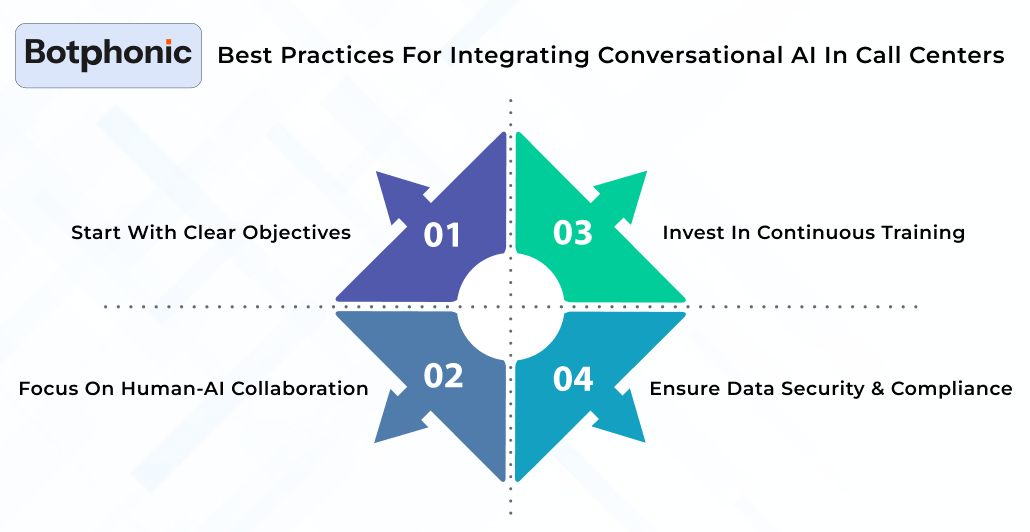
1. Start with Clear Objectives
Before getting to the thought of implementations, ensure to define what your goals are, what you want to achieve clearly. Whether it is reducing call volumes, improving customer satisfaction, or just streamlining support processes?
Laying out a well-thought strategy is definitely going to get you the maximum ROI from your conversational AI investment.
2. Focus on Human-AI Collaboration
While conversational AI in call centers is impressive, it’s still just a substitute for human empathy and complex problem-solving skills. The best results usually come from a hybrid approach. It allows AI to handle routine queries and human agents can steadily manage escalated or high-value issues. This collaboration also boosts productivity, reduces burnout, and even ensures customers are getting the best of both the worlds.
3. Invest in Continuous Training
AI isn’t just a “set-and-forget” solution. But it requires continuous training, it’s the key to improving its accuracy and even the quality of interactions. Regular updates to the AI call assistant, incorporating new customer data and feedback, are some of the critical components to keep the system sharp and effective.
4. Ensure Data Security & Compliance
As with any technology that handles sensitive customer data, security should always stand first. Be sure that your conversational AI solution is complying with data regulations, such as GDPR, and follow best practices for secure data storage and transmission.
 NOTE
NOTE
The Cost-Benefit Analysis of Conversational AI
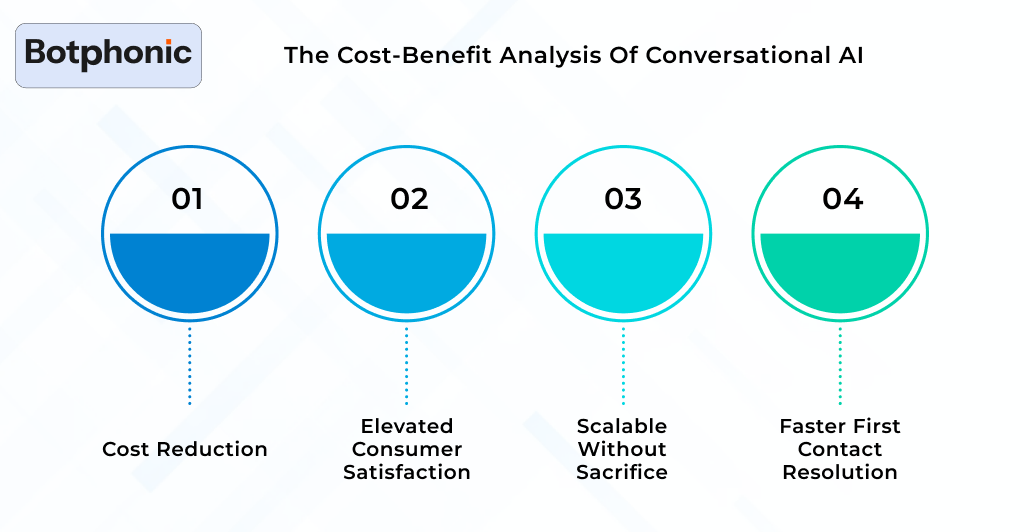
Effective from adopting such conversational Artificial Intelligence, call centers invest a lot initially to reduce costs and reap the long-term benefits. Like this:
- Cost Reduction: Cost minimization per interaction is achieved with the automation of routine inquiries and self-service options. Also, with a reduced customer support workforce, reduced overheads are another gain.
- Elevated Consumer Satisfaction: Speed in response time, personalization, and seamless cross-channel experience provide indicators for building high consumer satisfaction. Even as per reports 79% of clients said they recommend a company to a friend if they get assured personalize purchase experience every time they purchase.
- Scalable without Sacrifice: Fluctuating demand is a characteristic of every trend; such is probably the orders of AI systems, which can scale up during such changes without the need for more training or other hiring. Also, it guarantees a certain level of service in peak times.
- Faster First Contact Resolution: AI functionality improves FCR for those clients- new and existing-who engage contact as quickly as possible and then meet instant fixes by sorting issues and providing solutions at the first contact.
Just like, it’s known to be directly correlate with higher retention of customers and reduce costs due to follow-up calls.
Use Of Conversational AI In Your Call Center: A Quick Guide
Identify improvement areas such as,
- Reducing call volumes or enhancing CX as the first step.
- Choose an AI which works or graphics with our systems.
- Train your AI to solve basic inquiries and brilliantly escalate to complex issues.
- Keep the functioning of the AI under review and adjust it to improve outcome.
Operational AI Isn’t Just A Trend, Future Proof Your Customer Operations Ahead.
Request A Conversational Ai Demo!!Conclusion
Today, in the fast-growing competition of the United States market, conversational artificial intelligence in call centers is piped as much as- a need of the hour-strategically. Businesses award themselves in automating most routines and creating better customer experiences where they save costs, improve customer retention, and may even scale with respect to operational possibilities without sacrificing service quality. As technology in AI continues to evolve, so will the CX of the future-with these very intelligent systems defining it and showing AI call center real-world use cases.
Companies that understand and adopt interaction with conversational artificial intelligence are going to be future-ready as well as set the platform for long-term success.