Summarize Content With:
Quick Summary
AI call center software is managing the customer service sector by using smart technologies like machine learning, conversational AI, natural language processing (NLP), and automation. These platforms operate by automating routine customer interactions, improving efficiency, reducing operational costs, and enhancing customer satisfaction.
In this blog, we are going to discuss the features and information that you should be aware of before getting into the landscape of buying an AI call center software.
Introduction
Customer expectations have changed exponentially. Modern consumers are demanding instant, accurate, and always-available support, while businesses are facing rising labor costs, agent burnout, and unpredictable call volumes. Traditional call center systems were built on static IVR trees and human-only workflows and you should know it’s no longer scalable.
This is why organizations across different industries are choosing to buy AI call center software. AI-powered call center platforms operated by combining conversational AI, machine learning, natural language processing, and automation to manage customer interactions efficiently by improving customer experience. When it’s implemented correctly, AI call center software reduces the operational costs, improves first-call resolution and enables consistent support without even scaling headcount
What Is AI Call Center Software? (Technical Definition)
AI call center software is a contact center platform that actively uses artificial intelligence to automate, assist, and optimize customer interactions across voice and digital channels.
Unlike to those traditional call center software, AI-driven systems can easily:
- Understand natural language not just keywords
- Interpret customer intent and sentiment
- Make real-time decision
- Learn from historical interactions
- Start automating resolutions or intelligently escalate it to human agents
Core Technologies Powering AI Call Centers
- Automatic Speech Recognition (ASR): Converts voice into text in real time
- Natural Language Processing (NLP): Understands customer intent and context
- Machine Learning Models: Continuously improve accuracy and routing decisions
- Conversational AI Engines: Enable human-like dialogue
- Predictive Analytics: Anticipate customer needs and outcomes
Learn more: What Is an AI Call Center? A Beginner’s Guide
How AI Call Center Software Works
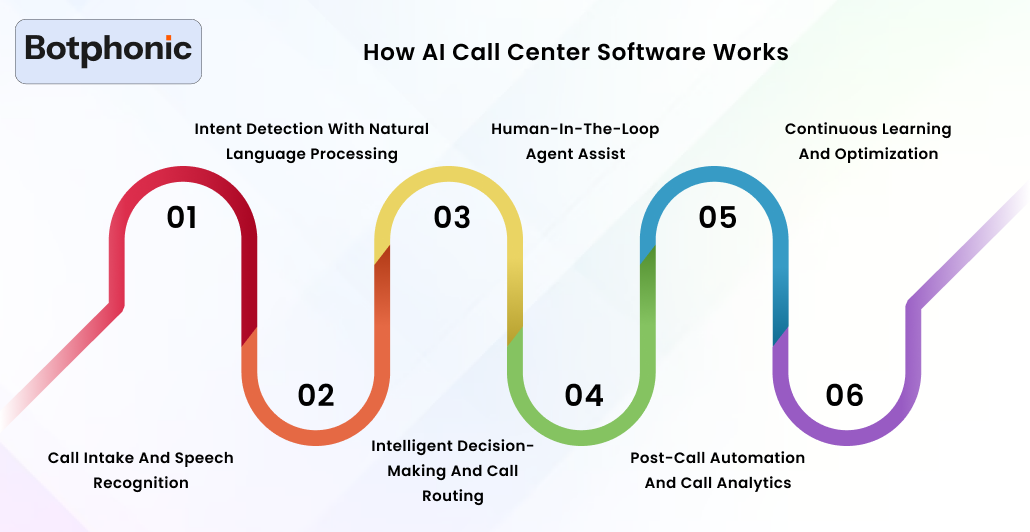
AI call centers use voice AI and natural language processing (NLP). Meanwhile, it also uses other technologies such as speech recognition and machine learning to handle customer calls. Modern AI-powered call center software understands intent and context and sentiment through its real-time operation, which distinguishes it from traditional systems.
1. Call Intake and Speech Recognition
The AI call center platform uses speech-to-text technology to transform a customer’s spoken words into written text at high speed. The advanced automatic speech recognition models use actual call center data for their training, which enables them to recognize different accents and background sounds and industry-specific vocabulary.
2. Intent Detection with Natural Language Processing
The system begins processing the call through natural language understanding after the call has been transcribed to examine the customer’s intent through their speech which includes billing help and appointment scheduling and order status and technical support. Conversational AI for call centers uses meaning interpretation to deliver better results than traditional phone trees which depend on keypad input for their functions.
3. Intelligent Decision Making and Call Routing
After intent detection is done, the AI decision engine determines what could be the best next action. The AI call routing system evaluates whether the request can be resolved on its own using an AI voice bot, routed to a human agent with the right skill set, or just handled through backend automation such as ticket creation or CRM updates.
4. Human-in-the-Loop Agent Assist
When a call is escalated to a live agent, AI agent assist software supports the conversations in real time. The AI customer support software shows relevant knowledge base articles, suggests responses, and pulls customer data through CR< integrations. This human in-the-loop approach ensures that agents have their control while benefitting from AI-driven insights that improves accuracy, speed, and consistency during customer interactions.
5. Post-Call Automation and Call Analytics
After the call ends, the AI call center system automatically:
- Generates call summaries
- Tags call outcomes
- Updates CRM and ticketing tools
- Scores calls for quality assurance
Using AI-powered call analytics and speech analytics software, teams gain insights into performance trends, compliance issues, and customer pain points, without even any manual review.
6. Continuous Learning and Optimization
Modern AI call center solutions work by improving it over time. Machine learning models work are retrained on real conversations, optimizing:
- Intent recognition accuracy
- Voice bot responses
- Call routing decisions
This continuous learning loop is what allows AI contact center software to scale efficiently while maintaining high customer satisfaction (CSAT).
The AI Call Center Tech Stack Buyers Need to Know
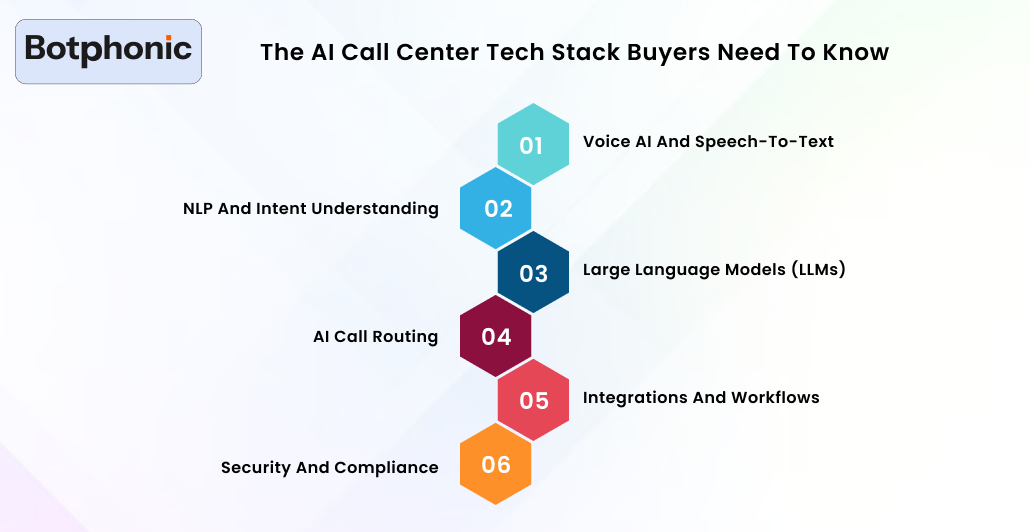
1. Voice AI and Speech-to-Text
Voice AI and speech-to-text technology operated by forming the foundation of AI call center software. Leveraging automation speech recognition, the AI call assistant converts live conversations into text with better accuracy.
Strong speech recognition is essential not just because it identifies the voice but also transcription quality directly impacts intent detection, automation accuracy, and overall customer experience.
2. NLP and Intent Understanding
Natural language processing and natural language understanding allows AI-powered call center software to detect what customers are actually saying. Conversational AI for call centers identifies intent, context, and sentiment without actually relying on rigid scripts, that enables more flexible and accurate call handling.
3. Large Language Models (LLMs)
Large language models act as the reasoning engine behind modern AI contact center software. LLMs generate natural responses, power AI voice bots, and assist agents in real time. Buyers should understand whether vendors use proprietary or third-party models, as this also affects data privacy, performance, and long-term cost.
4. AI Call Routing
AI call routing determines how each call is managed, once intent is identified. The AI call center system evaluates whether the issue can be resolved automatically, routed a skilled human agent, or just escalated based on urgency. Intelligent call routing helps reduce average handle time and improves first call resolution.
5. Integrations and Workflows
AI call center platforms integrate with CRM systems, ticketing tools, billing software, and internal databases. These integrations smartly enable automated call logging, ticket creation, and real-time data retrieval. For buyers, strong integration capabilities smartly reduce implementation friction and increase ROI.
6. Security and Compliance
Security and compliance are critical aspects in AI call center solutions. Enterprise-grade platforms support encryption, access controls, audit logs, and regulatory standards such as SOC 2, GDPR, HIPAA, or PCI DSS.
Buyers should also evaluate how customers’ data is stored, processed, and protected within the AI call center system.
 PRO TIP
Understanding the AI call center tech stack helps buyers cut through marketing claims and evaluate real capabilities. The most-effective AI call center automation operate by combining strong voice AI, intelligent automation, seamless integrations, and robust security to deliver cost savings without affecting customer experience. About 62 percent of companies have stated that they have started experimenting with AI.
Buying AI Call Center Software
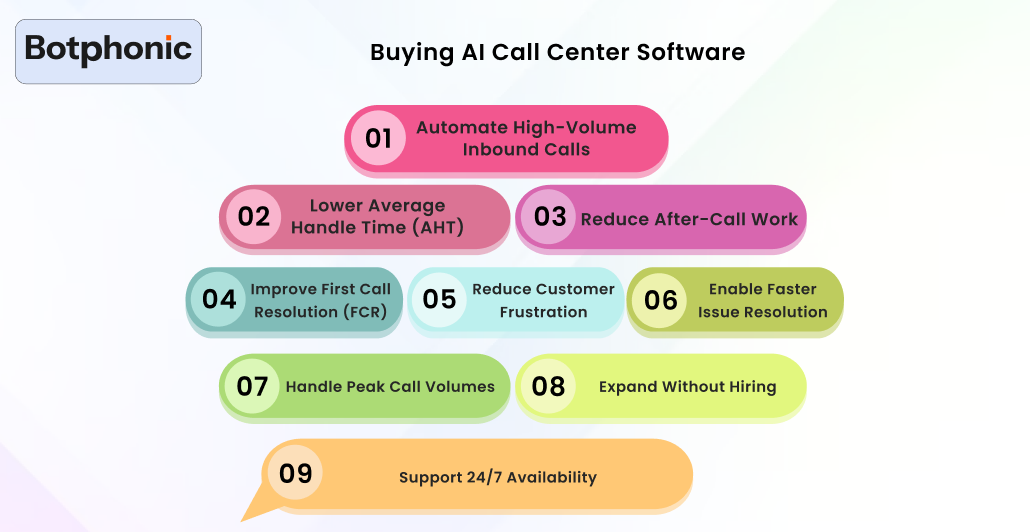
When you are buying an AI call center software ensure to focus on features that improves efficiency and reduces costs while protecting customer experience. It is a really important factor to focus on rather than any trendy demos. The best AI-powered call center platform effectively works in delivering measurable results by balancing automation with human support.
AI call center software assists organizations in lowering their operational expenses by smartly automating all the repetitive tasks and improving agent efficiency.
1. Automate High-Volume Inbound Calls
AI voice bots and conversational AI are designed to manage routine inquiries such as billing questions, order status, and also appointment scheduling. Meanwhile, automating these calls help in reducing agent dependency and lowers cost per call.
2. Lower Average Handle Time (AHT)
Intelligent call routing and real-time intent detection helps in faster issue resolution by directing calls to the right AI workflow or human agent. Moreover, it also directly improves contact center efficiency and operational margins.
3. Reduce After-Call Work
AI-powered call summarization automatically works by capturing key call details and updates CRM systems. Moreover, it also reduces manual note-taking while shortening wrap-up times and allowing agents to handle more calls per shift.
4. Improve First Call Resolution (FCR)
Conversational AI for call centers operates by understanding customer intent accurately and reduces unnecessary transfer and repeat calls. Having higher first call resolution actively leads to better customer satisfaction and lower support costs.
5. Reduce Customer Frustration
Natural language processing and sentiment analysis allows AI-powered call center software to
Respond naturally and detect frustration early. When its needed calls are escalated seamlessly to human agents and preserves customer trust.
6. Enable Faster Issue Resolution
AI call center automation smartly accelerates its access to relevant data and actions, it ensures customers are receiving faster responses without going through complex IVR menus.
7. Handle Peak Call Volumes
AI contact center software scales automatically during seasonal spikes or unexpected surges. Voice bots and automated workflows even help them prevent long wait times while managing service levels.
8. Expand Without Hiring
Automating routine interactions allows businesses to grow support capacity without even adding new agents. Moreover, this also allows AI call center software in managing fast-growing teams and global operations.
9. Support 24/7 Availability
AI-powered call center platforms enable round-the-clock support without needing any overnight staffing and improving accessibility while controlling costs.
 NOTE
NOTE
Pricing Intelligence: How AI Call Center Vendors Really Charge

The cost of AI call centers needs to be understood by buyers because vendors provide different pricing based on their selected features and operational scope and implementation methods. The vendors who promote low agent pricing actually charge more when advanced features and support services and integration abilities are added to their cost structure.
1. Subscription-Based Pricing
The subscription model of AI call center platforms charges users by monthly or annual fees which are based on the number of agents or seats used. The system provides essential functions which include AI voice bots and AI customer service, inclulding essential call routing capabilities.
Buyers must confirm which subscription expenses cover agent assist capabilities and call summarization features and analytics tools and integrations because these elements bring extra costs.
2. Usage-Based Pricing
Vendors begin to charge their clients according to the actual amount of product they use which includes AI voice bot call minutes and total interactions and API usage. The model suits businesses that experience variations in their call traffic but it creates difficulties because unexpected monthly costs result from sudden increases in phone contact. The method of calculating usage metrics includes hidden costs that must be understood by users.
3. Feature-Based Pricing
The company charges separate fees for advanced features which include sentiment analysis and AI agent assist and real-time analytics. The vendors offer their customers two different types of fees which include one-time implementation costs and continuous integration expenses.
The charges present major financial challenges for businesses that operate intricate IT systems, thus you must establish your requirements before beginning discussions.
4. Support and Maintenance Costs
The support services for enterprise-level AI call center systems provide three different support tiers which include standard support and premium support and 24/7 assistance. The companies start to impose additional charges when customers need a dedicated customer success manager or training service or priority support. The buyers need to assess whether they must pay for support as part of their subscription or if it will result in additional fees.
5. Hidden or Variable Costs
The additional expenses involve data storage charges and model retraining costs and customization expenses and security audit fees and compliance certification charges. Buyers need to receive a complete overview of all possible expenses which shows them the exact features included in the provided cost estimate. Budgeting problems arise from hidden costs, so organizations need to establish budget limits and moment-to-moment spending.
How Buyers Can Approach Pricing
When evaluating AI call center vendors, it’s important to:
- Compare total cost of ownership and not just per-agent rates
- Identify some must- have vs nice-to-have features and their associated costs
- Ask about overage charges for high-volume periods
- Understand implementation, integration, and support fees
- Consider long-term scalability costs
By approaching AI call center pricing smartly, buyers can balance cost, automation efficiency, and customer experience, it ensures that they have selected a platform that delivers real ROI.
Talk to an AI call center expert and see how conversational AI transforms your contact center.
Try Botphonic Now!!Conclusion
Buying an AI call center software is not just a tactical upgrade, but a critical decision that directly impacts long-term scalability, customer experience, and operational efficiency. Even the right AI call centers for inbound support or outbound support combines voice AI. conversational AI, NLP, intelligent call routing, and automation to reduce costs while improving first-call resolution and CSAT.
However, success doesn’t just depend on single factors but choosing a solution that balances automation with human-in-the-loop support, integrates seamlessly with existing systems, and offers transparent pricing. Businesses that invest wisely in AI contact center software position themselves to deliver faster, smarter, and more consistent customer support at scale.