“Most comparisons talk about APIs, latency, and pricing per minute.
That is not what keeps business owners awake at night.
What actually matters is this:
When your phone rings, does your business sound like it cares?
That is where Botphonic and Vapi quietly part ways.
Voice automation has long passed the stage of phone prompts and IVR trees.”
Companies are today using smart voicebot systems which are real time listeners, comprehenders and responders. Whether you refer to them as phone bots, AI phone assistants or voice activated AI, these systems are currently at the focal point of the customer experience.
Both Botphonic and Vapi are in the AI voice agent market, but they target quite distinct audiences. This comparison is intended to enable the decision makers particularly, small and mid sized businesses in the United States, to know which platform to use that suits the real world operations.
Understanding the Difference Between Botphonic and Vapi
At a surface level, both platforms enable AI calls, AI inbound call automation, and AI phone call automation. The distinction becomes clear once you look at how each product is designed to be used.
Vapi is a voice AI platform based mostly on developer orientation. It is flexible with APIs and modular components enabling engineers to build custom AI call flows. It is a suitable tool when the team has technical resources and time to experiment.
The Botphonic is an artificial intelligence voice agent platform with low code. It is concerned with immediate usability, predictability and actual business processes. It is not experimentation, but trusted automation, one that works on the first day.
| Cost Metric | Botphonic | Vapi |
| Entry Pricing | Starts at $29 per month | Usage based |
| Average Cost per Minute | $0.06 to $0.12 | $0.08 to $0.40 |
| Monthly Cost at 10,000 Minutes | $600 to $1,200 | $800 to $4,000 |
| Billing Predictability | High | Low to medium |
| Overage Charges | Clearly tiered | Configuration dependent |
| SME Cost Stability | Strong | Variable |
Core Philosophy: Infrastructure vs Outcome
Vapi is used as voice infrastructure. It provides you with building blocks like speech recognition, language model and telephony hooks. Teams are then supposed to develop their own logic there. Whereas, Botphonic is a fully operational AI phone system.
It integrates voicebot intelligence, automated answering services, CRM coordination, and post call analytics into a single working layer. For most USA SMEs, the difference is significant. One requires engineering time. The other replaces manual work immediately.
AI Call Experience and Voice Quality
Americans are becoming more and more used to AI calls, and the tolerance towards robot or baffling communication is low. Trust is directly influenced by voice quality, pacing and clarity.
Botphonic focuses on natural conversation design. The AI phone assistant has a dynamically adjusted tone, pacing, as well as phrasing. This especially comes in handy when dealing with industries like healthcare, real estate, and professional services where discussions are emotive.
Vapi supports high quality voices, but the natural flow requires a lot of configuration in the system. Calls can feel transactional if not carefully tuned. For businesses evaluating whether an AI voice agent is worth it, this distinction often determines adoption success.
| Performance Factor | Botphonic | Vapi |
| Average Response Latency | 300 to 500 ms | 600 to 1,200 ms |
| Call Handling Capacity | 100+ concurrent calls | Infrastructure dependent |
| Voice Response Accuracy | 95 percent plus | 90 to 94 percent |
| Call Completion Rate | High | Configuration sensitive |
| Missed Call Recovery | Automatic | Manual logic |
| Best Use Environment | Production business calls | Mixed production and testing |
IVR Comparison: AI IVR vs Traditional IVR
Conventional IVR systems are based on inflexible phone prompts and menu navigation. They tend to raise call rejection and frustration among customers.
Botphonic replaces traditional IVR with conversational AI. Callers speak naturally, and the system responds intelligently. This makes Botphonic a strong choice for companies evaluating AI IVR vs traditional IVR solutions.
Similar systems can be constructed using Vapi, although it does not offer an out of the box conversational IVR layer.
Use Cases Where Botphonic Excels
Botphonic is built around real operational scenarios. Common deployments include:
- AI receptionist for healthcare clinics
- AI call automation for clinics and medical offices
- AI inbound call automation for customer support
- AI missed call handling for local businesses
- AI interview scheduling for recruiters and HR teams
- Real estate AI follow up calls for agents and brokerages
- AI phone answering service for service based businesses
These applications are facilitated by templates and supply logic that saves on the setup time. Vapi is supportive of these, although every application has to be written by hand.
“When someone calls your business, they are already giving you something valuable. Their time. Their attention. Often their frustration.
They might be a patient calling a clinic.
A homeowner calling a real estate office.
A parent trying to schedule an appointment.
A lead deciding whether to trust you or hang up.
This is not an API problem.
This is a human moment.
Botphonic is built around that truth. Vapi is not.”
CRM and Workflow Integration
Modern AI phone systems cannot operate in isolation. They must integrate with sales and support workflows.
Botphonic offers deep native integrations including:
- HubSpot AI calling
- Salesforce AI voice agent workflows
- Zoho AI call automation
- Zapier AI call automation
Calls automatically update records, log notes, and trigger follow up actions.
Vapi relies primarily on API level integration. While flexible, this often requires additional engineering work to achieve the same level of automation.
Pricing Transparency and Scaling
Pricing of AI voice agents is a significant issue to small companies.
Botphonic provides clear strategies that are focused on foreseeable expansion. The more calls are made the higher the businesses are aware of what they are paying. Vapi follows a usage based model that can scale quickly in cost depending on call duration, model usage, and configuration complexity. This flexibility is valuable but turns costly if not kept in check.
Security, Compliance, and Trust
| Compliance Standard | Botphonic | Vapi |
| SOC 2 Type II | Supported | Infrastructure level only |
| GDPR | Native compliance | Requires implementation |
| HIPAA | Healthcare ready workflows | Custom enterprise setup |
| PCI DSS | Supported via secure flows | Depends on telephony stack |
| Data Encryption | End to end | Depends on configuration |
| Audit Logs | Built in | Developer managed |
For sectors such as healthcare, finance, and real estate, compliance is not optional.
Botphonic places strong emphasis on secure AI phone answering service design, data handling, and compliance readiness. This makes it suitable for regulated environments without requiring enterprise customization.
Vapi provides the technical foundation but often requires additional configuration to meet industry specific compliance needs.
Comparison Snapshot
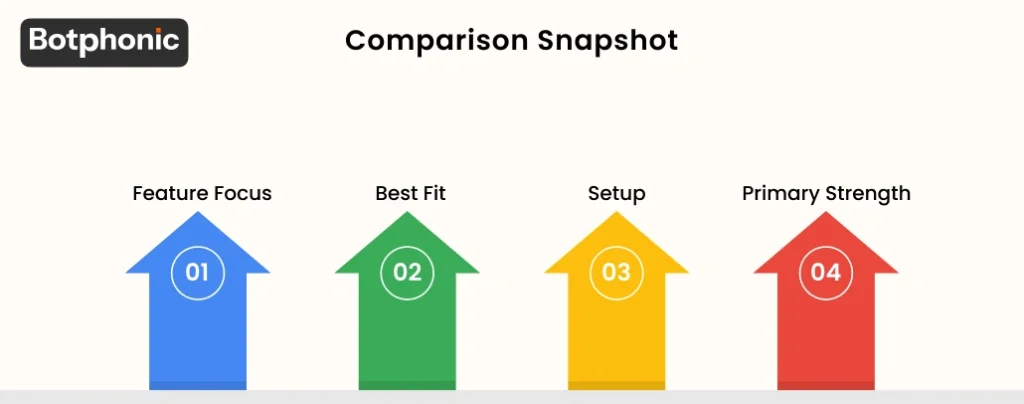
Feature Focus
Botphonic emphasizes outcomes, ease of use, and business readiness
Vapi emphasizes flexibility, customization, and developer control
Best Fit
Botphonic suits SMEs and non technical teams
Vapi suits engineering led organizations
Setup
Botphonic is low code
Vapi is API driven
Primary Strength
Botphonic excels in voicebot usability and real world automation
Vapi excels in experimental and custom voice AI builds
“Vapi is impressive if you are a developer.
It gives you building blocks, knobs, and switches.
But most businesses do not want to build a phone system.
They want their phone to work.
They want fewer missed calls.
They want fewer angry customers.
They want fewer leads slipping through cracks.
Botphonic starts at the outcome, not the architecture.”
How Botphonic Compares to Other Alternatives
Businesses evaluating Vapi often also explore:
- Botphonic vs Twilio Voice
- Botphonic vs Exotel
- Botphonic vs Aivo.co
- Botphonic vs Phonecall.bot
- Botphonic vs Vocode.dev
- Botphonic vs Saleshandy
- Botphonic vs Woodpecker
Across these comparisons, Botphonic consistently differentiates itself by focusing on low code deployment, natural voice interactions, and business ready AI call automation rather than raw infrastructure.
Final Thoughts for USA Small and Medium Businesses
Phone assistants that are based on AI are not experimental any longer. Customers demand quick, concise, and courteous communications. Companies that use archaic phone systems or highly technical platforms will be left behind.
Vapi is flexible in case your priority is to create a custom voice AI stack.
In case you are interested in implementing a stable AI-based phone system, which responds to calls, makes appointments, manages unanswered calls, and is directly connected to your CRM, Botphonic is the solution to pick. It is the simplicity, trust, and speed of execution that is important for most of the small and mid sized businesses in the United States.
“The biggest fear people have with AI calls is not replacement.
It is being trapped.
Being stuck talking to a machine that refuses to listen.
Botphonic does not try to replace humans.
It knows when to get out of the way.
Callers can reach a human easily.
Complex issues escalate automatically.
The AI supports the team instead of blocking them.
That single design choice changes everything about how callers feel.”
Start with a Voice AI Assistant That Works for Biz!
Botphonic helps companies replace manual phone handling with intelligent AI call automation that feels natural and delivers measurable results.
| Scenario | Better Choice | Why |
| Clinic with compliance needs | Botphonic | HIPAA ready AI phone assistant |
| SME scaling inbound calls | Botphonic | Predictable AI call automation |
| Developer building voice AI | Vapi | Infrastructure flexibility |
| Sales team using CRM daily | Botphonic | Native CRM intelligence |
| Global SME with limited tech | Botphonic | Low code voice AI platform |
Explore how a low code AI voice agent can transform your inbound calls, follow ups, and customer experience without adding technical overhead.“Make sure your phone speaks for you the way you would if you could answer every call yourself. Go Botphonic.”