Summarise this article with
In a vendor demo, an AI voice agent dials hundreds of prospects and fills your calendar overnight. The hard questions come later. Will it book meetings that people actually attend, and are you allowed to call these people at all?
It can work for narrow jobs like confirming interest, qualifying, booking, and routing. It works best when the person already inquired, opted in, or knows your company. A natural voice can’t rescue an irrelevant call to a stranger.
The law is the second hurdle. The Federal Communications Commission (FCC) treats AI voices as artificial voices under the Telephone Consumer Protection Act (TCPA), so you need the right permission and controls before the first dial. This guide shows how the call works, how to test it against your current process, and when to launch, narrow, or stop.
Does AI cold calling work? It depends on who you call
“Works” can mean four different things, and many vendor pages stop at the first one:
- It places calls reliably.
- It holds a conversation the person is willing to continue.
- It produces qualified meetings or another business result.
- It does all of that without raising complaints, opt-outs, or legal risk.
Capacity is the easy part. An AI voice agent can usually place more calls than your team, but more dials don’t prove better sales. What actually matters is whether those extra conversations have turned into meetings that reps really want.
The answer also changes with the audience. An agent calling a person who has requested a callback has a reason to call; they might have a product to discuss, or just a clean next step that they have to follow. Then an agent calling a cold list has nothing but only trust questions and the hardest consent. And that’s one of the main reasons why AI outbound calling results vary so much from list to list.
| Audience | Context the agent has | Suitable first job | Fit for an AI voice agent | Relative legal complexity |
| Net-new stranger list | Little or none | Keep it human-led; AI can help with research or dialing | Low | Highest; needs campaign-specific legal review |
| Recent inquiry or requested callback (recommended first pilot) | The form, request, product, and timing | Confirm interest, qualify, schedule, route | High | Depends on the consent wording, number, purpose, and state |
| Dormant lead or old opportunity | Customer relationship management (CRM) history and past conversations | Reconfirm interest, update needs, book a follow-up | Medium to high | A past relationship isn’t blanket permission; check the basis for calling |
| Existing customer or active order | Account, order, or appointment details | Reminders, renewals, scheduling, routing | High for simple, defined tasks | Often clearer, but consent, recording, and sector rules still apply |
“Relative legal complexity” compares the four scenarios in general. Counsel still decides whether a specific campaign can run.
So start where context and permission are clearest, which is usually recent inquiries and callbacks. Fully automated calls to a stranger list should not be your first pilot.
AI cold calling software comes in two main types, and they solve different problems. If you have reps available to take every call and mainly want more conversations per hour, an AI-powered dialer is the better fit. It automates dialing and queuing, and some tools add live coaching that suggests what to say. A standalone voice agent is different: it holds the conversation itself, and a person joins only at handoff. This guide covers AI voice agents.
If the speed of the call is a priority, and if you don’t have anyone on the phone, it’s better to use a different type of AI cold calling software. An AI-powered dialer automates the process for a human to place calls faster, and a coaching feature listens and recommends what to say. A stand-alone voice agent maintains the dialogue. This is a guide to AI voice agents for cold calling.
How an AI cold call works, from list to handoff
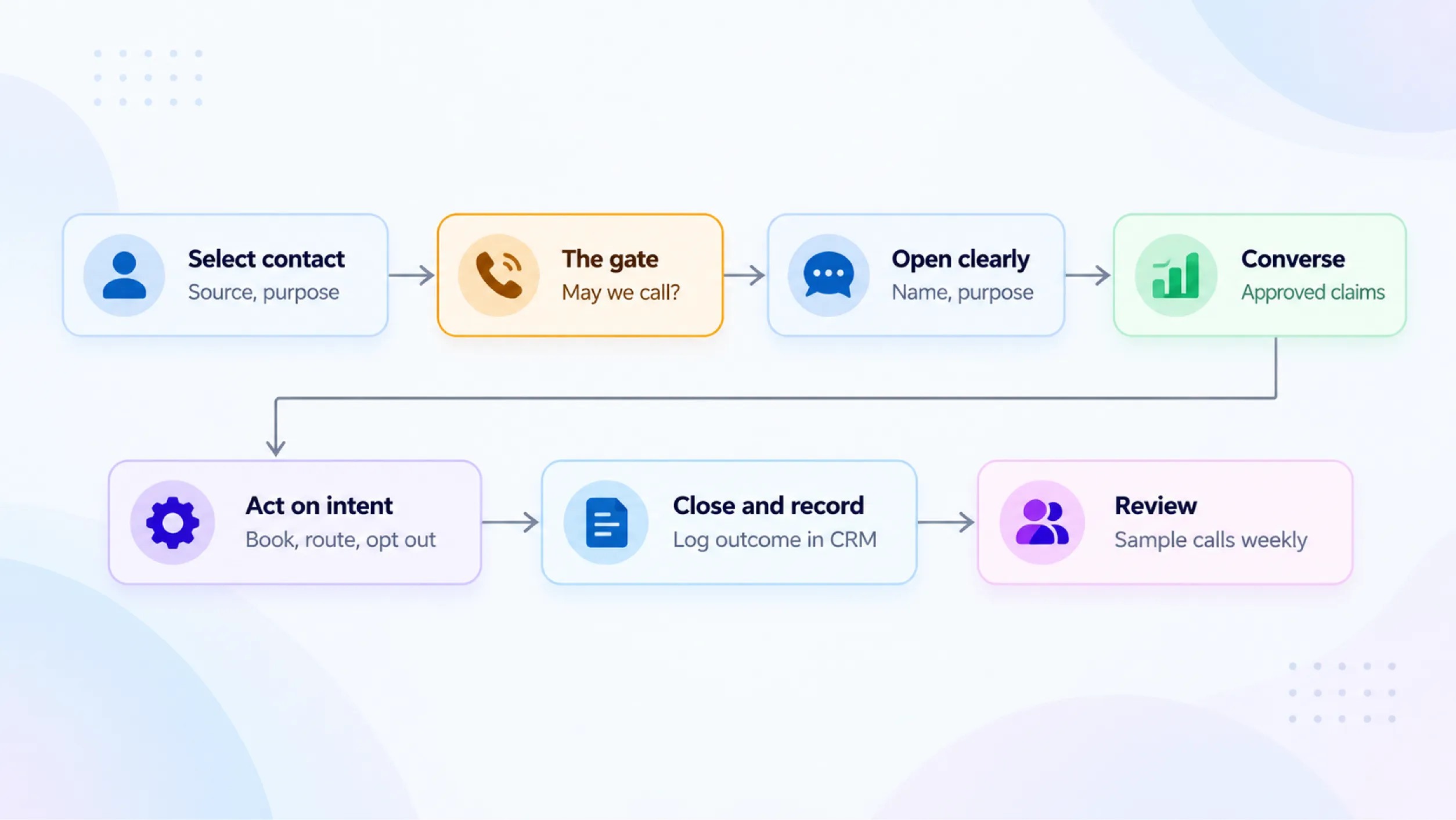
Most demos show the conversation. With automated cold calling, the steps that decide your results and your risk happen before and after it.
Every call starts with one question: may this number be called for this purpose?
| Step | What happens | Evidence to keep |
| 1. Select the contact | Approved source, known purpose, number type, and location | Source and timestamp |
| 2. Check eligibility (the gate) | Calling basis, Do Not Call (DNC) and internal suppression checks, local calling hours, frequency limits | Check results |
| 3. Open clearly | Name the business and purpose; deliver required AI or recording notices | Script version and notices delivered |
| 4. Stay on approved topics | Ask approved questions, make only approved claims, recover from interruptions | Call record |
| 5. Respond to what the person says | Suppress an opt-out, book a qualified prospect, or transfer with context | Outcome |
| 6. Close and record | Log the outcome, opt-out status, next step, and any permitted transcript | CRM entry |
| 7. Review | Sample calls; check complaints, wrong-person calls, and meeting quality | Review notes |
Step 2 matters most. If nobody can answer “may we call this number for this purpose?”, that contact should never reach the dialer. A great conversation with someone you shouldn’t have called is still a problem.
During the call, a good AI cold caller sticks to approved facts. If it doesn’t know an answer, it says so and offers a human follow-up instead of guessing. It also stops pitching as soon as the person says no in any form. “Take me off your list” and “please stop calling” should both trigger the same opt-out, logged where your human reps will see it.
This is where many pilots go wrong. The agent records an opt-out, but the record never reaches the team making the next call, so a rep phones the same person the following week. Your platform should close that gap: customers can run outbound campaigns on Botphonic, where the AI agent qualifies leads, books appointments, or transfers the call to a human rep, and updates the CRM your team already uses. Whichever vendor you choose, ask exactly how opt-outs are written back.
This is where many pilots go wrong. The agent logs an opt-out, but the record never reaches the team making the next call, so a rep phones the same person again the following week. Your platform should make that easy. For example, Botphonic’s Voice agent runs outbound campaigns where the agent qualifies the lead, schedules an appointment, etc., or even calls the lead to another person. It also logs every call and syncs them to the CRM your teams are already using.
Where AI helps and where people take over
Once the workflow gets clear, you can start by deciding which steps the agent should handle and when a rep should step in.
Give AI the predictable, repeatable tasks
AI works best on the predictable part of outbound calling. This means answering a call back when called, answering the original question that brought them in, and posing a few qualifying questions. It can also resurface a dormant lead in the CRM and schedule the next action or assign the lead to the appropriate person.
Every call is always classified with one of the following outcomes: booked, transferred, callback requested, opted out, wrong person, not interested, unresolved. Named outcomes allow the pilot to be easily measured and identify the agent’s difficulties.
Keep people on calls that need judgment
Hand the call to a person for negotiation, complex objections, unusual questions, or regulated advice. Do the same for distress, hostility, identity disputes, unclear consent, or any direct request for a human. Consider “AI qualifies, humans close” a guideline for your own strategy, depending on your selling process.
Do not forget to plan for the transfer that doesn’t take place. The agent is expected to provide an approved callback time, or to bid goodbye to the caller in a polite manner. Repeated transfers make the curious prospect an annoyed one.
Prove it with a pilot, not a vendor benchmark
Published conversion numbers for AI calling are easy to find and hard to compare. We found no independent benchmarks for autonomous AI cold calls in the sources we reviewed. Your outcome will be based on your list, your offer, and what is counted, so you can only guess what your results will be.
Set up a fair comparison
- Pick one audience, one list source, one offer, one call purpose, and one main outcome.
- Get legal approval for that audience before you split it. Never place calls you’re not allowed to make just to build a control group.
- Split eligible contacts between the AI agent and your current human process, using the same period, lead source, and follow-up.
- Write your stop rules before the first call.
Be sure to establish a voicemail policy before you launch. A voicemail left by an AI voice could result in the same rules for artificial voice being in effect as if the call were live. Get legal counsel to review that policy first, and get the voicemail to record conversations – don’t let it inflate your conversation count.
Measure meetings held, not dials
When you evaluate AI sales calls, use cost per qualified meeting held as your main metric. Use the pipeline your sales team accepts as the next measure. Bookings alone can make the agent look better than it is, because a meeting nobody attends costs you twice. Always say what you are dividing by, such as per eligible contact or per completed conversation.
Track trust signals next to sales results. These include opt-outs, complaints, wrong-person calls, requests for a human, missed disclosures, failed suppression updates, and calls made outside permitted hours. If any legal control fails, stop that part of the campaign immediately.
Every week, listen to a sample of good, bad, and neutral calls. If you have an analytics team, let them determine the sample size because it will vary by baseline. Only change one thing at a time to determine which change led to a change.
| Decision area | Define before launch | Compare after the pilot | Stop or review when |
| Audience | One approved source and eligibility rule | Whether AI and human groups stayed comparable | Eligibility or source evidence is missing |
| Main outcome | Qualified meeting held, or another named result | Outcome per eligible contact and cost per outcome | The team starts reporting dials or bookings instead |
| Meeting quality | What counts as a qualified opportunity | Pipeline accepted by sales and later conversion | AI books noticeably more poor-fit meetings |
| Trust | How the agent handles disclosure, rejection, and requests for a person | Opt-outs, complaints, wrong-person calls, requests for a human | Complaints or wrong-person calls pass your agreed limit |
| Conversation | Approved scope and handoff triggers | Unresolved questions, transfer completion, booking errors | The agent makes an unapproved claim or skips a required handoff |
| Controls | Required checks, notices, calling hours, and suppression | Failures counted for each control separately | Any call skips a mandatory legal control |
| Cost | Every cost component listed below | Cost per qualified meeting held versus your current process | The gain is too small to justify the risk |
Check your numbers before you blame the bot
Low connect rates often have nothing to do with the conversation. If your number shows up as “Spam Likely,” people never hear your opener, and an AI platform can’t fix carrier labeling on its own. Check with your telephony provider on how your numbers are registered and monitored, and measure connect rates for each number from the first day.
As the call starts connecting, the funnel shows where you have to look. If few conversations turn into meetings, the problem is most probably with the audience, the offer, or it might be the opening line. If meetings are plentiful but attendance or fit is poor, the agent might be booking too easily.
The minimum viable pilot for small teams
No analytics team? You can still run a fair comparison using a single segment, such as past inquiries that your records show you’re permitted to call. Create a small, fixed list and then divide it in half. You can assign one half to the AI agent and the other to a human caller, and lastly, run both over the same few weeks,
Start by measuring the same four things for each half: conversations held, meetings booked, meetings that actually took place, and opt-outs or complaints.
Apply the same stop rules as the full pilot. Halt affected calls at once if a control fails, such as an opt-out that wasn’t honored. Review the campaign if complaints or wrong-person calls pass your agreed limit. A test made on this scale can’t prove statistical significance. But it can still show whether the AI is clearly behind, about equal, or just promising enough for a larger test.
Is AI cold calling legal in the US in 2026?
What you need to know
- The FCC categorizes AI-generated voice as artificial voices, so if a telemarketer wants to use them, they need the recipient’s prior express written consent unless there is a specific exception that applies.
- Dialing a business contact doesn’t automatically exempt the call, especially when it reaches a personal cell phone.
- Have legal counsel approve every campaign, as state, recording, and industry-specific rules add further requirements.
Using AI for cold calling in the US is not automatically legal or illegal. Whether a call is allowed or not depends just on its purpose, the number being dialed, the consent you hold, and the recipient’s opt-out status, the disclosures you make, how the call is actually recorded, and applicable state law.
This section is for operational guidance only and is not legal advice.
See how Botphonic can help your team automate outbound calls and follow up with leads.
Try AI CallingAI voices count as artificial voices
The TCPA restricts calls that use an artificial or prerecorded voice. People often call these “robocalls,” but the FCC term, and the one that matters here, is artificial-voice calls. In Declaratory Ruling 24-17, the FCC confirmed that AI-generated voices fall under those restrictions, even when the agent can hold a conversation.
The same ruling says telemarketing calls using these voices need the person’s prior express written consent, unless an exception applies. The FCC’s calling rules in 47 CFR § 64.1200 also require these messages to identify the caller and, for sales calls, offer an opt-out. Have counsel map those rules to your call flow.
B2B changes the analysis but doesn’t end it
The Federal Trade Commission (FTC) enforces the Telemarketing Sales Rule (TSR), and many of its DNC provisions focus on consumer calls. That’s where the “B2B calls are exempt” myth comes from. A business prospect may still answer on a personal cell phone, where TCPA and state rules can apply.
The FTC also extended its ban on misrepresentations to B2B telemarketing in 2024, so a business call still can’t make false or misleading claims. The FTC’s guide to complying with the TSR explains which parts apply to which calls.
What changed by 2026
Checked October 13, 2026.
- The “one-to-one” consent rule is gone. A court vacated it, and the FCC removed it in 2025. That doesn’t make vague consent safe.
- One narrow opt-out rule is delayed. In January 2026, the FCC pushed its effective date to January 31, 2027 (DA 26-12). The delayed rule would apply an opt-out from one type of informational message to unrelated future calls and texts from the same caller. Other revocation rules still apply, so keep honoring every opt-out.
- Does the AI have to say it’s AI? In the sources we reviewed, there is no final federal rule requiring it. The FCC only proposed one in 2024. Existing caller-identification rules still apply to artificial-voice calls, and some states may add disclosure requirements, so plan to tell people and have counsel confirm.
State and recording rules add another layer
Individual states can add their own requirements as a security layer. For instance, registration, bonding, disclosures, and limits on calling hours. There might be some that cap call frequency, set strong consent standards, or let people sue privately. Rules on recording and transcribing calls also vary by state. In some states, everyone on a confidential call must agree before it can be recorded, and the Reporters Committee’s state-by-state recording guide lays out how these rules vary.
Healthcare, financial services, debt collection, political, and fundraising calls follow additional rules that this guide does not cover. If your campaign involves any of these areas, consult legal counsel before drafting your script.
Put the controls in place before the first dial
Compliance for AI cold calling depends on records you can produce. The flow table earlier lists what to keep at each step. Beyond that, confirm your team can produce these on request:
- For each contact: the exact consent wording where it applies, the responsible seller, and the number type and location logic you used.
- Campaign setup: caller ID configuration, the recording setting, and the approved script version.
- After the call: how long recordings and transcripts are kept, who can access them, and how complaints are handled.
Recordings and transcripts are sensitive data, so access control matters as much as storage. Whichever vendor you choose, ask how it protects them. For Botphonic’s approach, you can review how call records and audit trails are protected.
Ask every vendor these questions before you sign:
- Which controls does the platform block automatically, and which do we configure?
- What evidence can we export for a complaint or audit?
- What happens when a suppression update fails?
- Who approves new scripts and new states?
Agencies running calls for clients need one extra step. Each client is a separate caller and campaign, so document who the seller is, who controls the list and script, who handles opt-outs, and who keeps records. A white-label platform doesn’t shift that responsibility to the vendor.
| Area | Your business owns | The platform can support | Counsel owns |
| Audience and purpose | List source, offer, seller identity, truthful claims | Eligibility fields, import checks, campaign setup | The legal basis and restrictions |
| Consent and opt-outs | Collecting and keeping evidence, honoring internal opt-outs | Blocking suppressed numbers, writing back opt-outs | Consent wording, exemptions, and DNC interpretation |
| Timing | Markets and calling policy | Time-zone windows and frequency caps | Federal and state limits |
| The conversation | Accurate identity, purpose, offer, and approved claims | Delivering notices, following scripts, detecting opt-outs, transferring | Required disclosures and script risk |
| Records | Reviewing calls, handling complaints, controlling access | Storing events, script versions, outcomes, and permitted recordings | Required evidence and retention |
| Performance | Defining a qualified outcome and comparing results | Reporting funnel and conversation data | Keeping the test design lawful |
A platform can enforce controls, but it can’t create valid consent, approve your legal basis, or fix a weak list. Be wary of any product that calls itself “compliant” without showing the evidence behind the claim.
Launch, narrow, or stop?
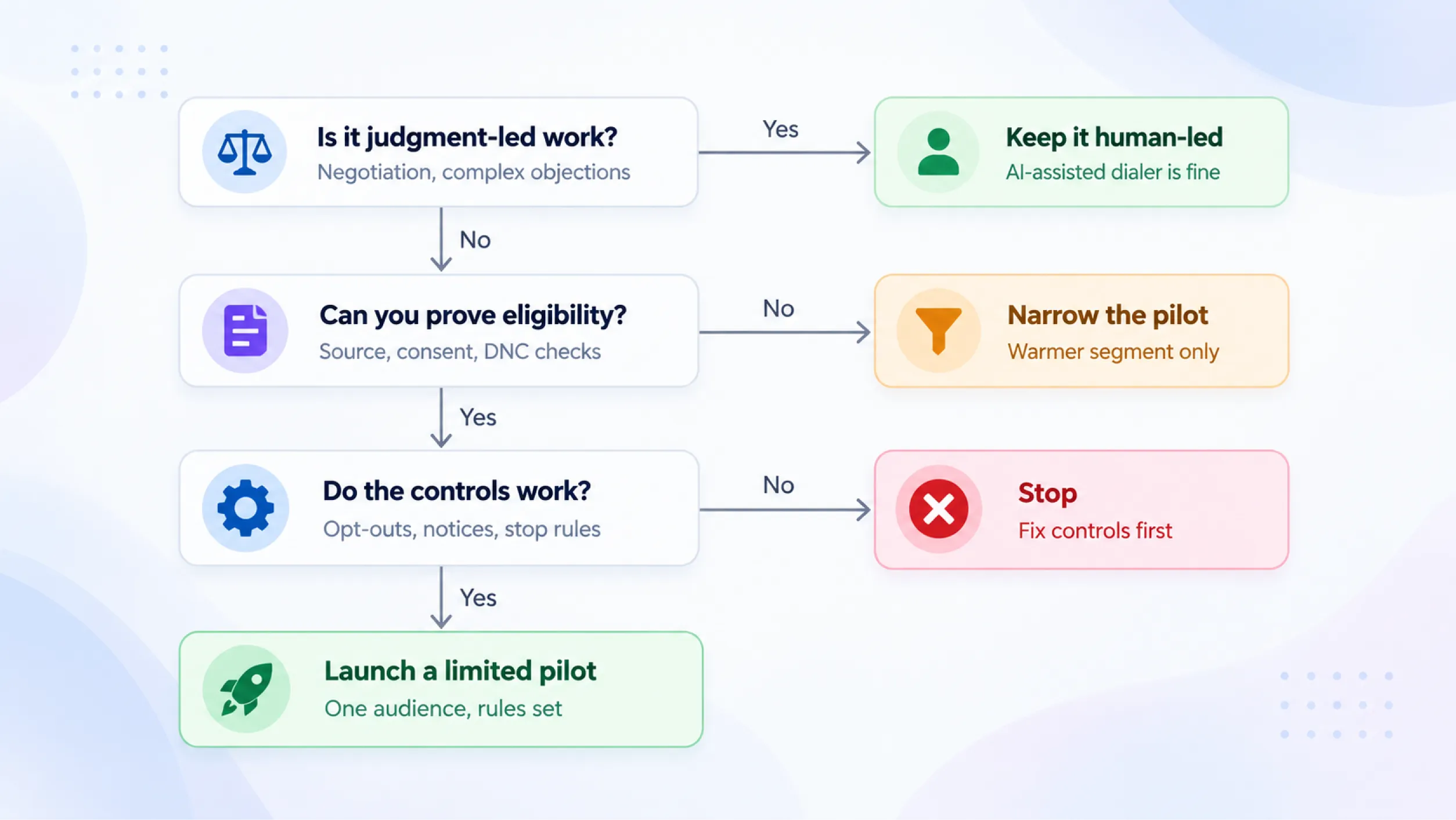
With a use case, a test, a legal map, and a control list in hand, you have four options:
- Launch a limited pilot when the audience is approved, the evidence is retrievable, controls work end to end, and stop rules are written.
- Narrow the pilot when the broad list is questionable, but a recent inquiry, callback, or existing-customer segment has clearer context and permission.
- Keep it human-led when judgment, negotiation, or relationships drive the outcome. An AI-assisted dialer can still cut manual work.
- Stop when you can’t show why each number is eligible, can’t honor opt-outs reliably, or can only measure dials.
The best first AI cold-calling campaign often isn’t very cold. A warmer segment gives the conversation a fair test before you add the hardest audience and legal conditions. If your plan clears these checks, ask Botphonic which controls from the ownership table run automatically, using the vendor questions above.
Quick checklist
- Choose one audience where context and permission are clearest
- Map every step from list selection to CRM write-back
- Set handoff triggers and a fallback for missed transfers
- Compare AI against a human group on meetings held
- Count every cost, from telephony to review time
- Get counsel to approve consent, disclosures, and state rules
- Write stop rules before the first dial
Test AI Cold Calling on a Small Scale Before You Commit
Don’t ask whether AI cold calling works in general. Ask whether it can do one narrow job for one approved audience better than your current process, without hurting trust or meeting quality.
Scale helps only after you have the right audience, permission, controls, and records. Your next step is to write the pilot on one page using the scorecard above and get legal sign-off before launch. Then price a small, controlled outbound pilot instead of a full rollout.
How we researched this: we read current FCC and FTC guidance, compared five existing guides on the topic, and reviewed Botphonic’s published outbound capabilities. We did not run a campaign benchmark.