Summarize Content With:
Summary
Artificial-intelligence calls no longer feel futuristic in the United States. Many seep into an American’s life already every day, often without the person realizing it. This post will dive into how Americans think about AI calls and what influences their views, as well as why AI consumer attitudes in the USA are important for companies using an AI call assistant and AI Voice Automation for Customer Support solutions.
Introduction
Your phone rings. You expect a human voice. Instead, you get a soothing, clear assistant who immediately understands your question. Now that moment feels prevalent across the U.S. Quiet A.I. calls also remake how Americans book and manage appointments, receive assistance, and solve problems.
AI no longer remains confined to apps and screens. It speaks, listens and responds. As a result of this transformation, AI consumer attitudes in the USA are evolving more rapidly than ever, shaped by emerging Conversational AI & Voice Technology Trends (USA).
Americans value time. They seek simple answers and clear solutions. AI calls address this problem by cutting wait times and managing nonspecialized conversations. And yet people continue to care a great deal about trust, transparency, and human discretion. This equilibrium determines how Americans experience an ai call assistant today.
A new study highlights just how pervasive AI exposure has already become. Roughly 73% percent of American adults say they would be at least somewhat comfortable letting A.I. manage tasks in their lives, such as communicating and scheduling.
This explains the increasing number of AI calls in the USA. People embrace AI help when it feels useful and respectful.
What Are AI Calls and AI Call Assistants?
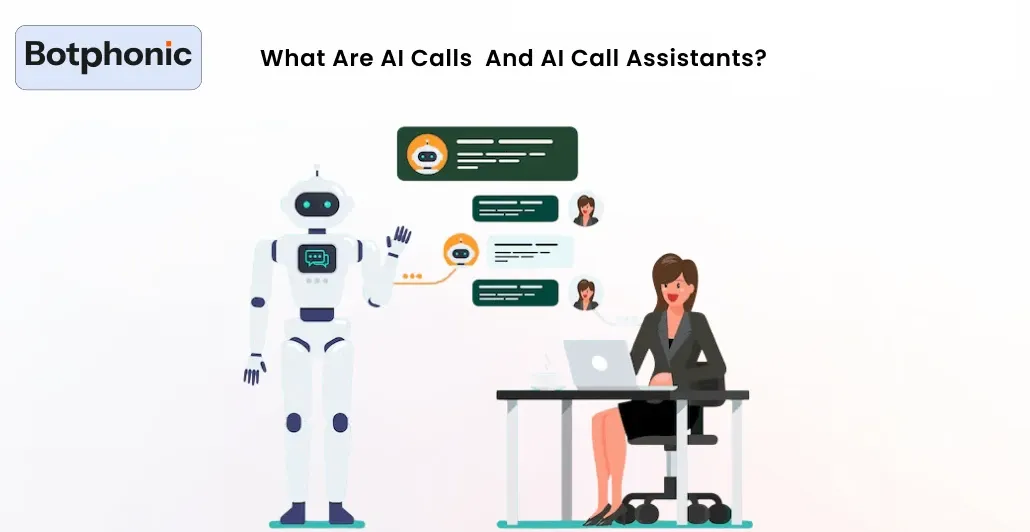
AI calls use technology behind artificial intelligence to manage voice conversations over the phone. These calls are not just about pre-recorded messages. They hear it and process it in real time, forming the backbone of AI Voice Automation for Customer Support.
An AI call assistant both answers incoming calls and makes outgoing calls for a company. It can welcome callers, pose questions, provide information, and take action. It would place many Americans and their transactions in contact with the systems when they call customer support, clinics, banks, or service providers.
In the USA, AI Consumer Attitude towards AI is transactional, based on how natural or human-like they feel the interaction is. People respond to A.I. calls if the voice is clear and the answers remain on topic. They get frustrated when the assistant sounds robotic or is confusing.
AI call assistants are not exactly the same as traditional IVR systems. IVRs make callers play button-pressing games and follow a script. AI assistants are permitting more natural language and dynamic responses. It’s a distinction that significantly informs how Americans think of A.I. calls.
 PRO TIP
How an AI Call Assistant Works Behind the Scenes
- Voice Recognition and Listening: It listens intently to the caller’s voice, an AI call assistant. It transcribes spoken words to text on the fly. This process allows the system to learn the accents, tone, and normal speech cadence of the USA, aligning with Conversational AI & Voice Technology Trends (USA).
- Understanding Caller Intent: After listening, theAIi call assistant determines what the caller is asking for. It reads intent, whether booking, asking questions, or needing support. It lays the foundation for AI in consumer attitudes in the USA.
- Generating the Right Response: The system chooses the best response depending on the query posed by the caller. It leverages trained language models to ensure answers are clear and natural. When A.I. doesn’t use complex words or long explanations, Americans are more likely to reply.
- Talking Back and the Natural Voice: The AI call assistant speaks its reply to you. It comes with a warm and friendly cry. It’s this final step that determines how Americans remember the experience of a phone call.
Why Businesses Must Pay Attention to AI Consumer Attitudes in the USA
“Companies are no longer able to afford not knowing what consumers think about Artificial Intelligence.” Behind the scenes: Americans observe how AI calls sound, take, and how clear or beneficial they are. Businesses that fail to address these trends risk irritated customers and missed opportunities.
An effective AI strategy delivers calls that engender trust, put time back on the clock, and augment human teams. The more effectively your AI calls match user expectations, the better your customer relationships become and the stronger your measurable AI ROI marketing USA outcomes.
| Preference | Why It Matters | Tip for Businesses |
| Fast & simple calls | Americans value time | Use AI for routine tasks |
| Natural voice | Comfort and trust | Choose human-like AI voices |
| Transparency | Trust grows when AI is identified | Always tell callers they are speaking to an AI |
| Human backup | Complex issues need humans | Provide an easy transfer to agents |
PRO TIP
Key Trends Shaping AI Call Adoption in the USA
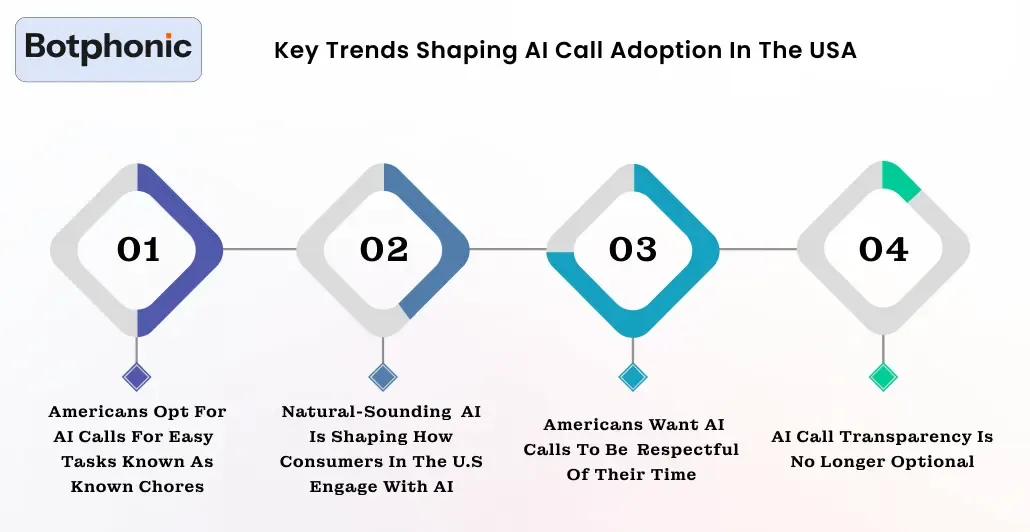
Trend 1: Americans Opt for AI Calls for Easy Tasks Known as known chores
AI requests are attractive to many people when the tasks are small and simple. They’d prefer to see an AI call assistant call in to make appointments, check the status of orders , or verify information. And it’s these little touches that begin to shape positive AI consumer sentiments in the USA.
And people are looking for answers, not a long conversation. AI calls meet this expectation when they are short and do the job.
AI calls meet expectations when they are short and do the job, which strengthens AI customer service adoption.
Tip: Get started with AI calls for repetitive tasks first, so you can get comfortable and a little bit trusting.
Trend 2: Natural-sounding AI is Shaping How Consumers in the U.S Engage with AI
Voice quality (55%) has a significant influence on Americans’ attitudes towards AI calls. A more conversational-sounding AI call assistant makes the conversation feel less awkward and scripted. This transformation is good for AI consumer attitudes across age groups in the US.
If an AI sounds clear and calm, callers will stay on the line longer. Speech quality and the way you sound are paramount; an untoward voice (sic = speech) quality makes people hang up early on.
Tip: Choose AI voices that are warm and clear, and easy to follow along with.
Trend 3: Americans want AI calls to be respectful of their time.
Time is of vital importance to Americans. Americans are a peevish lot when it comes to AI calls. “It is annoying to have an AI call assistant that repeats questions or takes forever to respond.
Good AI calling can give you better satisfaction and lower call drop rates. Time-sensitive politeness and the attitude of US consumers towards AI
Tip: When designing the AI conversations, have them take fewer steps and quicker responses.
Trend 4: AI Call Transparency Is No Longer Optional
Americans say they want to know when they’re talking to A.I. They dislike surprises during calls. Transparency is trust, and trust is the foundation for long-term adoption of an AI call assistant.
Distinct identification allows the caller to relax and know what to expect. Secret AI use frequently undermines trust.
Tip: Make sure to always let callers know they are speaking with an AI assistant.
Key Insights on US Consumer Perceptions of AI
Insight 1: Americans value helpfulness over the identity of who’s calling.
The vast majority of Americans prefer results, not labels. They take calls when the AI call assistant comes up with a solution and solves problems within seconds. What matters more is whether the voice is helpful, rather than if it’s human or A.I.
This observation accounts for why the AI consumer attitudes in the USA get better if AI does well.
Insight 2: Trust is Built When AI Call Assistants Speak Clearly
Transparent communication is a cornerstone of trust in AI calls. When A.I. speaks in convoluted jargon or answers obliquely, Americans lose their faith. An unambiguous AI call assistant earns credibility by the day.
A caller’s trust typically deepens when he or she knows every step of the call.
Insight 3: One Bad AI Judgment Will Change Perception Forever
Many Americans seem to remember negative AI call experiences more than positive ones. One confusing or frustrating call can blow trust in an instant. This fact has a dedicated following in the minds of AI consumer attitudes in the USA.
Every AI call is a first impression from the business.
Insight 4: AI Calls Work Best if It Can Help Rather Than Replace People
Americans still value human connection. They take AI calls when they augment human teams, not replace them. An AI call assistant is most effective as a helper, not a gatekeeper.
Mixed models produce better results and greater satisfaction.
Have Botphonic’s AI call assistant take care of the routine tasks while your team gets back to what they do best. Get better at customer service, hopefully today!
Start Today!How These Trends Impact Businesses in the USA
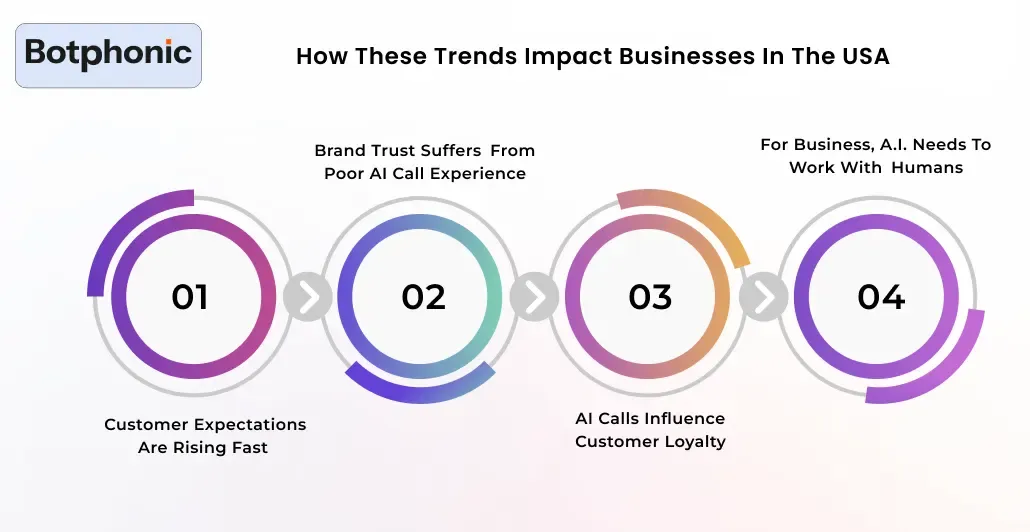
1. Customer Expectations Are Rising Fast
The way Call AI is called determines how the customers will assess service levels. Americans are now increasingly impatient for rapid replies and the avoidance of long delays. Companies that don’t embrace this new normal risk not keeping up asAIi consumer attitudes in the USA change.
2. Brand Trust Suffers from Poor AI Call Experience
A single mistaken AI call can damage a brand’s reputation. Americans recall confusion and lost time. Even where other services might work as a weak AI call assistant, trust can still be broken.
3. AI Calls Influence Customer Loyalty
Useful AI calls enhance satisfaction and repeat engagement. Americans go back to patronizing places that respect their time. This conduct relates to AI consumer attitudes in the USA.
4. For Business, AI Needs to Work With Humans
AI cannot handle every situation. Americans understand that complex needs have human requirements. Companies that pair AI calls with human assistance get better results.
With smarter conversational AI & voice technology trends it has become easier for businesses to enhance customer satisfaction, along with improved operational efficiency.
How Botphonic Matches These AI Call Trends and Insights
1. Botphonic Concentrate on Authentic and Natural Conversations
Botphonic ensures all its AI call assistants sound intelligible and natural. This approach fits with how we, as Americans, like our conversations. It backs positive AI consumer attitudes in the USA.
Tip: Friendly small talk will help callers relax and trust you.
2. Botphonic Honors Time and Sequence of Calls
Call solutions from Botphonic AI concentrate on quick answers and easy paths. The process eliminates the superfluous and redundant aspects. Americans appreciate this efficiency.
Tip: More satisfying calls that don’t last as long.
3. Botphonic Prioritizes Transparency and Control
Botphonic AI always makes clear it’s a bot in phone calls. It empowers callers and offers choices. Such openness enhances trust and acceptance.
Tip: Eliminate hesitation and uncertainty through transparency.
4. Botphonic Supports Humans, Not Replaces Them
Botphonic creates AI calls that work with teams, not in place of them. The AI call assistant takes care of simple chores and escalates tricky questions to a person.
Tip: Hybrid support models work best with an American audience.
Conclusion
AI calls continue to influence how Americans are interacting with businesses. Americans welcome AI assistance when it saves time, speaks clearly, and gives us a choice. Still, they want transparency and human cover.
Trust is the future for AI calls. Companies that recognize AI consumer attitudes in the USA and align with AI call automation trends in the USA can deliver better experiences and stronger AI ROI marketing USA results.
Botphonic adheres to this to a great degree. It enables businesses to satisfy contemporary demands by maintaining natural and human-like conversations.
Powerful, natural, transparent AI conversations that Americans trust with Botphonic. Discover how your business can have smarter conversations now.
Try Botphonic Today!