
Enterprise conversational AI is not just an extra feature that you can add but it has become a main component in enhancing customer interactions and still affordable. Many organizations have started taking a hard look at whether their current platforms, Aivo included, are pulling their weight.
It’s not just about going for the newest AI trend but about cost discipline, scalability, and measurable ROI. If your chatbot strategy isn’t reducing operational load but improving resolution rates or scaling without any issue, it’s logical to ask whether better alternatives exist. In this blog, we will see why companies are rethinking Aivo, what modern conversational AI platforms are expected to deliver, and how actually one should evaluate alternatives without falling for polished demos that don’t survive production reality.
Why Teams Are Reassessing Aivo in 2026
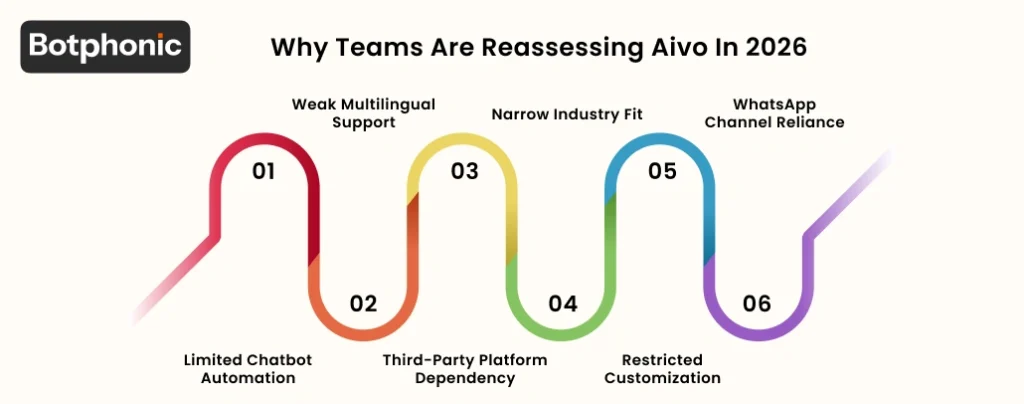
Aivo has built its reputation in an earlier phase of conversational AI, with intent-based models, scripted flows, and predictable customer journeys. This approach worked really well but only when automation expectations were modest and today the bar has gotten significantly higher.
Teams have started reassessing Aivo for a few recurring reasons:
Limited Chatbot Automation
Aivo’s automation capabilities often stop at managing basic and rule-driven interactions. As customer queries have become more contextual and multi-step. The chatbot often struggles to resolve complex queries from end-to-end, resulting in higher agent handoffs and lower automation ROI.
Weak Multilingual Support
Limited native multilingual capabilities restrict scalability for enterprises who are operating across regions. Supporting multiple languages usually requires additional configurations or parallel setups. Meanwhile, it increases complexity and reduces consistency in customer experience
Third-Party Platform Dependency
Aivo relies on external platforms for some special core functions that can introduce integration friction and operational risk. On the other hand, this dependency reduces control over performance, data flows, and long-term platform costs while increasing vendor lock-in.
Narrow Industry Fit
Aivo is optimized for specific industry use cases, which makes it less adaptable for organizations with complex or cross-industry workflows. Enterprises outside these focus areas might face some constraints when modeling unique customer journeys or compliance requirements.
Restricted Customization
Customization options are usually limited to predefined configurations. Even implementing advanced logic, dynamic workflows, or bespoke business rules might require workarounds or some additional development effort which slows innovation cycles.
WhatsApp Channel Reliance
A strong emphasis on Whatsapp automation creates channel concentration risk. Over reliance on a single messaging platform might only result in weakened omnichannel strategies and even expose customer engagement operations to policy changes or pricing shifts outside the enterprise’s control.
What Enterprises Expect From a Modern Conversational AI Platform
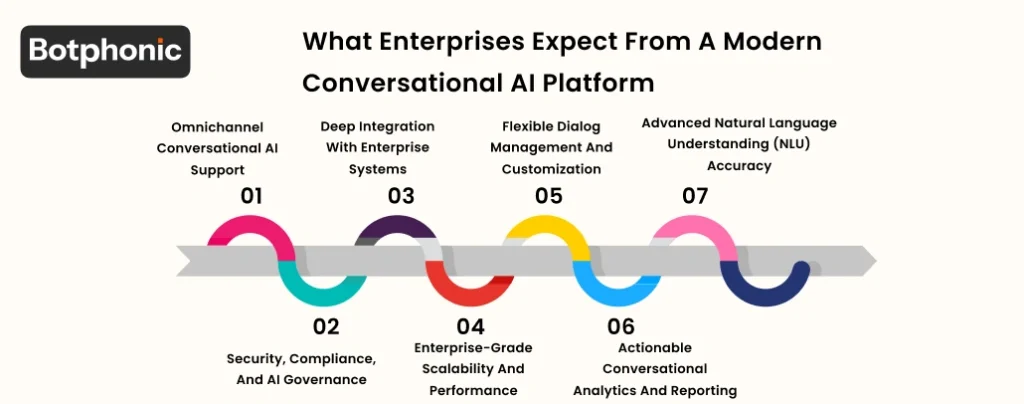
Modern enterprises are no longer looking at conversation AI as a standalone chatbot. Moreover, it is expected to function as a core layer within the customer experience and automation stack, which is capable of handling complexity, scale, and governance without constant manual intervention.
Omnichannel Conversational AI Support
True omnichannel capability means maintaining conversation context across channels rather than managing isolated experiences. Enterprises are expecting a seamless transition between channels such as web chat, WhatsApp, mobile apps, and contact center systems.
Security, Compliance, and AI Governance
Modern conversational AI platforms should meet enterprise security standards, including all the necessary ones such as data encryption, role-based access control, audit logging, and compliance with regulations such as GDPR. Transparency and governance are one of the main factors for regulated industries.
Deep Integration With Enterprise Systems
Conversational AI platforms are expected to integrate smartly with CRMs, ERPs, ticketing systems, knowledge bases, and even customer data platforms. These integrations allows workflow automation, real-time data retrieval, and also resolution of complex use cases.
Enterprise-Grade Scalability and Performance
A modern conversational AI platform should support high interaction volumes without any latency or degradation in response quality. Enterprises ask for consistent performance across peak loads, concurrent users, and multiple channels including web, mobile, messaging, and voice.
Flexible Dialog Management and Customization
Enterprises require the ability to design dynamic conversation flows, business logic, and also escalation paths without requiring any heavy engineering dependency. Flexible dialog management ensures that the platform can adapt to evolving processes and customer behaviour.
Actionable Conversational Analytics and Reporting
Enterprises expect more than basic usage metrics. Advanced conversational analytics should provide insight into intent performance, automation success rates, failure points, and even cost savings. Meanwhile, it also enables continuous optimization and ROI measurement.
Advanced Natural Language Understanding (NLU) Accuracy
Enterprises demand conversational AI platforms to accurately interpret customer intent across varied phrasing, languages, and contexts. Even modern NLU should reduce dependence on rigid intent structures, handle ambiguity, and improve over time with minimal manual training effort.
Top Aivo Alternatives Worth a Serious Budget Review
1. Botphonic AI
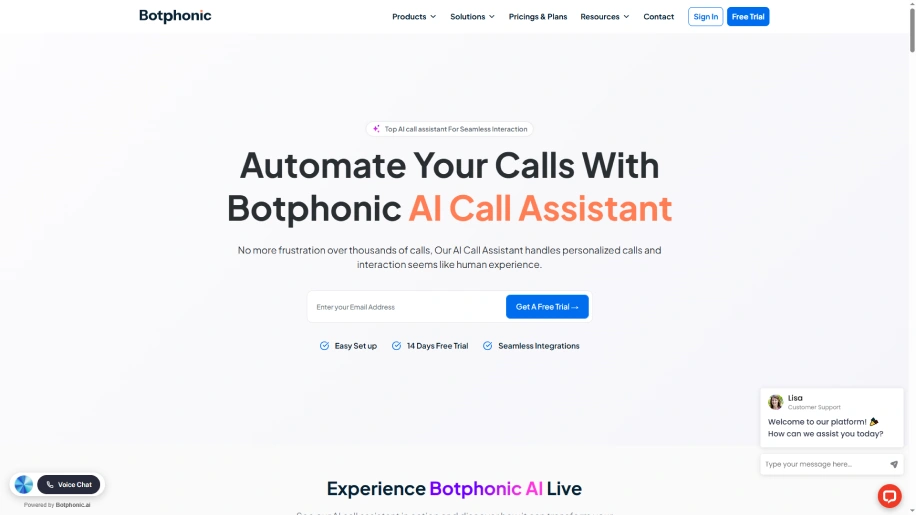
Botphonic AI is considered as a voice-first conversational AI platform. It is designed to automate inbound and outbound calls at scale while smartly managing human-like interaction quality. Botphonic supports AI-driven call management, appointment scheduling, lead qualification, call transcription, and CRM integrations.
Budget and Scalability Considerations
Botphonic usually offers measurable cost reduction through automation, even though its advanced workflows might require configuration effort during setup. It offers a tiered plan which enables firms to opt for a suitable plan based on their company’s needs.
Salient Features
- Conversational Voice Automation: Manages both inbound and outbound calls with natural language responses.
- Sentiment Analysis: Verifies caller tone to adjust it’s responses dynamically.
- CRM & Calendar Integrations: Sync with major CRM systems and scheduling tools.
- Lead Qualification & Routing: Identifies key caller data and routes them based on intent.
- Real-Time Transcription & Analytics: Provides call summaries and performance logs that help in making strategic decisions.
Ideal Use Cases
High-volume support lines, appointment scheduling, sales outreach, and even after-hours customer engagement can be done easily.

2. Zadarma
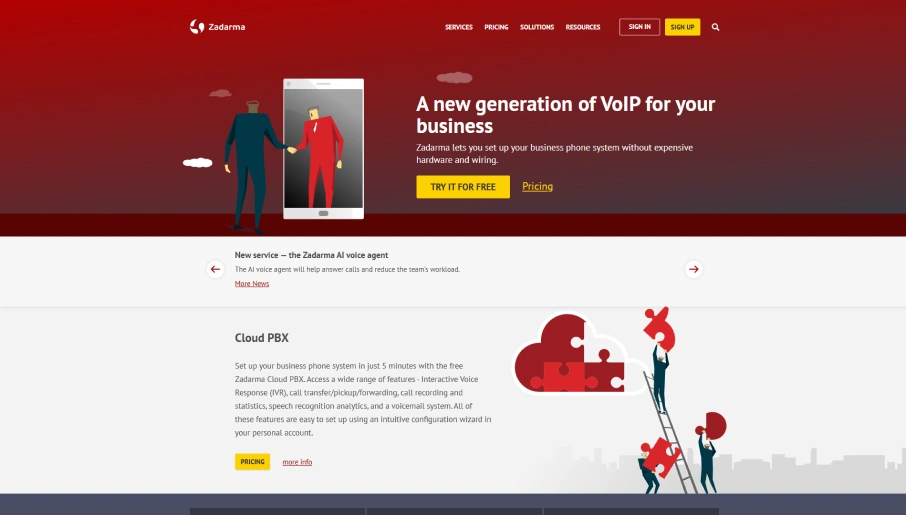
Zadarma’s AI voice agent is smartly integrated with its cloud PBX infrastructure, which functions as an automated receptionist and call routing assistant. Meanwhile Zadarma uses LLM-based speech understanding to manage inbound calls, answer questions, and escalate conversations when needed.
Salient Features
- PBX-Native Deployment: Integrates effortlessly with existing telephony infrastructure.
- LLM‑Powered Speech Understanding: Offers natural speech interpretation, even if there is varied phrasing.
- Multi-language Support: Manages calls in multiple languages with configurable voice profiles and offers support.
- Knowledge Base Integration: Offers answers to the queries based on linked organizational data.
- Call Recording and Analytics: Tracks interactions and performance metrics for better evaluation of ROI.
3. ServiceAgent
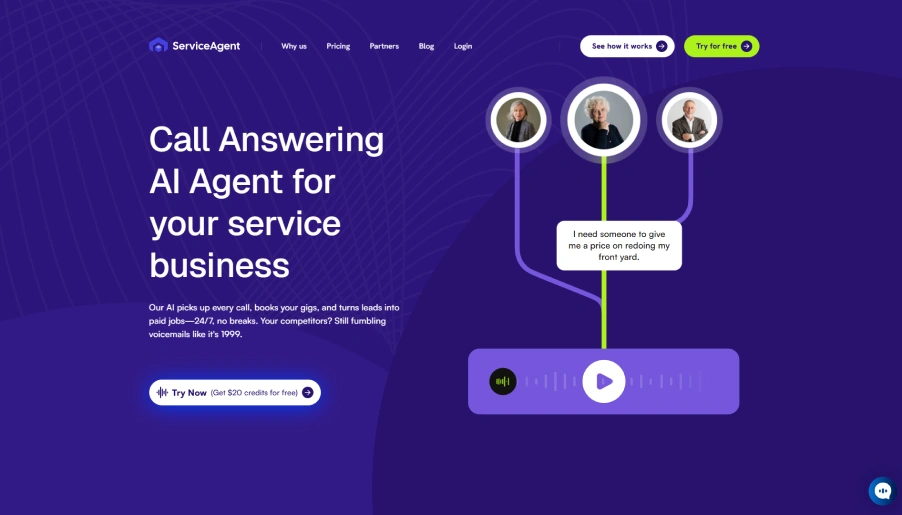
ServiceAgent is a specialized AI call-answering solution that is built specifically for service-based industries. It’s designed to manage inbound calls, qualifies requests, and even schedules appointments on its own.
Salient Features
- Industry-Specific Dialogue Models: The system is trained on service vertical communications.
- 24/7 Call Handling: Shows lesser missed opportunities outside business hours.
- Lead Capture and Scheduling: Qualifies inbound calls and books appointments autonomously.
- Call Summaries and Alerts: Provides structured reports to field teams.
- CRM and Calendar Sync: The system ensures there’s operational continuity with backend systems.
4. Goodcall
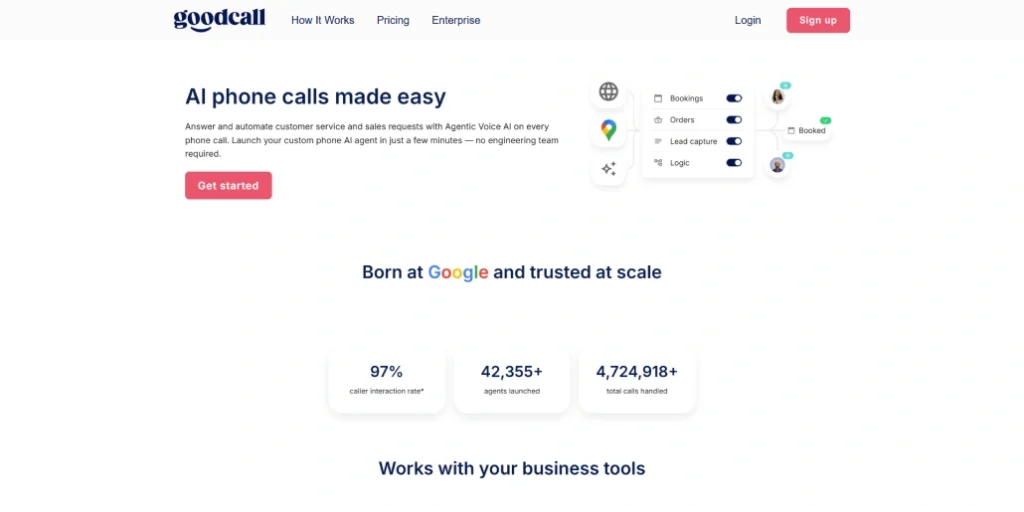
Goodcall offers an AI phone answering solution that is focused on outcome-driven automation and transparent usage-based pricing. It also supports inbound and outbound calls with natural conversational flow and smart intent recognition.
Salient Features
- Usage‑Based Billing: Costs are tied to call volume and complexity.
- Natural Conversational Flow: The system is designed with AI that mimics human dialogue in calls.
- Inbound and Outbound Support: Operates by automating both reactive and proactive engagements.
- Developer Sandbox/Credits: Allows rapid testing before even wide deployment.
- Call Summaries & Analytics: Tracks outcomes and engagement quality actively.
Learn more: Discovered Top 6 GoodCall Alternatives
5. Fonio
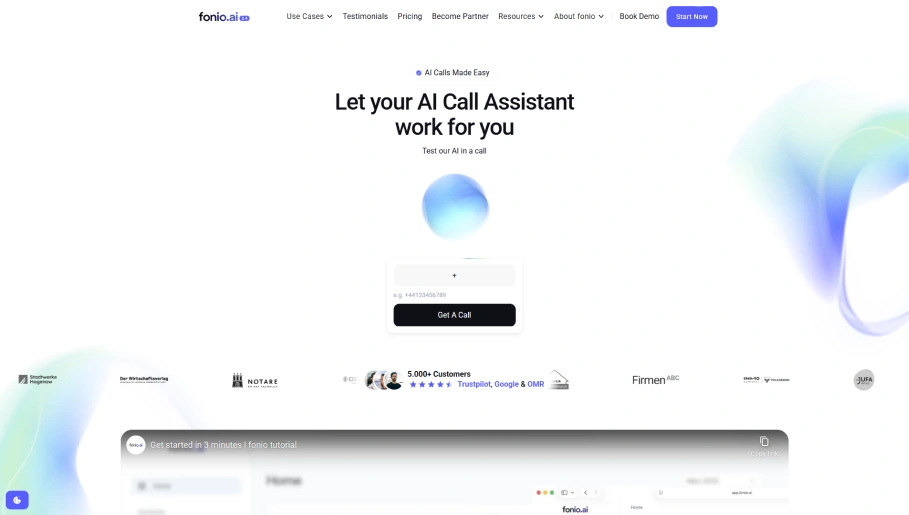
Fonio is an AI-powered telephone assistant which is designed for flexible integration with calendars, CRMs, and also enterprise systems. This platform enables API access for workflow customization while maintaining strong data governance controls.
Salient Features
- API‑Driven Workflow Customization: Enables programmatic control over call logic.
- CRM/Calendar Integration: Allows easy sync lead and appointment data in real time.
- Outbound Calling: Generates AI-driven outreach calls via API triggers.
- Automated Transcription and Tagging: Structures call data for easy analytics review.
- Data Governance Controls: Prioritizes secure data handling and compliance.
6. Bland AI
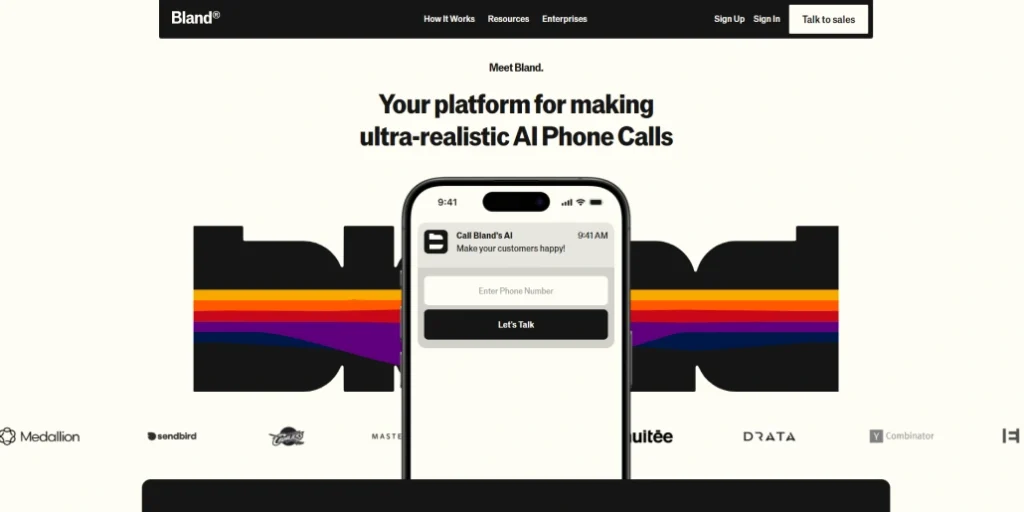
Bland AI is an API-first conversational voice platform that is built for teams that want technical control over their workflow. It offers programmable inbound and outbound calls with custom voice personalities and branded voice cloning.
Salient Features
- API‑First Architecture: Offers full programmatic control via APIs and webhooks.
- Custom Voice Personalities: Builds branded or realistic voice agents as per users’ requirements.
- Self-Hosted Deployment: Meets strict security and compliance requirements.
- Programmable Workflows: Easily creates complex call logic paths without any vendor constraints.
- Inbound & Outbound Support: Can flexibly manage both engagement types.
Learn more: 5 Most Popular Bland AI Alternatives
Aivo vs Alternatives: Side-by-Side Capability Comparison
| Platform | Voice Automation | Multi-Language | CRM / Calendar Integration | Best For |
| Botphonic AI | Yes | Yes | Yes | High-volume support & sales |
| Zadarma | LLM-powered | 8+ | PBX linked | PBX-integrated automation |
| ServiceAgent | Domain-specific | Limited | Yes | Field service verticals |
| Goodcall | Yes | Varies | Some | SMBs, cost-conscious teams |
| Fonio | Yes | Yes | Yes | Flexible API workflows |
| Bland AI | Yes | Varies | API integrations | Customizable enterprise deployments |
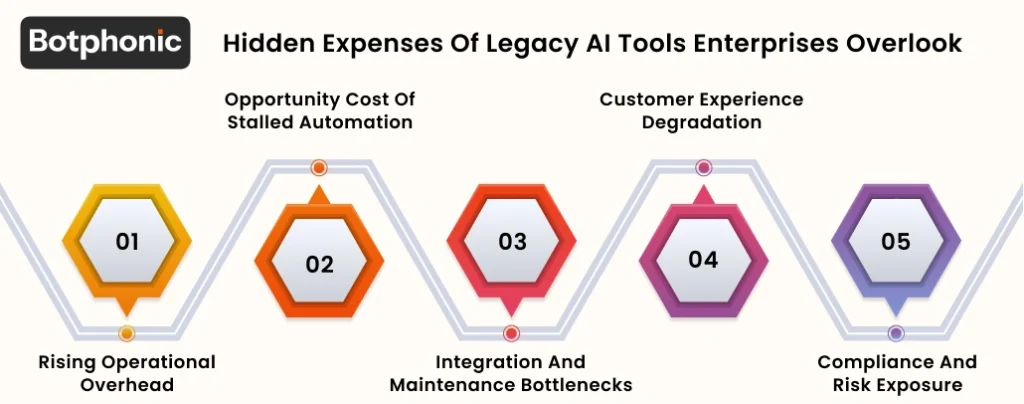
Many enterprises usually underestimate the true cost of maintaining their existing conversational AI platform. At first glance, just continuing with the status quo might seem better than switching. However, the hidden costs often adds up quietly, eroding efficiency, customer experience, and ROI over time.
1. Rising Operational Overhead
Traditional platforms usually require ongoing manual intervention that helps them maintain intents, workflows, and even integrations. Teams often spend hours in retraining the AI, correcting misrouted conversations, and updating those canned responses.
2. Opportunity Cost of Stalled Automation
When a platform isn’t able to handle complex interactions or scale across new channels, teams are usually forced to rely on human agents for those tasks that could have been automated. Each manual handoff represents lost efficiency and delayed resolution.
3. Integration and Maintenance Bottlenecks
Older systems or just narrowly scoped platforms usually fail to integrate seamlessly with modern CRMs, ERPs, or ticketing tools. Maintaining workarounds or just custom scripts adds hidden engineering and IT costs over time, while creating points of failure.
4. Customer Experience Degradation
A platform that usually struggles in understanding nuanced queries manages multi-step requests, or supports multiple languages leads to frustrated customers. Missed first-contact resolutions, repetitive interactions, and inconsistent experiences can result in lower retention, negative reviews, and most importantly lost revenue.
5. Compliance and Risk Exposure
Platforms that do not meet evolving data privacy, governance, or security standards introduce compliance risk. Organizations might even face fines, remediation costs, or damage to brand reputation.
Conclusion
The process of selecting an appropriate conversational AI system requires more than evaluating licensing agreements because it needs to assess all aspects of automation together with integration methods and actual return on investment. Aivo provides basic workflow functions but businesses need to pay additional costs because they cannot customize their system and use multiple languages and different communication channels. The modern market presents various options like Botphonic AI and Zadarma and ServiceAgent and Goodcall and Fonio and Bland AI which deliver advanced automation together with smooth system connections and expandable system capabilities.
Your platform choice requires thorough evaluation because it needs to decrease operating costs while creating better customer experiences that generate actual benefits.