Summarize Content With:
Introduction
Real estate in Austin is not a hobby. It is a duel with a knife in a custom-made suit.
Every incoming call counts in a market such as Austin where moving out is never a slow process and where listings are not that slow either. Someone is making a call regarding a showing. One of them is interested in knowing whether there is a condo available in South Congress. Someone is “just browsing.” Whole brokerages have been financed on that alone.
This is the reality that most agents shun. The phone rings. You miss it. The next name in Google is that prospect. Commission gone. No drama. No second chances.
At this point, smart call automation ceases to be an innovation and begins to make money.
Not theory. Not hype. Execution.
Unroutine Routine Calls
A surprising amount of inbound calls are missed by the average real estate office in the United States, particularly, post-hours, and during tours of property. That is not a rounding error. That is lost revenue.
Even in the relatively safe mid six figure median home prices of Austin, a single buyer lead loss can translate to tens of thousands in commission within a year. But most of the brokerages continue to use voicemail and hope.
Hope is not a strategy.
There is a smart AI receptionist system that responds to all calls. Instantly. Nights. Weekends. In the course of listing appointments. During open houses. As you are haggling over inspection credits.
- No hold music
- No robotic menus
- A natural conversation
- Real questions
- Real answers
- Lead captured
- Appointment booked
- CRM updated
Ten minutes to set up. Years of upside.
The Math Is Brutal
Let us strip the fluff.
Suppose a medium sized Austin brokerage has 200 incoming calls every month. At the most, a quarter are not responded to. This is half a century of lost positions.
Now suppose that only 10 percent of those calling would have turned into clients in the long term. That is five transactions. At a commission of 2.5 percent on a home of $550,000, you will be looking at a commission of 13,750 per deal. Multiply by five.
That amounts to 68,750 dollars in a month.
Even half of those numbers will make the opportunity cost enormous. And this is not speculation. It is arithmetic.
There is an AI call assistant for business available in the modern world to seal that leak.
The Real Working of an AI Receptionist
Forget the buzzwords. Here is what matters.
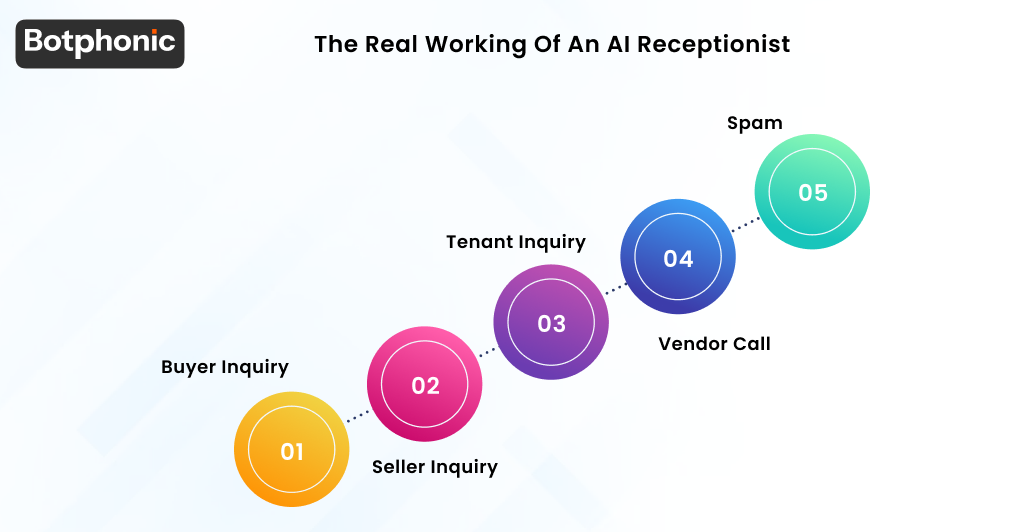
An advanced AI virtual assistant for real estate is used to answer inbound calls. It identifies intent. Qualifies the lead. And routes or books according to rules.
Call handling examples:
- Buyer inquiry: It inquires on budget, schedule, funding condition, the favorite areas of Austin.
- Seller inquiry: It collects the address of the property, motivation, the schedule, and arranges a valuation consultation.
- Tenant inquiry: It ensures availability, pre screens and makes a showing.
- Vendor call: It routes appropriately.
- Spam: It filters it out.
All within one conversation.
And of course, it is also connected with CRMs, calendars, and dialers. Moroever, it implies that when a prospect makes a call regarding a listing in East Austin the system will already know whether that particular property is active, under contract, or pending. It responds accordingly.
No human scrambling. No awkward pauses.
This is Why This Should Not Be Overlooked by Austin Agents
Austin is not a sleepy market. It is being driven by technology growth, inflow immigration, and insatiable demand. The country has experienced one of the best population growths in the past ten years. In surveys it was found that about 78% of buyers prefer agents who answer them on first call.
Translation:
More buyers. More sellers. More competition.
Customers demand immediate customer services. The conversion rates are dramatic when it comes to responding to a lead within minutes rather than hours later. The faster in real estate the better. Trust equals listings.
Five minutes are not enough to make a smart call assistant respond. It responds in five seconds.
- While you are in traffic
- During presentation of comps
- While you are asleep
Transforming Service into Sales Funnel
A majority of agents are using inbound service calls as tasks. A person enquiring:
- on HOA fee
- Whether a backyard is fenced or not
- Verifies school zones
Here is the shift.
Each service call is a qualification opportunity.
A smart receptionist position can be programmed to serve more than to reply to trite questions. It can pivot.
Caller enquires about the HOA in Round Rock property. The system validates the quantity. Then inquire about whether they are renting or owning and proceeds when they intend to relocate. Then proposes to plan a buyer consultation.
That is not pushy. That is strategic.
Structured conversational paths can be created within minutes of setup and transform curiosity into pipeline.
This does not concern agent replacement. It is about avoiding leaving a call without further actions.
The Call Assistant Business Is Not a Gimmick
Novelty tech and infrastructure are different.
Enterprise grade voice models, telephony integration, and structured data logging are features of a serious call assistant which is used in business. It does not just record calls. It derives meaning, emotion, and things.
When a caller tells you,
“I am moving out of California and need something near downtown Austin by August”
that is recorded, classified and sent into your CRM as structured fields.
- Relocation
- Out of state
- Timeline August
- Preference downtown
Now your follow up is precise.
No scribbled notes. No guesswork.
Botphonic Sets the Bar
It is full of tools that purport to bring in modernization in the reception. Very few are created to generate income rather than simply reject calls.
Botphonic is positioning itself as a conversion focused call assistant. It is not just answering but qualifying, routing and booking. It manages the call flows inbound and also offers real estate cold calling with AI that are meant to raise the number of appointments scheduled, not only to decrease the workload.
That distinction matters.
You do not require a friendly robot in real estate. You need a digital rainmaker.
Biophonic enables brokerages to write call scripts that are specific to real estate.
- Ready made buyer intake flows
- Seller qualification
- Open house follow up
- Rental inquiries
- Investor screening
This is not the issue of sounding futuristic. It entails the establishment of a funnel that can be repeated.
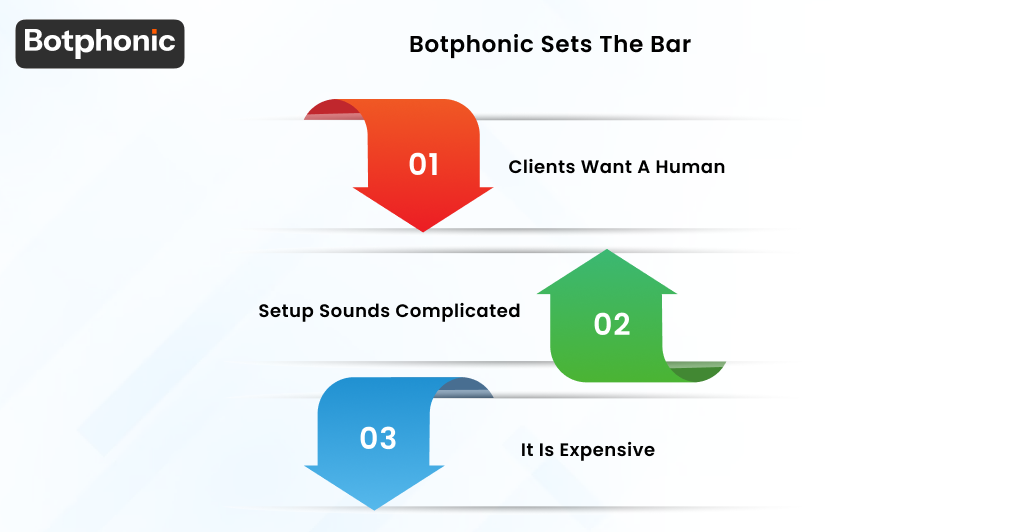
1. Clients Want a Human
Of course they do.
And they still get one.
An intelligent AI receptionist does not lets lead go away. It safeguards them against low valued interruption and lost high valued calls. It escalates when needed.
- Complicated negotiation question → Transfer to agent
- Emotional seller → Route immediately
- Routine inquiry → Handle automatically
In fact, many consumers prefer quick, competent responses over voicemail and call backs. Transparency solves trust concerns. The assistant can identify itself clearly while offering seamless handoff to a human.
Clarity builds confidence.
2. Setup Sounds Complicated
It is not.
Contemporary platforms are developed using no code interfaces. You draw the lines of conversation. Define routing rules. Connect your calendar. Sync your CRM. Done.
Ten minutes until preliminary deployment. The process of refinement is done in the course of time according to the call information.
Start with one use case. Buyer queries below 750000 Austin Listings. Expand from there.
On the first day, one is not required to be perfect. Coverage is.
3. It Is Expensive
Compared to what.
The cost of a full time receptionist in Texas will be between $40,000 and $55,000 per year with benefits. Such an individual has a presence of a few hours. Takes vacation and also get sick.
The working of a digital receptionist is 24-hours a day, seven days a week with a consistent performance. A human salary is usually a fraction of the pricing.
And this investment unlike payroll is directly proportional to inbound volume.
Missing commission is even more expensive than the software.
Real Estates. A Response Time Game
Advertisements in a competitive market like Austin will receive several requests in a few hours. The returning agent is usually rewarded with the showing. Whoever receives the showing often receives the client.
A smart call assistant ensures your brokerage responds first every time.
Not that you are working harder.
Your system is smarter, that is why.
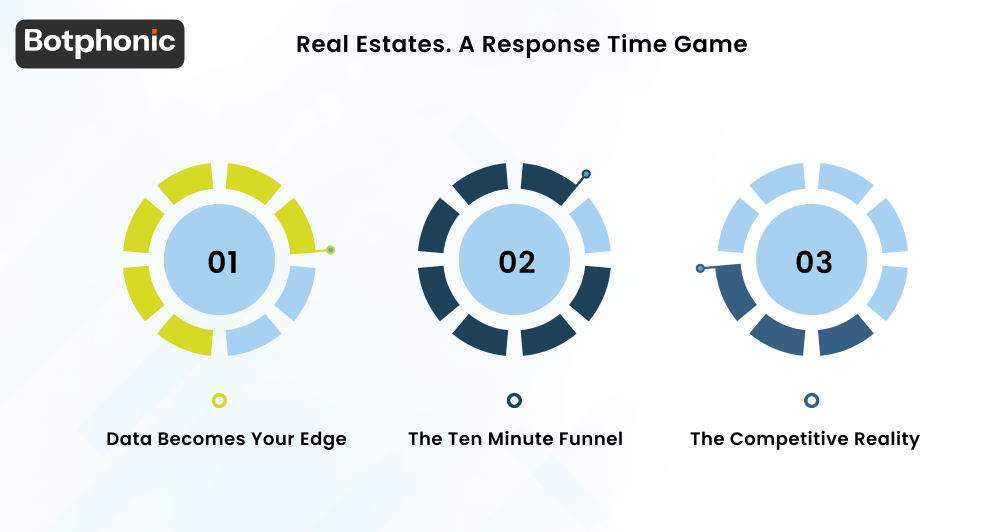
1. Data Becomes Your Edge
Interestingly this is where it becomes exciting.
Every call that your receptionist system attends generates data.
- Call duration
- Intent category
- Conversion outcome
- Appointment booked or not
- FAQs
Trends appear.
You know that calls regarding some ZIP codes are more converted. The decision cycle on relocation calls in some states is shorter. And even after-hours calls are a sign of strong intentions to buy.
2. The Ten Minute Funnel
Would it not be good to cut the promise to pieces?
Ten minutes to transform regular calls into a sales funnel.
Process:
- Identify your key call types: Buyer. Seller. Tenant. Vendor.
- Write your qualification queries for both.
- Include a calendar to make bookings.
- Integrate your CRM.
- Activate.
This is where every incoming call takes the same direction. No longer unorganized meetings or conversations where the conversation ends with “I will call you later”.
3. The Competitive Reality
Austin is already being embraced by other agents to automate. They are capturing all the late night inquiries. They are booking consultations when their competitors are asleep.
This is not the future. This is now.
If you choose not to implement a modern receptionist system, that is a strategic decision. Just be honest about what you are sacrificing.
Speed. Coverage. Data. Scalability.
There is No Difference Between Service and Sales
Here is the paradigm shift.
Sales are not distinctly different with customer service. In the real estate industry, they are interchangeable. The difference between people having to put their trust on a transaction with you worth $700,000 to not trust you at all may be determined by how you answer the question about property taxes.
An advanced call assistant system implies that each query is answered equally, simultaneously, and immediately. Such uniformity creates a brand. And brand drives referrals.
And real estate real estate referrals in Austin are blood.
What This Will Have on the Next 12 Months
Interest rates change. Inventory varies. Migration patterns shift.
One thing that doesn’t change is that the agent who controls the conversation controls the commission.
An advanced AI receptionist system leaves you in charge of all incoming communications. It transforms the unknowing into action. Turmoil into the pipeline.
You can continue letting the phone ring on voicemail and hope your brand equity works your way.
Or you may put in a wiser front line and make all rings a possible closing.
Austin is not slowing down. Neither are your competitors.
Whether or not automation should be a part of your brokerage is not the real question.
It is the number of commissions you will allow to ring out, before you see it does.
Audit your call gaps, deploy an AI receptionist, and start converting every ring into a pipeline.
Schedule a Demo!!Conclusion
In a market such as Austin, a missed call is not a minor error. Real estate has always been about the first responder. That principle has not changed. What has changed is the speed of the game. Buyers demand immediate response. Sellers demand availability. If you’re not there, someone else will be.
An AI receptionist is not about replacing agents. It’s about preserving opportunity. It responds immediately, qualifies accurately, and converts seamlessly. The true power of an AI receptionist is control. You go from reacting to capturing. Every call is now data and each after-hours lead is now a converted conversation.
You can continue to treat inbound calls as administrative tasks. Or you can treat them as revenue-building infrastructure. In a response-based industry, the brokerage that owns the first conversation owns the commission.