Summarize Content With:
Introduction
Healthcare operates on even slimmer margins than most administrators detest admitting to. That pressure builds up in Nashville. This city is a metropolis with not a single hospital. It is the hub of American healthcare activities. Corporate headquarters, revenue cycle hubs, compliance groups, call centers. A giant machine that works with the help of human coordination and inexhaustible telephone calls. And in the very heart of that mess is the front desk. It is there that an AI receptionist enters the modern world and silently rereads the equation.
The Phone Call Problem
The amount of healthcare revenue that is being driven by phone calls is appalling.
- Booking of appointments
- Checking intake
- Updating of prior authorization
- Checking insurance
- Billing inquiries
All voice driven. But the majority of clinics still use human receptionist who have three lines, a waiting room and a broken EHR window. That system breaks under size. It always has. It simply took the labor shortages and the increase in costs to cause the realization.
Nashville’s Competitive Intensity
This is quicker than the majority of markets in Nashville clinics. The intensity of the healthcare in this area establishes a competitive rivalry. There is rapid switching of providers between patients. Loyalty disappears in case a call is not answered.
Patients do not make complaints any more. They simply find another provider and come to another. What an expensive silent churn.
AI Receptionist: A Blunt Operational Upgrade
An AI receptionist is not a visionary robot that can answer existential queries but a high-tech voice robot, which is conditioned to answer high-frequency healthcare interactions on the same note.
- Calls answered instantly
- Without tension, time-booking of appointments
- Rightly collected intake questions
- Even before a human being logs in to work a day, insurance information is checked
- It does not get tired
1. Availability: The First Value Proposition
The reformations are limitations of traditional reception. The accumulation of AI is not. 24/7 including holidays. And that is more than administrators are fond of pointing out.
After-hours calls can be used to represent high-intent patients. People making calls at 9: 30 PM do not shop around. Not to pick that call and you are losing a patient. calculate it per month and it is heinous arithmetic.
2. Labor Economics
Now layer in labor economics. Front desk turnover in the healthcare is notorious. Circles of training are endless. Each new employee presupposes the expenses of the training process, decreased operations and the highest human error rates. The is a non-churning AI receptionist. It scales instantly. No hiring pipeline. No burnout curve.
It is the true value of consistency
There is hysterics of human reaction. One of the employees is a good and sociable person. The other one is in a hurry and distracted. Patients notice. AI removes variability. The same voice is given to all the callers, the same rhythm, the same pattern of the work organization. It is far easier to build trust with such predictability than one could suspect.
Compliance: Where Hype Meets Architecture
However, healthcare is not retail. The wall which is immovable is compliance. Any automation in this case dies or lives by its own accord by conciliating with regulation. HIPAA is non-negotiable. Table stakes in information security. And in a policy-filled environment like the healthcare clinics of the U.S have the right to guard.
In this case the discussion becomes hype to architecture.
What a Proper AI Receptionist Requires
An AI voice assistant for healthcare of the present day cannot be developed as a bolt-on solution.
- Rest and in Transit Encryption
- Role-based access
- Audit logs
- EHR systems interoperability
- Vendor agreements of services in business partners
Any fewer would be amateur hour.
And policy alignment is not necessary only in HIPAA. There is a stringent network of state and federal laws on clinics. Govt. Policy Compliant solution is not a marketing statement. It is survival.
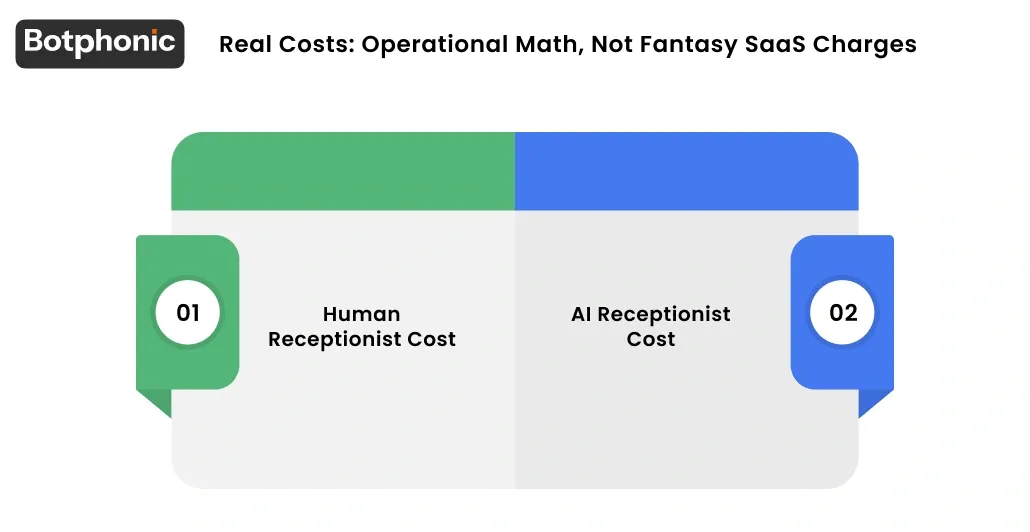
Real Costs: Operational Math, Not Fantasy SaaS Charges
Let’s talk real costs. Fantasy SaaS charges using the landing page. Actual operational math.
1. Human Receptionist Cost
In America, a typical full time medical receptionist spends 38,000-55,000 annually on salary, benefits, taxes and overhead. The range is slightly smaller on paper in Nashville but it is high when turnover and training cycles are undertaken. Or now bring up a few front desk workers to work extra hours. The cost stacks quickly.
2. AI Receptionist Cost
A call rate and capability of an AI receptionist will cost between 300 and 1500 per month. The delta can be seen even on the higher end. The more cunning operators do not stop, there with comparisons of payrolls. They appraise revenue received.
Revenue Recovery
The missed calls translate to the missed appointments. Wasted time and worth of patients through cancelation of appointments. In the majority of cases when AI reception is applied properly to clinics, two-digit reserves in the number of booked appointments may be observed only due to an answer to the calls at any time.
That is not magic. It is arithmetic.
Patient Experience: The Psychological Objection
Psychological is the most important point of contention other than compliance and cost. Healthcare leaders are patient experience concerned.
- Will human beings tolerate chatting with AI?
- Will it feel cold?
- Mechanical?
- Impersonal?
1. Reality Check
Reality check. The speed and clarity of patients are more of a concern to patients than most providers believe it to be. In case the voice is natural, and the working process is seamless, resistance will vanish in a short period of time. Among younger generations. Digital natives want to get an immediate answer. They have already dealt with voice assistants on a daily basis. Healthcare is only catching up.
2. Nuance Matters: The Hybrid Model
That said, nuance matters. The healthcare AI phone automation should not substitute human empathy. It should assume repetitive load so that human beings can cope with complexities. The most suitable deployments are hybrid escalation.
- AI handles routine calls
- The cases of emotions, sensitivity or complexity are interfered by human beings
That balance renders the level of satisfaction high.
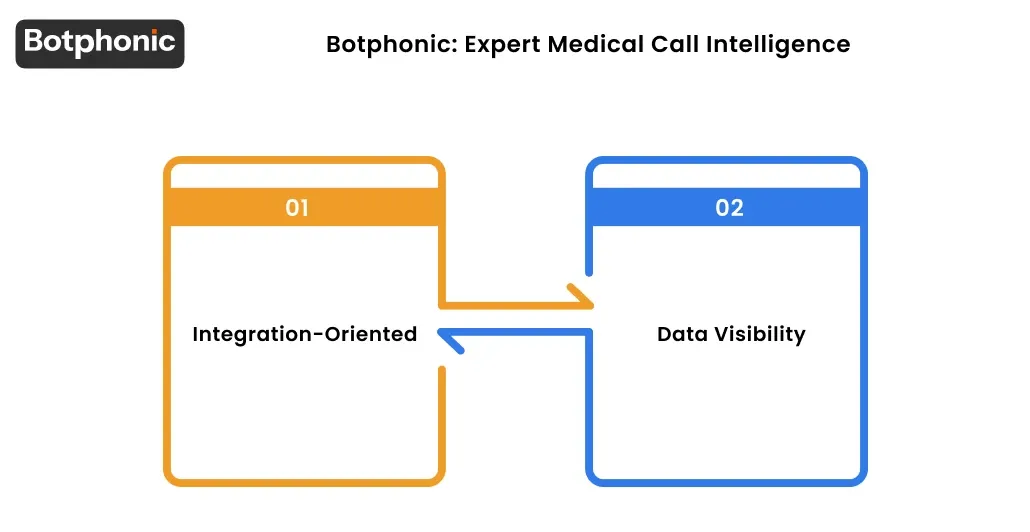
Botphonic: Expert Medical Call Intelligence
In this case Botphonic starts to identify with the noise. It is the platform that places a strong emphasis on the voice realism and the structured healthcare processes. Not generic call automation. Expert medical call intelligence.
- Arrangement of appointments
- Diversion of triage
- Intake seizing
- Multilinguality
The fundamentals are duly covered.
1. Integration-Oriented
Better said Botphonic is integration oriented. An artificial intelligence receptionist who is unable to communicate with your EHR is a weakness. The further automation creates more work alone. What actual value is created is systems that are able to automatically sync the calendars, update records, and capture conversations. At that high rate of integration operational leverage explodes.
2. Data Visibility
The other consideration that is not considered is data visibility. Freudian classical reception generates almost zero analytics. Pick-ups are, dialogues are amused, revelations are forgotten. AI flips that dynamic. Every contact is taken to an organized information.
- Busiest times
- Call numbers
- Frequently asked questions by the patients
There is a sudden capability of measuring front desk operations.
And when you might quantify something you can maximize it.
Scale, Standardization, and the Nashville Domino Effect
The Nashville operators are starting to take the heat. Particularly, multi-location practices. Inefficiency is increased by scale. What appears to have been handled in one clinic, becomes a nightmare in five. The introduction of AI is associated with the standardization of locations.
- Same scripts
- Same protocols
- Same data capture
This is what provokes efficiency at the enterprise level without an enterprise-level bureaucracy.
Competitive Optics
A different competitive optics angle exists. The patients are becoming more and more critical on accessibility among the providers. Can they reach you easily? Can they get answers quickly?
An immediate response clinic is a modern clinic. One that sends you to voicemail is outmoded. The attitude has more effect on devotion than most clinical groups would like to accept.
Implementation: What Separates Winners from Failed Pilots
Of course, not all the projects are successful in the implementation. Buying AI is easy. It is not implementing it in the right way.
1. What Winning Clinics Do
The winning clinics do not consider AI reception a plug-in but rather similar to infrastructure.
- They audit call flows
- Map patient journeys
- Define escalation paths
- Apply the AI to real life scenarios
- Eagle eye entry into relations
- Iterate fast
This type of an operating discipline separates the success stories and those pilots who are not successful.
2. Avoiding the Vendor Trap
There is also the vendor trap. The healthcare voice AI is overly filled with generic voice AI. Slick demos, weak compliance, and lastly minimal integration depth. Bad choice of platforms creates a technical debt that is difficult to settle in the future. In this case, due diligence is not an option.
So what do you recommend to the clinics?
- Start with compliance documents. Should the vendor fail to properly articulate security architecture, the buyer should walk away.
- Then the demand actually incorporates the demos. Not mockups. Jurisprudence of live processes and real systems.
- Then ask for call recordings. Nothing informs us any better than the actual interaction.
- And put the ashamed question. What does the failure of the AI entail? Even no system is functional without failure. Fallback routing, logic of human handoff and transparent logging ought to be responded to.
When such an answer is undefined that is not a solution but a bane.
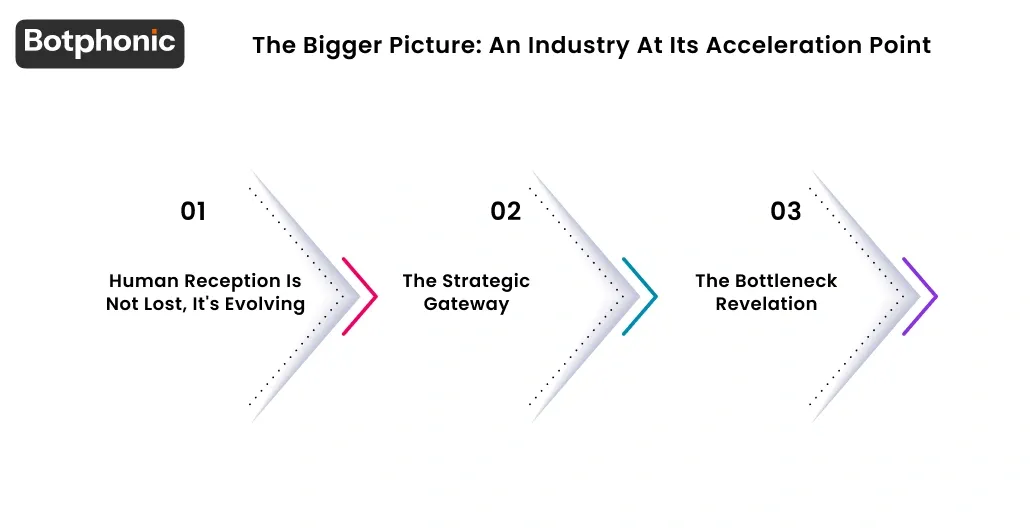
The Bigger Picture: An Industry at Its Acceleration Point
Let’s zoom out. The adoption of AI in healthcare follows the same waves of technology as before.
- Early skepticism
- Gradual pilots
- There is a sudden increase in acceleration when it crosses cost and performance thresholds
The present stage is the acceleration stage. Labor shortages and margin pressure are causing decisions that would otherwise have been ten-year decisions to be forced.
Even Nashville will probably be a rapid moving market compared to most markets. The number of healthcare operators is so thick as to bring about a domino effect. Other entrepreneurs come in as soon as one or more big players can demonstrate their ROI. No one would want to become the last clinic to continue to sink in missed calls and shortage of staff.
1. Human Reception Is Not Lost, It’s Evolving
Does that mean that human reception is lost? No. That narrative is lazy. Rather, the former model of human control over things is lost. There is an improvement in the next-generation front desk.
- AI absorbs repetition
- Humans handle nuance
That separation of labor already is occurring.
The clinics that understand this are not asking the question or whether the reception of AI will be normalized. They are asking about how they can roll it out at a rapid pace without disrupting the experience of patients. That is the right question.
2. The Strategic Gateway
Then broadly speaking there is the strategic perspective. The acceptance of AI call assistant is not even the last phase. It is the gateway. Companies start evaluating processes adjacent to automation of the voice and finding it to be justified.
- Automated intake
- Voice-based follow-ups
- Intelligent triage
- Revenue cycle augmentation
The stack expands naturally.
What seems to be a front desk experiment might prove to be an operational change. Not overnight. Not magically. But steadily. One workflow at a time.
3. The Bottleneck Revelation
And somewhere in such a shift, leadership teams get this revelation. It was not just any desk at the front desk. Moreover, It was an open-air bottleneck. Eliminate the friction in the system and the entire breathing system is different.
The Final Question
And this brings up one more and one more embarrassing question that most clinics are still not prepared to answer completely. When the patients can call you immediately, make a booking faster and socialize more conveniently in other places, how soon are the accessibility parameters going to take over and define where they will be getting care anywhere.
Conclusion
The front desk was never just a desk. It was the first impression, the missed call, the lost patient, and the untapped revenue, all in one overwhelmed human. An AI receptionist does not replace that human. It removes the ceiling on what that human can do. According to the U.S. Bureau of Labor Statistics, the annual wage for traditional medical assistants was $44,200 in May 2024.
The Nashville healthcare industry is not waiting. And the margin squeeze is real. The math of labor is unyielding. The patients are already switching. The clinics that are moving quickly on AI reception are not following a trend, they are filling a gap that has been quietly bleeding revenue for years. The question is no longer whether an AI receptionist has a place in your clinic. It does.