
Summarize Content With:
Introduction
Enough of faking compliance. Banks in the United States alone paid over $300 billion as fines and losses from compliance failure within the ten years after the 2008 financial crisis. That figure compares to loss of credit due to the crisis itself. Think about that. Not bad trades. Not bad loans. Bad controls.
Now fast forward. Most top executives of banks who participated in benchmarking research by the McKinsey and Company confessed that they are more sure of dealing with credit risk rather than compliance risk. That is not a minor gap. That is a flashing red light.
The issue of compliance and governance of cloud managed services has taken the centre stage in regard to operational resilience. When you make them your checklist you are already on the losing end.
This is not regarding evading fines. It is also concerning the creation of a system capable of withstanding any scrutiny, scaling, and speeding without breaking the law.
The Compliance Cost Problem No one Wants to Admit
In the past ten years, banks were aggressive in the expansion of compliance functions. Headcount ballooned. Budgets swelled. In certain institutions, the compliance expenses increased over the course of a few years by over 20 percent.
And the large size was not effective.
According to a survey of major banks around the world conducted by McKinsey, regulatory compliance resources were 0.79 percent of total full-time equivalents and approximately 0.4 percent of total revenue. That sounds tidy. It is not. The difference between the institutions was huge. Others invested heavily in technology of up to more than 50 million a year with minimal returns on maturity.
Increased spending on the compliance technology did not necessarily result in a higher strength of compliance. Indeed, the majority of banks continue to spend about 79 per cent of compliance expenses on staff. Average is only 9 percent as technology. Translation. The heavy lifting in the world that requires automation is done by humans.
| Metric | Finding |
| Compliance staff as % of total FTEs | 0.79% |
| Compliance costs as % of revenue | ~0.4% |
| % of compliance expenses on staff | 79% |
| % of compliance expenses on technology Only | 9% |
| Technology investment at some institutions | Over $50M/year with minimal maturity gains |
“Manual compliance in a multi-cloud setup is like operating a data center with a flip phone. Nostalgic. Not effective.”
Automation Is Not Future But Necessity
Let’s get practical.
The cloud environments are dynamic. Workloads are brought up and down within seconds. Configurations drift. The APIs bridge the systems along the borders. The regulatory requirements change on a quarterly basis. Manual audits cannot keep up. Not in 2026. Never in a serious business.
The only model that can work is continuous compliance.
- Policy-as-code systems implement governance policies directly in infrastructure pipelines
- Configuration drift is identified and flagged automatically
- Evidence gathering is continuous, not a chaotic scramble before an audit
Organizations that incorporate compliance automation complete audits faster and experience significantly fewer violations than those that rely on manual processes. That is not hype. It is math.
And here is the blunt truth: when your compliance team still uses spreadsheets to monitor cloud controls, it takes just one misconfiguration to make headlines.
Security and Governance Need to Work Together
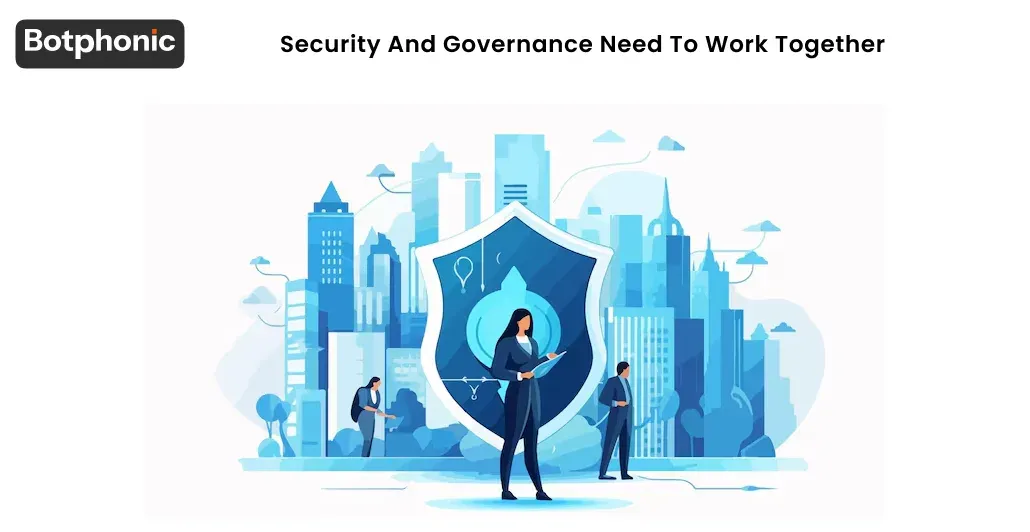
Over the years, businesses have regarded security and governance as brothers who are forced to eat at the same table.
- Security Teams Owned
Firewall, encryption, intrusion detection security teams, Separate dashboards and budgets.
- Governance Teams Owned
Policies, role definitions, documented procedures Separate meetings. That model is obsolete.
The governance driven security takes place in cloud managed services.
- Embedded controls are found at design time.
- Regulatory requirements are directly mapped to access management, encryption, logging and audit trails.
- Shared responsibility models are well spelled out.
One of the most common causes of the cloud breaches is mismanaged shared responsibility. The majority of the breaches do not involve complex zero-day attacks. They are based on misconfigurations. Over-permissioned access. Unmonitored assets.
Governance fixes that. Not by adding paperwork. Integrating responsibility into the architecture.
Governance is the operating system that informs you when to spring the security, as long as the shield is security.
Agile Compliance: Practical and Possible
Banks were the first to use agile operating models in customer facing functions. Cross-functional squads. Product ownership. Faster releases. Better engagement.
Risk and compliance functions were behind schedule. There is independence, which is associated with slow adoption. Control teams were afraid of losing objectivity in case they were embedded too deeply among the business.
Then reality intervened.
- Products that are constructed without input of compliance early are costly to clean up.
- The changes in regulations that are introduced too late pose operational bottlenecks. In-built monitoring processes create redundancy.
- Risk and compliance agile models are now based on two imperatives. Nurture first line agile teams and evolve second line processes.
- Other institutions have compliance officers on product squads reporting to the second line of defense.
- Others use flow-to-work pools of multiskilled compliance experts that rotate on the basis of priority.
The benefits are tangible. Risks identified earlier. Changes in regulations occurred quicker. Reduced handoffs. Clearer accountability.
It is not a matter of ensuring compliance being fashionable. It is about making it effective.
Governance: The Architecture of Risk Culture
You may post all the value posters you desire. Risk culture cracks when there is no powerful governance and control structures.
Good governance systems accomplish two things.
- Addressing compliance requirements.
- Actualizing intention.
When safety is a value, the governance structures improve the safety measures in reporting, make it performance-based, and in decision rights. Controls change in the event that innovation is a proclaimed priority. They use up-to-date technology. They do not turn out to be bureaucratic skeletons.
Here user-centered design is important. When there are ten or three approvals and clicks required to take a process by employees, there will be shortcuts. Not due to the fact that they are wicked. Because they are human.
Cloud Governance in 2026
Competition in the form of regulatory pressure is rising across the industries.
| Industry | Regulatory Driver |
| Financial Services | Basel Committee principles require auditability and transparency in third-party cloud operations |
| Manufacturing / IoT / AI | IEC 62443 cybersecurity standards apply to connected and AI-integrated environments |
| Professional Services (GenAI) | New governance expectations under AI legislation in both the US and EU |
Conformance is not a yearly certification practice anymore. It is a living system.
Cloud managed service providers are decisive in this. With
- Proactive monitoring
- Automated configuration administration
- Ongoing production of evidence
The ability to map assets, controls, and compliance measures in hybrid environments using unified dashboards.
Trust Begins with Visibility
Compliance officers and CIOs require one source of truthfulness. Meanwhile, the five disintegrated instruments that hardly match.
Certified partners minimize the exposure to risks through the way of following proven governance patterns and being frequently audited. This is not marketing fluff. Discipline is enforced through independent audits, and discipline is what keeps regulators away.
The Five Motions That Can Keep Leaders and Laggards Apart
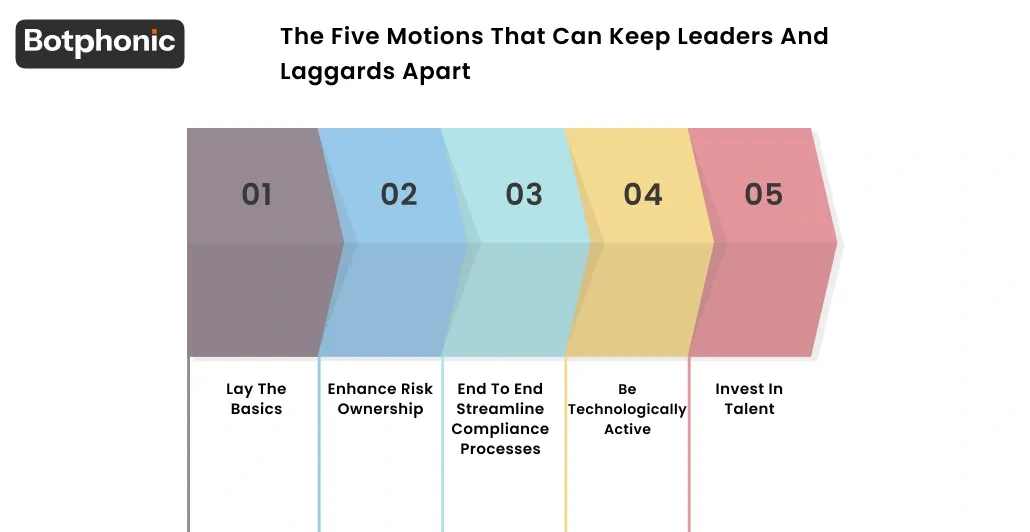
According to the understanding of global benchmarking, there are always five activities that distinguish mature compliance organizations.
- Lay The Basics: Develop effective enterprise risk management models. Match risk taxonomies and control libraries. Bring compliance as part of a greater risk management and not separately.
- Enhance Risk Ownership: Compliance is not a legal requirement that is contracted to the second line. It is a business risk. Tone from the top matters. So do performance metrics.
- End To End Streamline Compliance Processes: Map out the AI call assistant out to the fullest extent then automate. And also, eradicate unnecessary handoffs. Clarify roles. Then digitize.
- Be Technologically Active: Only use cases of AI receptionists can be approved to be scaled. Develop minimum viable products. Expand with discipline. Never use proof-of-concept graveyards.
- Invest In Talent: The legalistic interpretation of compliance is being replaced by data-based risk management. The expertise of analytics is no longer a luxury. Top institutions are developing internal schools to develop such abilities.
Incompetence cannot be automated. However, you can give effective teams systems that leverage their effectiveness.
Modernization is Accelerated through Governance
The myth about strong governance and its negative impact on innovation persists.
Reality says the opposite.
Digital investments in enterprises that reconcile security, compliance, and modernization initiatives achieve faster time to value. Workload migrations, AI AI receptionists and AI call assistant for business deployments, and API integrations are faster when built-in governance as governance queries are answered beforehand.
Change management processes guarantee that the changes to be implemented are assessed, authorized and tested prior to implementation. This minimizes disruptions and regulatory surprises within the system.
Constant checking will make sure that deviations are identified at an early stage. Not when customers make complaints. Not when regulators make enquiries.
Governance is a scaffolding that enables you to reach greater heights. In its absence, each and every innovation is a risk.
Conversational AI is seen as sharing a shared responsibility model. They safeguard the infrastructure. Customers obtain arrangements, entrance, and data utilization.
Simple in theory. The majority of the attacks of a cloud are based on the misconceptions or disregard of this shared responsibility barrier. Storage buckets which are overexposed. Excessive permissions.
| Cloud Provider Owns | Customer Owns |
| Physical infrastructure security | Access configuration and permissions |
| Hypervisor and network isolation | Data classification and handling |
| Core platform availability | Application-layer controls |
| Hardware maintenance | Monitoring and logging of own workloads |
The Governance structures should be specific on the ownership of what. They should give real time access to assets and controls. They are required to be accountable. Assuming that you cannot respond, in minutes, who can access sensitive data in your hybrid environment, you lack governance. You have hope.
“Hope is not a strategy.”
The Multipliers are Training and Culture
The finest government structure cannot survive without educated citizens. Training programs are done regularly to enforce expectations. There is constant awareness to keep security in mind. Documentation eliminates ambiguity.
However, training is not enough. Culture matters. Psychological safety and a high-trust environment also promote concern escalation in employees at an early stage. Excessively punitive cultures push matters into the shadows. Governance offers organization. Culture provides oxygen. Either of them in absence stifles performance.
Compliance as Competitive Differentiator
In the future, in 2026 and afterwards, compliance in AI receptionist is not one too heavy. It is a differentiator.
- Customers need transparency.
- Auditability is required by regulators.
- Boards demand resilience.
Those organizations that entrench continuous governance, automation, integrate visibility, and align talent with technology are in a stronger position.
| Reactive Compliance | Embedded Compliance |
| Expensive consultant engagements after incidents | Continuous automated monitoring |
| Writing checks for fines and settlements | Faster audit cycles, fewer violations |
| Justifying yourself to regulators | Proactive transparency with regulators |
| Compliance as a bottleneck | Compliance as a competitive advantage |
Those, who consider compliance as an afterthought, will keep contracting consultants every time something goes wrong, writing checks, and justifying themselves to the regulators.
Conclusion
Cloud managed services compliance and governance are no longer nice-to-haves, but the foundation of operational resilience and competitive differentiation. The risk of catastrophic penalties, operational bottlenecks, and reputational damage awaits organizations that view compliance as a checkbox. The future is clear: embed governance into the cloud architecture itself, automate continuously, and align talent, processes, and technology to build a living, breathing compliance ecosystem.
Even the Conversational AI in financial services helps you tackle numerous issues. Discipline, transparency, and proactive governance are no longer costs of doing business, but differentiators that fuel innovation, build customer trust, and mitigate regulatory risk. In today’s environment, success is reserved for those who embed compliance as a strategic enabler, not a reactive function.
Don’t wait for misconfigurations or regulatory fines to hit your bottom line. Embed AI-driven automation.
Schedule a Demo with Botphonic