Summarize Content With:
Quick Summary
AI phone call assistants have become monumental to businesses managing a global market, high call traffic, and multilingual customer bases. While modern AI-based call systems can provide real-time translation, automation of sophisticated workflows, follow-up duties, and cut cost on operations, customer satisfaction may be increased. Whether BPOs are managing millions of customer interactions or SaaS companies, AI phone call support can reconstruct an entirely new way of communicating from one edge to the other.
Introduction
Customer expectations have changed way faster than the pace of traditional call centers. Customers need instant answers, calls in their own language, and support around the clock irrespective of time zone or availability of agents. Unfortunately, putting together such a multilingual, 24/7 human team is costly, operationally heavy, and thus impractical for many businesses.
In comes AI phone call assistants into the fray.
These are no longer simple IVRs or scripted bots. AI callers sounded natural, picked up nuances, interpreted human emotions, instantly translated, and made redundant entire manual processes. They are increasingly becoming a game-changer for the modern world, especially for businesses operating globally or in a rapidly scaling industry.
Our in-depth exploration below outlines the comprehensive view of everything that hot businesses ought to know about AI phone call assistants and their new dimension in multilingual customer service.
Understanding AI Phone Call Assistants for Multilingual Customer Service and Their Growing Impact
An AI phone call assistant is a smart voice system that handles outbound and inbound calls in real time. They are equipped with state-of-the-art speech recognition, natural-language processing, multilingual translation engines, and workflow automation layers.
These assistants have advanced far beyond merely responding to inquiries. They:
- Can engage in normal conversation
- Instantly translate calls
- Perform tasks such as making appointments or checking accounts
- Trigger internal workflows
- Automatically do follow-ups
- Escalate only when needed
The increased prevalence of these assistants can be attributed to some factors on the ground:
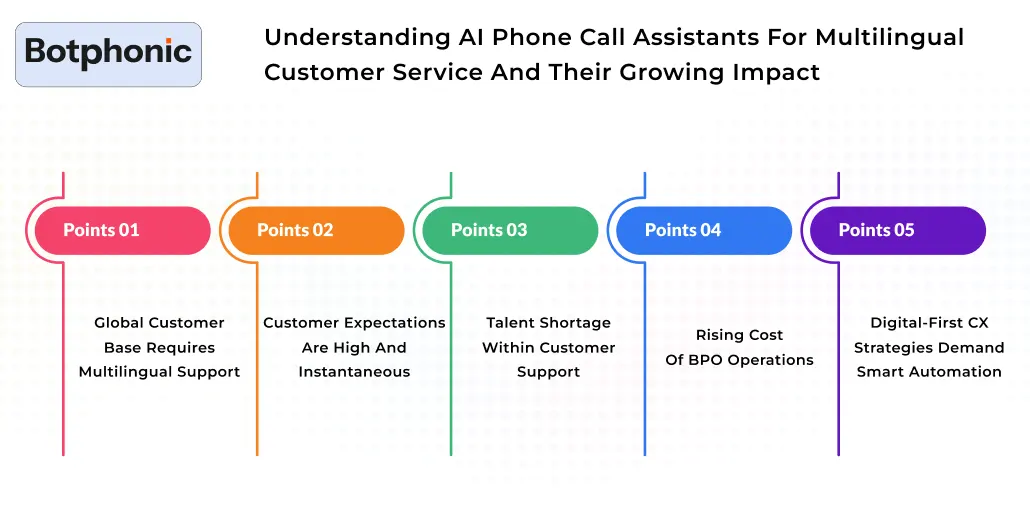
1. Global Customer Base Requires Multilingual Support
Companies venturing across borders cannot act on the premise of having agents who speak two or three languages. Meanwhile, AI systems can support dozens, switching the language automatically at the caller’s preference.
2. Customer Expectations Are High and Instantaneous
No one wants to spend time listening to hold music or putting up with an archaic IVR system. Moreover, AI brings the benefit of real-time engagement, better availability, and faster resolutions.
3. Talent Shortage within Customer Support
Recruiting for multilingual agents is slow and costly. AI takes the burden off these staffing shortages without hampering service delivery.
4. Rising Cost of BPO Operations
Wages in BPOs are on the rise, alongside training costs and compliance. AI is optimizing these cost structures and is taking over some repetitive tasks.
5. Digital-First CX Strategies Demand Smart Automation
Firms that embrace automation tend to be the ones that have lower churn rates, higher satisfaction scores, and more efficiently functioning support pipelines.
In a nutshell: AI phone call assistants help businesses provide consistent, scalable, and multilingual service in an ever-more-competitive landscape.
 PRO TIP
Core Capabilities of an AI Phone Call Assistant
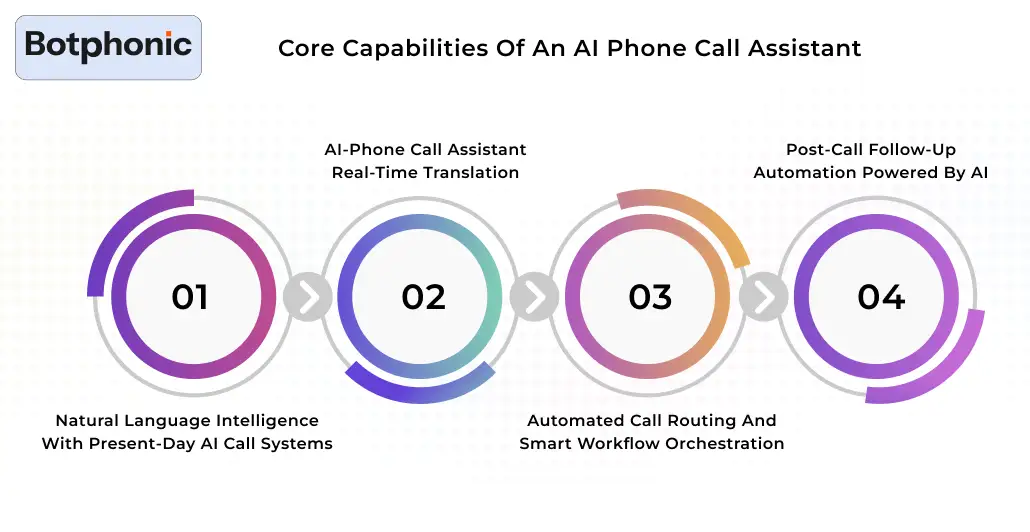
1. Natural Language Intelligence with Present-day AI Call Systems
One of the remarkable capabilities of AI call technology is to interpret calls made by humans. Modern AI callers converse naturally with humans in a free-flowing manner, speaking on topics of their own selection. They have extraordinary accuracy in recognizing accents, tonal variations, regional expressions, and subtle phrasings. The systems are aware of context for many turns, ask clarifying questions when required, and respond in a personalized way, not stiff and robotic.
The natural language intelligence thus engendered guarantees that the caller is treated with an experience similar to dealing with an exceptionally trained human agent. It also indicates that the business does not have to script every possible phrasing or scenario since AI will interpret the actual intent wherever the call goes. This flexibility offers greater satisfaction by reducing friction while also improving the overall experience of interaction in support.
2. AI-Phone Call Assistant Real-Time Translation
The most revolutionary ability that these AI call assistant carry is their capability of translating speech while it is occurring. Such a feature allows businesses to leverage synergies across borders with little need to advertise for specialized multilingual teams. The system automatically recognizes the language of the caller and responds fluently while sustaining the same tone and meaning, irrespective of dialect or cultural nuances.
This real-time translation service can also be useful for escalations. The AI generates a transcript to the agent’s liking when the call is transferred to a human agent. It ensures that the agent understands the context and can effectively continue conversing with the client feature. In addition, it leads to reduced time-to-resolution and efficient customer interactions. While also opening up business avenues that they may otherwise not have pursued due to language constraints.
3. Automated Call Routing and Smart Workflow Orchestration
AI phone call assistant are not only conversational robots; they also act as facilitators for back-end processes. When the AI understands the intent behind a call, it can carry out tasks on its own by verifying the identity of the caller, pulling the relevant account details, updating the customer relationship management (CRM) records, or triggering workflows among connected systems. In other words, when a customer requests for refund, the AI call assistant can collect all necessary refund data and trigger the refund workflow by itself.
By streamlining this process, this level of automation minimizes errors while putting an ever-increasing pace on operations by systematically handling every call. In case of escalation needs, AI would direct the caller to an agent or department, at the same time contextualizing all relevant information to eliminate redundant re-explanation to the customer.
4. Post-Call Follow-Up Automation Powered by AI
Due to understaffing, follow-ups have been largely neglected, but they are crucial to customer satisfaction and brand loyalty. These AI phone call assistants help completely automate follow-ups by sending confirmation messages, reminders, feedback requests, and information updates just after the call. These follow-ups maintain consistency, personalization, and are in many languages.
AI can assign check-ins beyond ordinary messaging services, keep track of renewal reminders, or begin campaigns for follow-up messaging after a purchase. As a result, customers are contacted promptly. In the end, these automated follow-ups enhance customer retention rates, minimize missed appointments, and encourage proactive engagement from customers who feel supported throughout their journey.
 NOTE
NOTE
Why Multilingual AI Phone Call Support Is the New Competitive Standard
Companies that operate in global markets can’t always rely on limited language coverage or delayed responses if they are thinking of gaining customers’ trust. Multilingual AI phone call support has become the new baseline for competitive organizations as it’s effectively delivering availability, consistency, and accessibility that human teams have always struggled to match. With AI, customers no longer need to navigate language barriers or have to wait. And, most importantly, there won’t be any inefficient call routing systems. Instead, they are actively receiving immediate and accurate assistance that is tailored to their preferences.
For businesses, this just translates into measurable operational advantages. The best AI phone call software for bpo providers is effectively supporting markets to expand it’s reach without adding on hiring costs. It’s effectively streamlining communications across regions, simplifying compliance, and enabling companies to offer a uniform service quality regardless of geography.
Use Cases of AI Phone Call Assistants for Global Retail and E-Commerce
Global retailers and e-commerce brands always face heavy call volumes that range from product inquiries to shipping updates. Offering high-quality multilingual support at scale has been expensive and extremely unreliable. AI changes this dynamic entirely. Retailers are now able to handle inquiries from customers across Asia, Europe, and the Americas without maintaining separate language-specific teams.
AI phone call assistants help shoppers track their orders, understand product details, navigate return policies, and, most importantly, receive post-purchase support in their own native language. This multilingual fluency effectively helps in improving.
1. Multilingual Customer Support at Global Scale
When you have a retail footprint across continents, language variance becomes an operational obstacle. An AI phone call assistant for multilingual customer support is capable of providing real-time multilingual support that neutralizes this issue overnight.
- Instant translation and localized responses enhances customer experience and becomes consistent.
- Reduces miscommunication risk and effectively boosts first-call resolution.
2. Order Management & Status Resolution
Let’s be honest and accept that about 80% of calls in e-commerce revolve around, “Where’s my order?” Integrating AI can help you with these queries and provide machine-like discipline.
- Automated order lookups are directly integrated into OMS/WMS.
- Proactive delay notifications are shared even before the customer considers dialing in.
3. Returns, Exchanges & Policy Guidance
Returns are a necessary evil; AI assistants streamline this issue with the typical back-and-forth of details.
- With eligibility checks, label assurance, exchange options, and store credits explanations automations, everything can be handled easily.
- Keeps policy interpretation clear and consistent, preventing those “I was informed that….”
4. Fraud Prevention & Identity Verification
Global operations actively attract fraud attempts.
- Voice biometrics, automated KYC workflows, and pattern detection help flag these risks at an early stage.
- Reduces manual verification load for BPO teams.
Top 5 Ways AI Phone Call Systems Transform BPO Centers & High-Volume Support
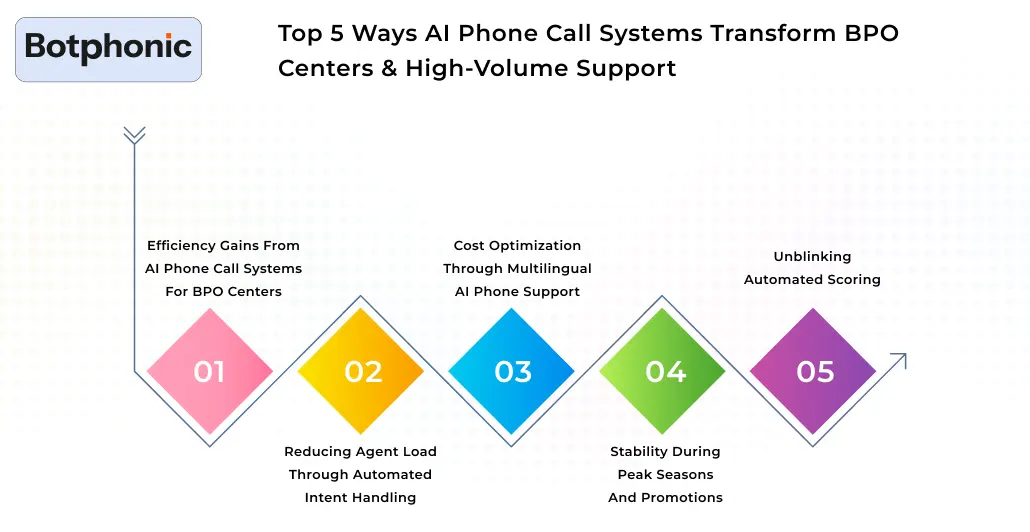
1. Efficiency Gains from AI Phone Call Systems for BPO Centers
AI is not merely decorative but is now firmly embedded as an operational support. By automating repetitive call flows and enforcing interactions with a uniform response style to relieve the pressure of queue holding on their BPO centers, finally, it appears that the throughput demanded from them by clients has begun to be delivered. Thus, they benefit from faster handling times, consistent performance, and a support engine that does not give in to pressure with a change in volumes.
2. Reducing Agent Load Through Automated Intent Handling
Most of the calls in this area are more or less predictable-whether order checks, basic troubleshooting, policy questions, or account verifications, in its insubordinate manner, just gets the job done on such matters. The intention of the caller is figured out instantly within seconds; whatever it can resolve it does, and only the tough queries are escalated to the agents.
3. Cost Optimization Through Multilingual AI Phone Support
The previous model was hiring a team of agents that could converse in several languages, arranging sittings of such teams across different regions, a model that is costly and inefficient. AI systems for multilingual customer support provide the means to avoid this problem altogether. Integrated into the call flow are instant multilingual capabilities, allowing one to reduce payroll complexity, shrink labor overhead, and still provide a refined global customer experience.
4. Stability During Peak Seasons and Promotions
Peak business means peak pressure. The operations teams become braced for impact, the HRs are wearied, and managers simply keep praying that the queues do not breach SLA dashboards. AI for multilingual customer support changes the whole paradigm. It scales instantaneously, absorbs the overflow, and stabilizes service level even during a surge in call volume.
5. Unblinking Automated Scoring
Human quality teams give their best, but some factors make it sometimes impossible: fatigue, bias, and inconsistency. AI scores every interaction on the same parameters every time, without disregard. That substantiality puts the key performance metrics higher, while subjective evaluation spoils the scene.
Conclusion
AI phone call assistants have moved from the realm of experimental tech to a foundation pillar. For any business that deals with high call volumes, global customers, and multilingual service expectations, an AI call assistant works as a saviour. This isn’t the era where human-only support teams are available, but AI is effectively stepping into the gaps and offering unparalleled consistency with real-time intelligence. In Gartner’s survey, it was found that about 65% CMOs say there will be advances in AI that will change roles in the next two years.
From instant multilingual conversation to automated workflow, real-time translation, and intelligent call routing, AI is just transforming the entire customer communication chain. It’s actively lightening the agent workload, sharpening QA accuracy, and trimming unnecessary operational excuses.