
Summarize Content With:
Quick Summary
In this blog, we’ll explore how AI is changing the call center industry, from market growth projections and cutting-edge technologies to performance metrics and industry trends. We’ll also deep dive into the challenges businesses are facing as they are adopting AI solutions. And lastly, we see some future predictions on how AI will continue to reshape customer service operations.
Introduction
As the digital transformation of industries has continued to accelerate, AI driven technologies have become central in reshaping the customer service operations. To say it in particular, AI-powered call centers have emerged as game-changers and enabled businesses to offer faster and personalized services while also offering cost-effective customer experiences. In the future, AI will be an integral part of call center operations, handling a substantial portion of customer interactions and driving operational efficiencies across numerous sectors.
As businesses are continuing to adopt AI to automate routine tasks and offer round-the-clock service, understanding the AI call centre statistics and insights for 2026 is essential for staying ahead of the curve. Moreover, the integration of AI is not just about reducing costs but also enhancing the overall customer experience, ensuring businesses remain competitive in a fast-paced, and customer-centric market.
The State of AI Call Centers in 2026
Market Size and Growth Projections:
Presently, the global AI pop against call centers is growing, and the estimation points to more than 25% growth during the year 2026 in terms of the compound annual growth rate, pointing to a market forecast of $60 billion.
Such a surge turns out to be a reflection of a massive adoption of AI in different industries. Businesses are increasingly realizing what the enhancement in operational efficiency and customer experience can offer them.
It is estimated that, by 2026, AI will manage approximately 45% of customer interactions, compared to just 20% in 2023.
Technologies driving AI call centers come in
These include
- Natural Language Processing (NLP): NLP is the area of artificial intelligence that enables non-governmental organizations to understand, interpret, and respond to human language with great accuracy. This has improved chatbots and voice assistants so that they can respond more efficiently to client queries.
- Machine Learning (ML): AI-powered ML models assist call centers in predicting customer behavior and needs in advance, which decreases the response time and increases FCR rates.
- Speech Recognition and Voice Analytics: AI-driven speech-to-text and sentiment analysis technologies help understand customers’ emotions and enable more empathetic and personalized responses.
- Robotic Process Automation (RPA): RPA includes automating all the repetitive tasks such as ticketing, account updates, and data entry so that human agents use their skills to handle more complicated inquiries.
Integration with CRM & Omnichannel Platforms
AI customer service integrating with Customer Relationship Management (CRM) systems like Salesforce. This also allows AI to access customer data and share personalized service across multiple channels, including phone calls, emails, and also live chats.
Learn more: AI Call Center Meaning & Real-World Use Cases
AI Call Center Performance Metrics & Statistics
1. Call Resolution Time and AI Efficiency
The most crucial impact of AI is how it reduces call resolution time. AIvoice assistants and AI-driven chatbots can easily handle simple customer issues in seconds. Moreover, it operates so functionally that it lowers average handle time (AHT). For example, AI solutions have reduced resolution time by 30% in sectors like telecommunications and retail.
Additionally, AI smartly improves first contact resolution (FCR) rates, as systems are designed to resolve issues on the first attempt. Effectively reducing the need for clients to call in.
2. Cost Efficiency & ROI
AI-driven call centers are always proving to be cost-effective. By automating common tasks and reducing call volumes, businesses can even save upto 25% on customer service and expenses. Moreover, AI call center software predictive analytics also help call centers to optimize staffing and resource allocation leading to even greater cost savings.
A study also found that businesses who are utilizing AI call centers have seen about a 30% increase in ROI within just a year of implementation. It’s most likely due to reduction in overhead costs and improved customer retention.
3. AI Adoption Impact on Customer Satisfaction (CSAT) Scores
With AI providing quicker and more accurate responses, customer satisfaction scores have seen substantial improvement. In fact, AI-driven call centers even report an average 10% increase in CSAT within the first 12 months.
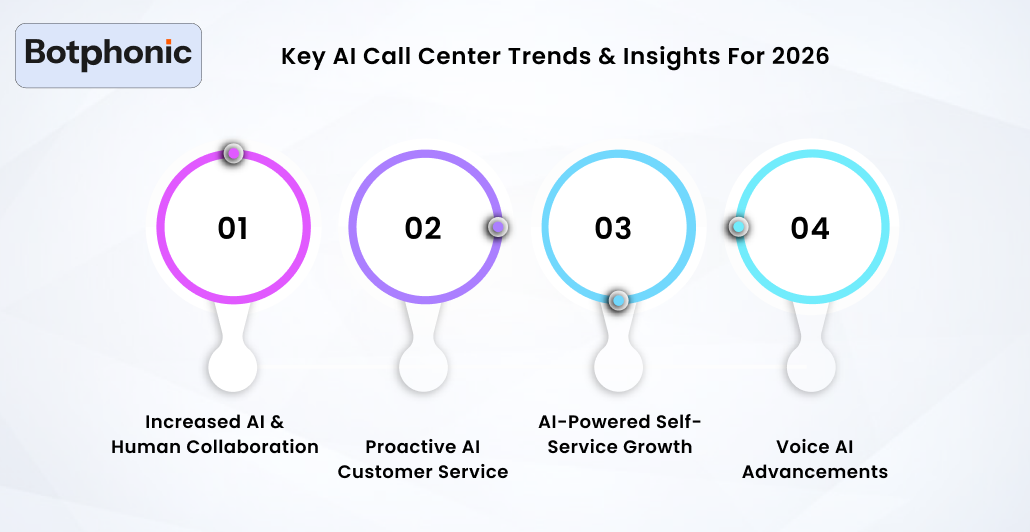
Key AI Call Center Trends & Insights for 2026
1. Increased AI & Human Collaboration
By 2026, the hybrid AI-human model will undoubtedly become the standard in call centers. AI will act as the first-line support, handling routine queries while human agents will focus on more complex or emotionally charged issues. This collaboration between AI and human agents maximizes productivity while preserving a personalized customer experience.
2. Proactive AI Customer Service
One of the most exciting trends is the rise of proactive AI. Utilizing predictive analysis, AI can easily anticipate customer needs prior to them even occurring. For instance, an AI system detects an issue with a customer’s recent purchase or service, it can easily reach out to offer assistance, which eventually reduces the frustration and improves overall satisfaction. Studies even show that proactive AI intervention reduces customer complaints by 20%.
3. AI-Powered Self-Service Growth
The demand for AI-driven self-service tools, like chatbots, automated IVR systems, and even self-help knowledge bases is growing. By 2026, 50% of customer service interaction will be managed by AI-driven self-service channels. Enabling businesses to provide even faster solutions and reduce operational costs.
4. Voice AI Advancements
The future of voice AI lies in its ability to move far away than just simple scripted responses to more conversational AI that uses deep learning and neural networks to understand and respond to a wider range of customer queries. By 2026, emotion recognition and personalized interactions will eventually become commonplace in voice AI systems, ensuring that calls feel more human and empathetic. Moreover, AI also helps organizations save time in various fields like feedback analysis, summarizing content and more.
 NOTE
NOTE
Challenges and Considerations for AI Call Centers
1. Data Privacy and Security Concerns
As conversational AI in call centers are handling vast amounts of customer data, data privacy and security will a;ways remain a major concern. Call centers need to ensure compliance with regulations like GDPR and maintain better standards of data protection. Best practices include regular audits, secure data encryption, and AI models will be trained with anonymized data.
2. AI Training and Data Quality
AI systems rely on high-grade data to operate effectively. The execution of machine learning models will also be affected by biased or poor-quality data. Call centers should also invest in data quality management and ensure that AI systems are trained on diverse and accurate data sets to avoid customer dissatisfaction or legal complications.
3. Balancing Automation & Human Empathy
While AI is excellently automating routine tasks, it cannot replicate the emotional intelligence of human agents. Therefore, balancing this automation with human empathy will be essential in preserving definite customer relationships. AI should also complement, not replace, human agents.
 PRO TIP
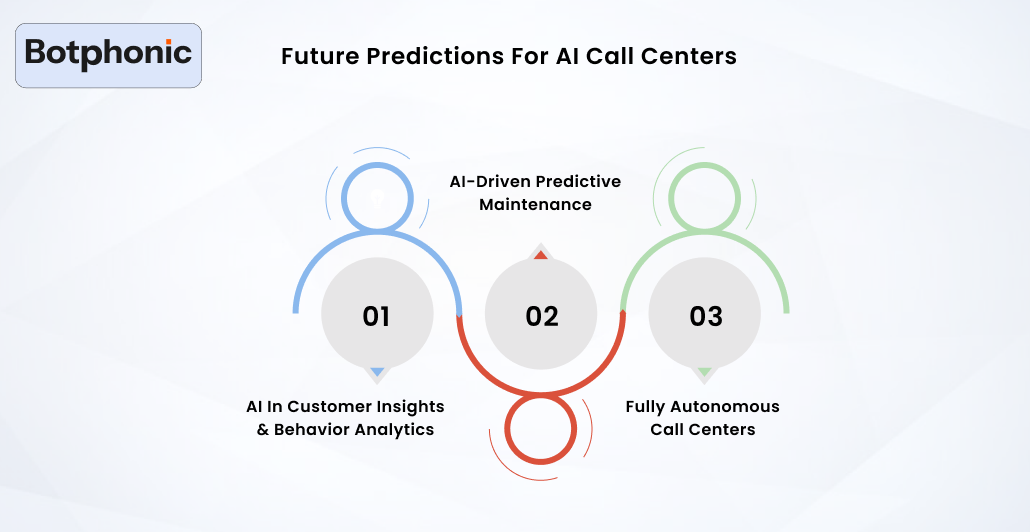
Future Predictions for AI Call Centers
1. AI in Customer Insights & Behavior Analytics
As estimated in the next few years, AI call center trends will evolve to provide more real-time customer insights and behavioral predictions. By 2026, AI-powered analytics will help call centers identify client’s intent, segment users, and tailor conversations as per individual’s preferences, leading to an even more personalized customer journey.
2. AI-Driven Predictive Maintenance
AI is also going to enable predictive maintenance in call center infrastructure. Using AI to analyze data from call center systems and forecast potential issues even before they occur. Meanwhile, they ensure minimal downtime and smoother operations.
3. Fully Autonomous Call Centers
While it’s still in the early stages, fully autonomous AI call centers may become a reality by 2026. In these systems, AI will start managing everything from customer queries to back-end processes, with little to no human intervention. However, human oversight is always going to be necessary. To ensure quality and manage all exceptionally complex cases on time.
Deploy AI call centers before your customer run out of patience
Book Your Demo Now!!Conclusion
As AI continues to evolve, call centers are becoming more sophisticated and customer friendly, while being efficient. The AI call centers statistics and insights in this blog have offered you a glimpse into the future of AI in customer service. By 2026, AI call centers will play a pivotal role in improving operational efficiency, reducing costs, and also in boosting customer satisfaction.
As businesses have started embracing these AI-driven technologies, staying ahead of trends and optimizing data-driven insights is going to be essential for their success. For businesses who are looking to adopt AI solutions, now is the time they can start integrating with these technologies to deliver next-level customer experiences.