Summarize Content With:
Quick Summary
AI call center software is reshaping how U.S. businesses are handling customer interactions by combining automation, intelligence, and human support. From intelligent call routing to real-time agent assist and speech analytics, AI-powered call center platforms are helping organizations reduce costs, improve efficiency, and deliver consistent customer experiences.
In this blog, we will see an AI call center software overview of what AI call center software is, how it works, its core features, benefits and most importantly, real-world use cases across U.S industries.
Introduction
As technology is evolving everyday, its impact on customer service is also changing. U.S. businesses either large or small-scale are increasingly turning to AI call centre software to make their operations smarter.
What Is AI Call Center Software?
To give you an AI call center software overview, it is a technology platform that actively uses artificial intelligence to automate, optimize, and also enhance customer interactions across voice-based channels. Unlike traditional call center systems, AI-powered call centers aren’t just routing calls but they are actually understanding intent behind their queries, analyzing speech, and supporting agents while conversations are happening.
These platforms often include AI voice bots, speech analytics, real-time agent assistance, and intelligent IVR systems, all working together to enhance the customer service outcomes. To put it simply, AI call center software actively transforms call centers from reactive cost centers into data-driven customer experience engines.
If we say this in practical terms, this means AI call center solutions can:
- Answer routine calls using AI voice bots
- Route customer intelligently based on their intent and context
- Provide live agent guidance during on going calls
- Monitor calls for compliance and quality
- Generate predictive insights from call data
For U.S. businesses, AI call center software represents a shift from reactive customer support to proactive, and data-driven engagement.
 PRO TIP
How AI Call Center Software Works
AI call center software operates through a layered architecture that works by combining voice processing, intelligence, and automation. While the technology is complicated, the flow of work is really straightforward.
Let’s check out the practical workflow, and know how several technologies into a single operational workflow:
- Speech Recognition and Natural Language Processing (NLP): Actively converts customers’ speech into structured data.
- Intent Detection Models: Works by identifying why a customer is calling.
- Intelligent Call Routing: Directs the calls to the right agent, department, or responsible AI virtual agent.
- Real-Time AI Agent Assist Tools: Offers prompts, suggestions, and knowledge base articles during live calls.
- Speech Analytics and Call Monitoring: Analyzes the conversations for performance, compliance, and sentiment.
- AI-driven Reporting and Analytics: Turn all the call data into actionable insights for managers.
To put it simply, the result is obviously faster resolution, lower average handle time, and also consistent customer support across the board.
 NOTE
NOTE
Core Features of AI Call Center Software
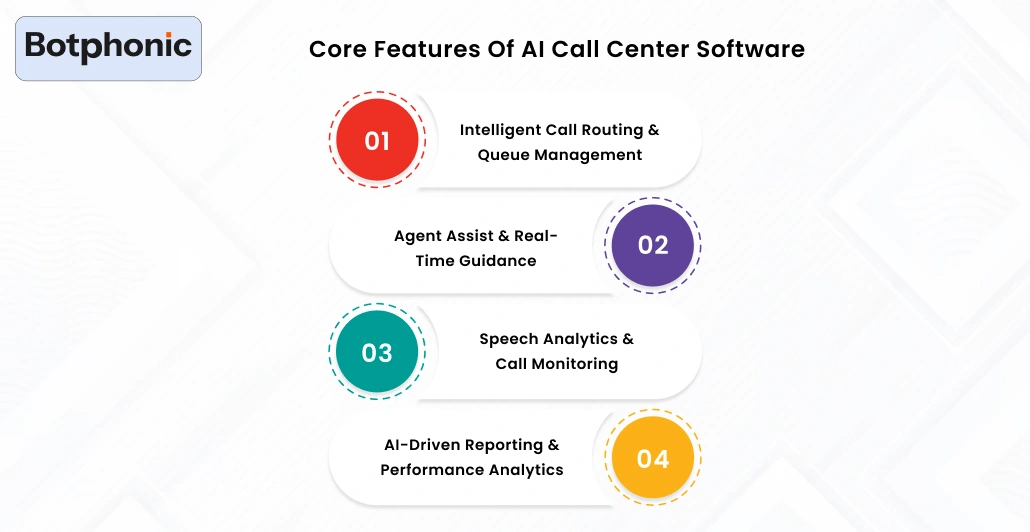
1. Intelligent Call Routing & Queue Management
The most valuable property of AI-powered call center software is intelligent call routing. Instead of simple rules-based routing, AI actively analyzes customer intent, previous interactions, and even agent skill sets which allows it to route calls dynamically.
This even reduces the numbers of call transfers, reduces wait times, and enhances first-call resolution. These three metrics are what matters most to U.S. call center leaders. Furthermore, AI-driven queue management prioritizes high-value or urgent calls automatically while keeping service levels intact during peak volumes.
2. Agent Assist & Real-Time Guidance
Agent assist is where AI call center software actively delivers immediate value on the front lines. These tools even work by listening to live calls and provide contextual assistance to agents without even disrupting the conversation.
As an agent converse with a customer, the system transcribes the calls, analyzes sentiment, and surfaces only relevant information. This could even include suggested responses, troubleshooting steps, product details, or even compliance scripts.
Agent assist tools even reduce training time. As new hires rap up faster because they won’t even have to memorize every policy or procedure. Even experienced agents benefit as the conversational AI in call centers acts as a safety net, ensuring consistency across different interactions.
3. Speech Analytics & Call Monitoring
Speech analytics is one of the most transformative aspects of AI call center software. Usually, quality assurance teams could only review a small fraction of calls due to time constraints. Meanwhile, AI helps eliminate this limitation.
By analyzing 100% of customer interactions, AI-powered speech analytics tools identify trends, recurring issues, and also sentiment shifts. They can even flag calls where customers sound frustrated, detect keywords that are related to cancellations or complaints, and lastly it even monitors compliance automatically.
For U.S. businesses who are focused on customer retention, speech analytics assists by providing early warning signals. Instead of reacting to churn after the situation has taken place, companies can even address issues proactively. This level of insight simply isn’t even possible with manual call monitoring.
4. AI-Driven Reporting & Performance Analytics
AI-driven reporting movies call center analytics from being described to predictive. Instead of showing what happened in the previous month, AI call center analytics even help forecast what’s more likely to happen next.
By analyzing call volumes, customer sentiment, and agent performance, AI-powered dashboards provide insights into staffing needs, training gaps, and also processes inefficiencies. Managers can even identify which scripts are going to work, which issues cause repeat calls, and who needs additional coaching.
For U.S. organizations who are under constant pressure to justify budgets, AI-driven reporting provides clear, data-backed answers. It turns call center operations into a measurable, optimizable function rather than a black box.
Learn more: What Is an AI Call Center? A Beginner’s Guide
Benefits of AI Call Center Software for U.S. Businesses
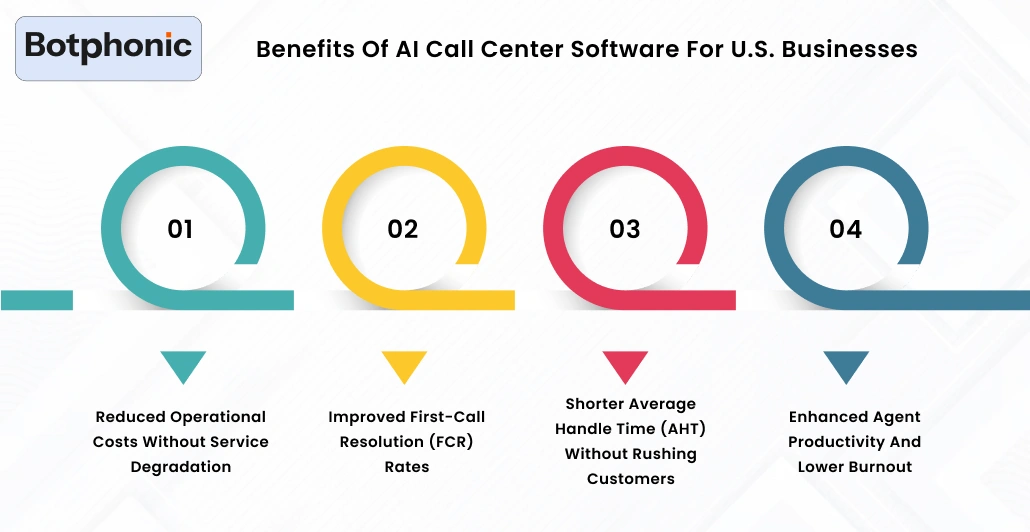
AI call center software delivers value across cost control, performance optimization, customer experience, and also long-term scalability. For U.S. organizations operating in competitive compliance-heavy environments, these benefits are both operational and strategic.
1. Reduced Operational Costs Without Service Degradation
The most immediate benefits of AI-powered call center software is cost reduction. By automating routine and repetitive calls, like order status checks, balance inquiries, or appointment scheduling,. The AI call assistant helps by:
- Automating routine tasks like balance inquiries, and appointment booking.
- Reducing staffing requirements during peak hours and minimizing overtime expenses.
- Never sacrificing service quality, with AI voice bots and intelligent IVR handle high-volume tasks, leaving humans to work on value-driven tasks.
2. Improved First-Call Resolution (FCR) Rates
First-call resolution is a core performance metric for any call center. AI call center software improves FCR by ensuring customers are directed to the right resource the first time. It:
- Effectively uses intent detection and historical data to ensure customers are reaching the most suitable agent from the beginning.
- AI agent assist tools surface relevant information in real time, aiding faster issue resolution.
Moreover, it results in:
- Fewer transfers and callbacks, leading to higher customer satisfaction.
- Directly reduces call volume and operational costs, providing both immediate and long-term benefits.
3. Shorter Average Handle Time (AHT) Without Rushing Customers
Reducing average handle time has always meant pushing agents to move faster even at the expense of customer experience. AI call center software changes the equation entirely. It helps by offering:
- Real-time instruction and instant accessibility to knowledge bases, while reducing time spent on each call.
- Automated summaries that allows agents to wrap up calls faster without losing the element of personalization.
And, it results in:
- Small reduction in AHT can have a massive impact on cost savings as well, particularly for U.S. call centers with high-volume interactions
- Faster resolutions without compromising customer experience.
4. Enhanced Agent Productivity and Lower Burnout
Agent burnout is a problem that every call center is suffering from. AI-powered call center platforms help address this by actively reducing cognitive load and repetitive work. Agent assist tools help in reducing cognitive load by:
- Offering features like speech analytics, automated quality monitoring, and also it lowers the stress on call center staff.
- Eliminating the scrambling through scripts or switching between multiple systems during calls.
Meanwhile, it leads to:
- Increased agent productivity and reduced burnout that also enhanced job satisfaction and retention.
- A less stressful environment that helps maintain workforce stability.
NOTE
AI Call Center Software Use Cases by Industry (U.S.)
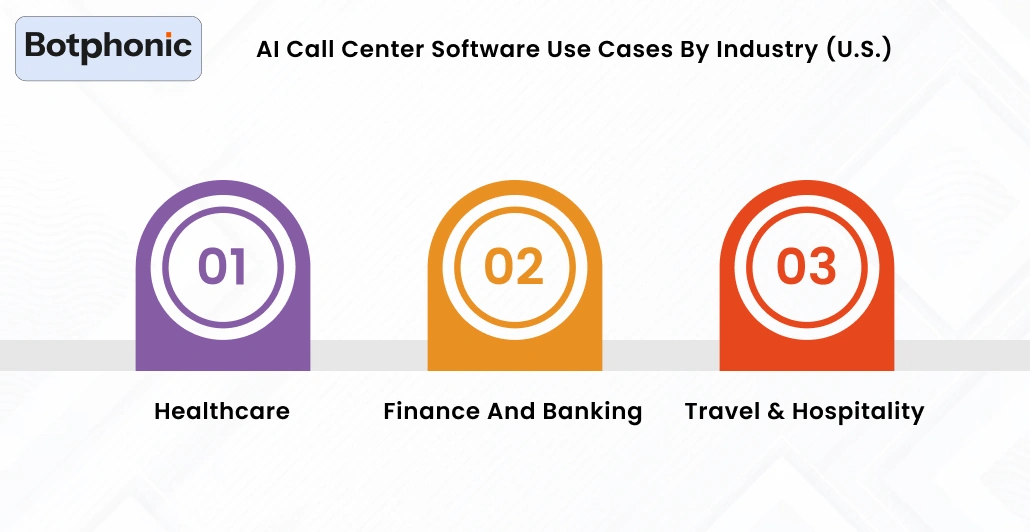
AI-driven call center software is changing how the interaction is being made via businesses to customers across various sectors. For U.S. companies, the value is clear, whether it’s reducing costs, improving services, or just ensuring compliance, AI call center trends aren’t just present but offering major operational benefits.
1. Healthcare
- Appointment Scheduling and Reminders
AI-powered systems handle appointment scheduling, confirmations, and even reminders, reducing the burden on human agents. Patients can easily book, reschedule, or just cancel the appointments as per their convenience via AI voice assistant.
- Patient Queries and Prescription Refills
AI systems actively answer common patient queries, such as symptoms, insurance verifications, or refills as well.
- HIPAA Compliance Monitoring
AI tools ensure that all calls are complying with HIPAA regulations by monitoring and flagging any breaches of patient confidentiality.
2. Finance and Banking
- Account Inquiries and Balance Checks
AI handles all the routine inquiries including balance checks, transaction history and also loan status, which allows representatives to focus on more complex customer needs.
- Fraud Detection and Prevention
The systems always monitor for unusual account activity for security breaches and flags potential fraud in real time.
- Loans and Mortgage Application Assistance
Guides customers through the loan or mortgage application processes, and answers frequently asked questions while assisting them in document collection.
3. Travel & Hospitality
- Booking Assistance
AI chatbots or voicebots helps handle booking inquiries and helps customers select flights, hotels, and vacation packages based on their preferences and availability.
- Itinerary Updates and Notifications
The system notifies
customers of flight delays, gate changes, or even if its weather disruption, proactively while also offering rebooking assistance when required.
- Customer Support & Feedback Collection
AI call assistants gather feedback, address common queries, and even resolve issues ranging from booking errors to complaints, while improving overall customer satisfaction.
AI Call Center Software vs Traditional Call Centers
| Feature | AI Call Center Software | Traditional Call Centers |
| Cost Efficiency | Automates tasks, reducing staffing costs. | Higher labor costs due to human-driven processes. |
| Scalability | Easily scales to handle fluctuating call volume. | Requires manual staffing adjustments, limiting scalability. |
| Customer Experience | 24/7 availability with fast, personalized AI responses. | Limited to business hours, slower response times. |
| Speed | Instant responses, reducing wait times. | Slower, with longer wait times for agents. |
| Automation | Automates common queries (e.g., orders, account info). | Mostly manual, with minimal automation. |
| First-Call Resolution (FCR) | Higher FCR with smart call routing and AI assistance. | Lower FCR, often requiring multiple transfers. |
| Agent Productivity | Real-time AI support boosts agent efficiency. | Lower productivity due to manual handling of all tasks. |
| Compliance & Risk Management | Automated monitoring for compliance and risk flagging. | Manual compliance checks, higher risk of errors. |
| Data Analytics | Real-time insights from AI analytics. | Limited actionable insights, relying on feedback surveys. |
| Training | Faster onboarding with AI-driven guidance. | Longer onboarding with extensive training. |
| Flexibility | Supports multiple channels (voice, chat, email). | Primarily voice-based, limiting flexibility. |
Try Botphonic Demo And See Results.
Try Demo Now!!Conclusion
AI call centre software is a major asset for U.S. businesses actively providing a powerful solution for reducing costs, improving customer experiences, and also driving operational efficiency.
By automating routine tasks, enhancing agent productivity, and while offering personalized service, AI actively empowers call centers to meet the growing demands of clients. Some reports have stated that about 90% of contact centers are planning to increase their investment in AI over the next two years.
As companies have started to embrace AI, they are not only gaining operational efficiency but an ability to provide a seamless, and data-driven customer service experience. Transitioning from traditional AI-powered call centers is a smart strategic move towards future-proofing business.