Summarize Content With:
Quick Summary
AI-powered call centers are changing customer support, but one should know success depends on tracking the real and right metrics.
In this guide we will see 9 most important AI call center performance metrics, they are grouped by operational efficiency, customer experience, AI accuracy, and cost & ROI. These metrics help businesses in measuring AI call center KPIs, optimize automation, and prove real business impact.
Introduction
AI has changed the way success used to get measured. It has become an essential component of modern contact centers. From voice bots and virtual agents to automated IVR systems, AI is effectively managing millions of customer interactions. However, deploying AI never guarantees better outcomes.
To scale and improve your customer support, companies should track AI call centre performance metrics that reflect efficiency, experience, intelligence, and even financial value. Contrary to those traditional call center reporting, AI contact center metrics focuses on how well automation understands intent, resolves issues, and reduces customer effort, while smartly delivering ROI.
What Are Call Center Metrics?
Call center metrics are quantifiable measurements that are used to evaluate how effectively a call center manages customer interactions. They even help organizations track performance, identify bottlenecks, and even help improve operational efficiency and customer experience.
In earlier periods, call center metrics focused on agent productivity and call volume. But in modern, AI-powered environments it has transformed into AI call center performance metrics that also measures automation effectiveness, conversational quality, and business impact.
The Role of Call Center Metrics in Modern Support Operations
Call center metrics have always served as the foundation for decision-making in customer service. It actively provides visibility into what actually is working and what’s not. Most importantly, it also helps in acknowledging where improvements are actually needed.
By analyzing call center metrics, organizations can easily:
- Improve customer satisfaction
- Identify operational inefficiencies
- Balance automation with human support
- Align customer support performance with business goals
- Measure the impact of AI and transformation schemes
Traditional Call Center Metrics vs AI Call Center Metrics
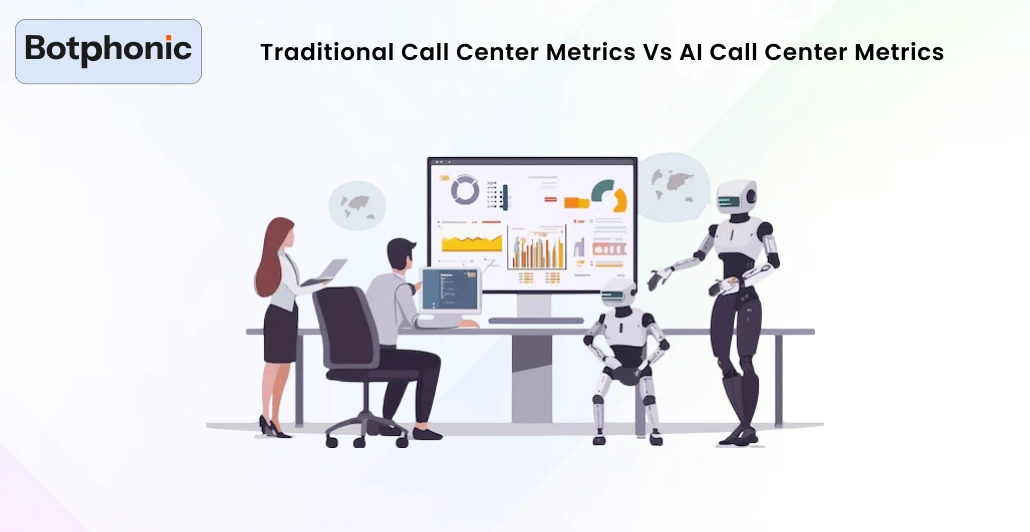
As customer support has evolved from human-only operations to AI-powered contact centers, the way performance is measured has also changed. While traditional call center metrics has always focused on agent productivity and call volume, AI call center performance metrics evaluate the automation effectiveness, conversational quality, and even business outcomes.
Understanding the variance between these two methods is critical for organizations modernizing their customer service operations.
Traditional Call Center Metrics
Traditional call center metrics were designed to manage and optimize human agent performance. These metrics focus on efficiency, staffing, and service levels rather than automation quality and intelligence.
Common Traditional Call Center Metrics Average Handle Time
- (AHT): Helps in measuring how long agents expend on each call
- Calls Handled per Agent: Assists in tracking agent productivity
- Service Level: Percent of calls responded in a defined time
- Agent Occupancy Rate: Evaluates how busy agents are during working hours
- Abandonment Rate: Traces how many visitors usually hang up before even reaching an agent
Limitations of Traditional Metrics
While these metrics are useful, traditional metrics have clear limitations, such as they usually:
- Focus on speed over resolution quality
- Offer little insight into customer effort or satisfaction
- Do not measure automation or AI effectiveness
- Fail to explain why actually issues are occurring
These metrics are generally insufficient for evaluating modern and AI-driven customer support environments.
AI Call Center Metrics
AI-powered call centers usually need a broader and more-focused measurement framework. AI call center performance metrics usually go beyond activity tracking and evaluating how well the AI system is understanding, resolving, and enhancing customer interactions. By 2030, it’s stated that 80% of customer interactions will be managed by AI.
Common AI Call Center Metrics
- Call Containment Rate: Percentage of issues that have been resolved by AI without any human intervention
- Intent Recognition Accuracy: Evaluates how accurately AI is understanding client’s requests
- First Call Resolution (FCR): Whether issues are getting resolute in the first interaction itself
- Customer Satisfaction Score (CSAT): Customer perception of AI interactions
- Customer Effort Score (CES): How easy it is to resolve an issue using AI
- Escalation Rate to Human Agents: Frequency of AI handoffs
- Cost per Contact: Financial impact AI-handled interactions has made
- Automation ROI: Business value that has been generated from AI adoption
These metrics help curate a foundation of AI contact center metrics, virtual agent performance metrics, and call center automation metrics.
Key Differences Between Traditional and AI Call Center Metrics
| Area | Traditional Call Center Metrics | AI Call Center Metrics |
| Primary Focus | Agent productivity | Automation effectiveness |
| Measurement Style | Activity-based | Outcome-based |
| Customer Insight | Limited | Deep (CSAT, CES, sentiment) |
| Intelligence Tracking | Not applicable | Intent accuracy, learning performance |
| Scalability Measurement | Headcount-driven | Automation-driven |
| ROI Visibility | Indirect | Direct and measurable |
Essential Performance Metrics For Smart AI Call Center
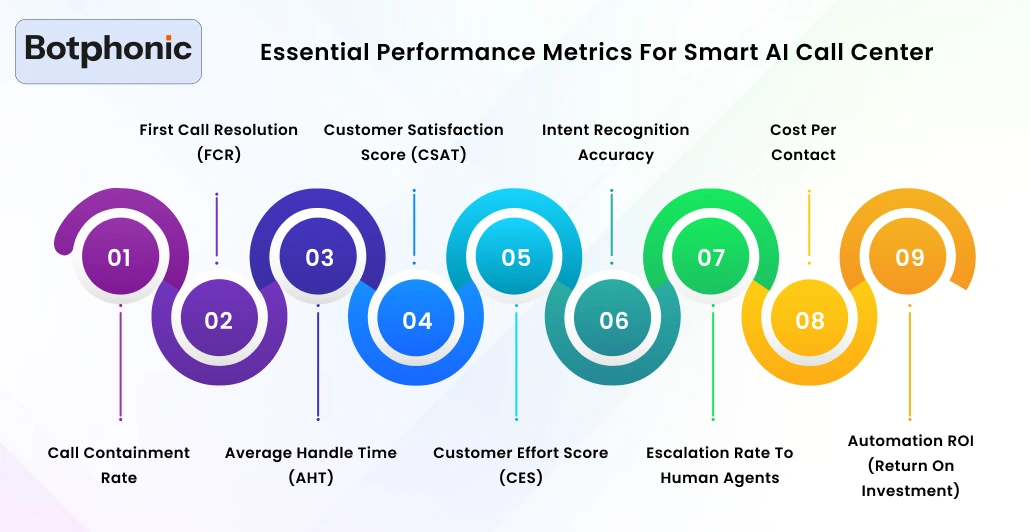
To optimize your AI call center, you need to focus on the AI call assistant you have chosen and it’s performance metrics that goes beyond basic operational efficiency. The right metrics help you evaluate not only AI call center KPIs but also customer satisfaction, automation effectiveness, and ROI.
The metrics are grouped into four key categories, such as:
- Operational Metrics
- Customer Experience Metrics
- AI Intelligence & Accuracy Metrics
- Cost & ROI Metrics
Operational Metrics
Operational metrics helps businesses assess how efficiently AI systems manage interactions, resolve issues, and scale. These are one of the critical evaluation metrics for AI contact center metrics.
1. Call Containment Rate
The call containment rate helps in measuring the number of calls that have been resolved by the system without requiring escalation to a human agent. It is also one of the most important metrics for AI call center success because it directly impacts both operational efficiency and cost reduction.
Why It Matters:
- High containment rate signals that AI is able to resolve a significant amount of customer issues autonomously.
- Low containment rates might indicate gaps in the AI’s ability to manage complex issues, which requires additional training or improved decision trees.
2. First Call Resolution (FCR)
First call resolution measures the ability of AI or human agents to resolve a client’s issue during the first interaction. This metric is also a critical indicator of both AI contact center metrics and overall customer service performance.
Why It Matters:
- High FCR rates are usually correlated with increased customer satisfaction and lowered support costs.
- In AI-driven environments, FCR also reflects the quality of AI’s intent recognition and how good it actually is to resolve queries without needing any escalation.
3. Average Handle Time (AHT)
Average Handle ime is used for measuring average time taken to resolve a customer issue, it measures the moment calls or chat has begun until the resolution is received. This metrics also help assess the efficiency of your AI call center automation.
Why It Matters:
- Lower AHT indicates that the AI is resolving issues smartly without any making customer interactions unnecessary longer.
- However, too low AHT might even show rushed interactions or incomplete resolutions so balancing speed with quality is key.
Customer Experience Metrics
Customer experience metrics are essential to understand how customers perceive their AI-driven interactions and how satisfied they are with the process.
4. Customer Satisfaction Score (CSAT)
Customer Satisfaction Score evaluates the customer’s overall satisfaction with their interaction made with AI. It is usually collected after an interaction through post-call surveys or chat rating systems.
Why It Matters:
- CSAT is considered as key metric that explains how well your AI-powered contact center is meeting customer expectations.
- Low CSAT can easily indicate that AI responses were not enough or that customers had to add more effort that expected to get a solution.
5. Customer Effort Score (CES)
Customer effort score measures how easy it is for clients to get their issues resolved, moreover, it also focuses on the effort the customer had to put in during their interaction with AI or human agents.
Why It Matters:
- Lower CES is indicative of a seamless experience where customers can get answers or resolutions with minimal effort.
- High CES usually correlates with frustration or dissatisfaction, which could easily lead to higher churn or negative sentiment.
Learn more: AI Call Center Architecture: Technical Overview
AI Intelligence & Accuracy Metrics
6. Intent Recognition Accuracy
Intent recognition accuracy is sued for measuring how well the AI understands the intent behind a customers’ query. High accuracy is important for providing relevant and accurate responses to client’s requests.
Why It Matters:
- Accurate intent recognition helps you ensure that AI provides the right answers the first time, which smartly improves call containment rate and FCR.
- Poor intent recognition can lead to incorrect responses, customer frustration, and also increased escalation rates.
7. Escalation Rate to Human Agents
This metric assists in tracking how often AI hands off interactions to human agents, which indicates the limitations of the AI’s capabilities.
Why It Matters:
- Low escalation rates are often a sign that implies that AI is handling most queries autonomously, that saves costs and improves efficiency.
- High escalation rates might also indicate that the AI is not trained to manage complex issues.
Cost & ROI Metrics
Cost and ROI metrics help measure the financial impact and return on investment from adopting AI in your call center.
8. Cost Per Contact
Cost per contact calculates the average cost of each interaction that is managed by AI, it also includes infrastructure, AI model training, and maintenance.
Why It Matters:
- Cost per Contact is one of the critical metrics for measuring the cost-efficiency of AI adoption.
- A low cost per contact implies that AI is effectively reducing the need for human agents and optimizing support costs.
9. Automation ROI (Return on Investment)
Automation ROI is used for measuring financial return from adopting AI in your call center. Moreover, it includes cost savings, productivity improvements, and customer satisfaction as well.
Why It Matters:
- High ROI proves that AI investments are paying off in various tangible results such as reduced operation costs and even enhanced customer services.
- Low ROI usually indicates that the AI system is underperforming, which requires further optimization or training.
The 9 essential performance metrics that are outlined above are the building blocks of any successful AI-powered call center. By tracking AI call center KPIs, businesses can easily optimize their call center automation metrics, improve customer experience, and ensure a strong return on investment from their AI initiatives.
 NOTE
NOTE
How to Use AI Call Center Metrics for Continuous Optimization
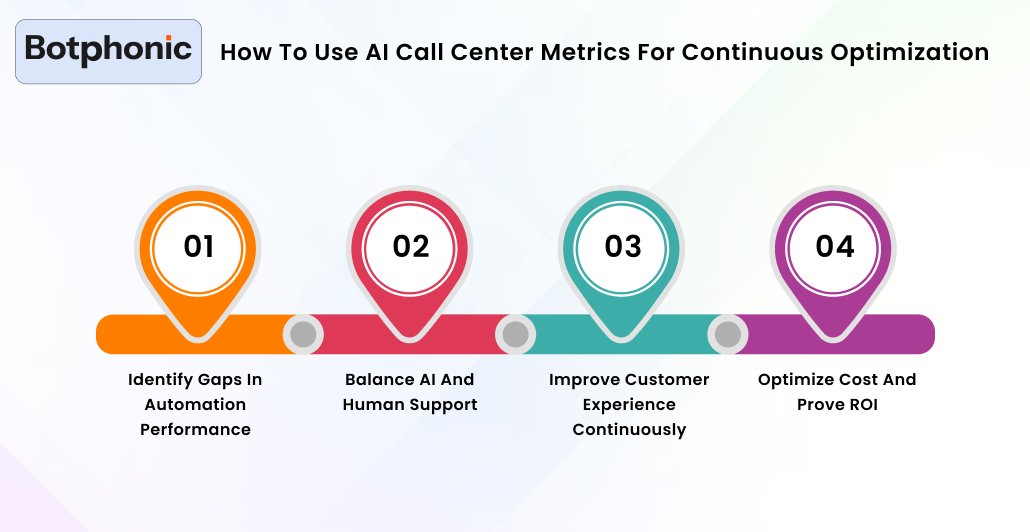
To track AI call center performance metrics is not an easy task also it’s not a one-time activity. Moreover, the real value can only be evaluated when these metrics are used continuously to optimize workflows, improve AI intelligence, and enhance customer experience. Implementing an AI call center for your business isn’t enough if you are not optimizing it.
Let’s see how businesses can easily use AI call center KPIs for ongoing improvement:
1. Identify Gaps in Automation Performance
Analyzing metrics like call containment rate, intent recognition accuracy, and escalation rate, businesses can easily verify where AI is failing to resolve their customer’s issues. These insights even help teams to:
- Retrain their AI models with real conversation data
- Expand the intent libraries and dialogue flows
- Improve AI decision-making logic
This helps ensure that your AI call center automation is becoming smarter over time.
2. Balance AI and Human Support
AI call center metrics help companies to strike the right balance between automation and human touch. Metrics like FCR and Customer Effort Score (CES) implicates when AI should manage queries independently and when seamless escalation to human representative is necessary.
Moreover, this hybrid approach enhances the overall efficiency without even compromising customer satisfaction.
 PRO TIP
3. Improve Customer Experience Continuously
Customer experience metrics like CSAT and CES usually helps by providing direct feedback on how customers actually perceive AI interactions. Monitoring these trends in these metrics allows businesses to:
- Refine their AI conversational tone and responses
- Reduce repetitive questions and unnecessary steps
- Personalize AI-driven interactions
4. Optimize Cost and Prove ROI
Metrics such as cost per contact and automation ROI helps leadership teams in justifying AI investments, Even regular evaluation ensures:
- Support costs are reduced consistently
- AI adoption aligns with business growth goals
- Automation helps in delivering measurable financial value
AI-powered call centers have changed whole modern customer support , but you should know success depends on how effectively the performance is measured and optimized.
Conclusion
Focusing on these 9 essential AI call center performance metrics, that covers operational efficiency, customer experience, AI intelligence and cost & ROI, businesses can easily gain complete visibility into their AI contact center performance.
By tracking the right AI call center KPIs, virtual agent performance metrics, and call center automation metrics, organizations can easily improve issue resolution rates, enhance customer satisfaction, reduce operational costs, and maximize return on AI investments.
If you are not tracking your AI call center metrics yet, it’s time to start.
Try Botphonic Today!!