Summarize Content With:
Quick Summary
This blog will cover topics including AI call center meaning, AI-supported communication in customer experience enhancement, the cost-efficient availability of AI call centers 24-7, and offering personalized support. AI call centers simply put are working in varied sectors all around the world. We will also discuss the stories to show that AI is not just the future, but the trend of customer interaction.
Introduction
An AI call centre is a modern customer support system powered by artificial intelligence that automates inbound and outbound interactions. Understanding the AI call center meaning, real-world use cases, and measurable business impact helps organizations reduce costs, scale support, and improve customer experience. To put it simply, at its core AI-powered call centers effectively use machine learning, natural language processing (NLP), and even speech recognition technologies.
So, how do you think AI call centers work? And, what kind of effect do they have in business practically? We will delve into what AI call centers are, how they actually work, and the mass potentials they have.
AI Call Center Meaning: What Is It?
The AI call center denotes a customer-support mechanism in which intelligence technologies heavily integrate themselves into call-center operations to handle inquiries, resolve issues, and even provide assistance. The AI perspective within these domains usually combines technologies such as Natural Language Processing (NLP), Speech recognition, and even Machine Learning to process a client’s request and offer prompt response.
An AI-powered call center offers way more than just basic automation. It basically optimizes these technologies to provide smart and efficient personalized service experience. These systems can handle everything from answering FAQ to troubleshooting common issues, even without the requirement of switching agents for the easy tasks.
Key Components That Make AI Call Center Functioning:
- Chatbots: AI chatbots integrate with customers through either text or voice. Furthermore, they can automate processes like account inquiries, appointment scheduling, and effective product recommendation.
- Speech Recognition: This technology allows AI to understand a customer’s spoken language actively, thus enabling the automation process of voice-based customer interactions.
- Machine Learning: AI systems improve their responses to and learn from past interactions by using historical data; therefore, providing better and more accurate assistance as time goes by.
- Omnichannel Support: AI call centers are designed to work across not one, but many channels, including social media, phone, email, and chat ensuring a consistent customer experience no matter where they reach out.
The Game-Changers: Groundbreaking AI Use Cases
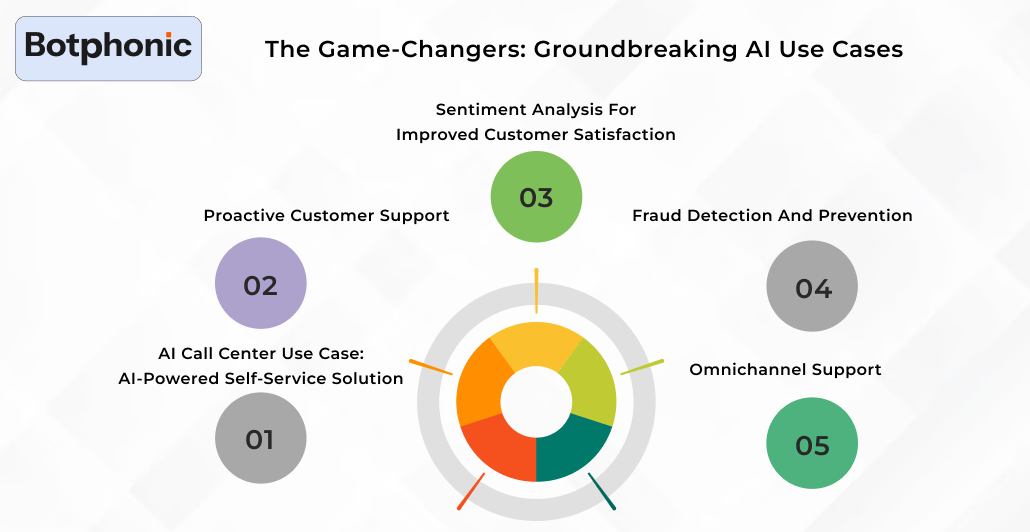
AI isn’t only improving the efficiency of call centers but it’s also creating new possibilities for customer interaction. Here are some use-cases that just proves the worth of AI in call centers:
1. AI-Powered Self-Service Solutions
Customers like to solve their issues on their own, without having to talk to anyone. AI call centers are effectively meeting this demand by offering advanced self-service. Solutions via chatbots and voice assistants. These systems even help you handle a wide range of issues, including troubleshooting and password resets.
For example, interactive voice response (IVR) systems that utilize AI can easily instruct customers through troubleshooting steps. Or, it might even direct them to the appropriate department, effectively eliminating the need for long hold times and improving efficiency.
2. Proactive Customer Support
AI can easily predict potential issues or needs even before a client asks for them. Using predictive analytics, AI systems can analyze historical data and even identify patterns, such as frequent service issues or other upcoming subscription renewals. Moreover, it also allows businesses to offer proactive support, addressing problems before they even escalate.
3. Sentiment Analysis for Improved Customer Satisfaction
Sentiment analysis is one of the smartest applications. By analyzing the emotional tone of customer interactions, AI can easily assess customer sentiment in real-time and route the conversation to the appropriate agent. For instance, if a customer is frustrated if angry, AI can escalate the issue to a human agent instantly, who can handle the situation with empathy.
4. Fraud Detection and Prevention
AI systems can also help you in detecting and preventing fraud just by analyzing speech patterns, detecting anomalies in customer behavior and even cross-checking responses against other known fraud indicators. Moreover, this helps provide an added layer of protection in industries like, healthcare, finance, insurance, and even in telecommunications.
5. Omnichannel Support
With customers interacting across a number of channels, AI call centers are also designed in reference to that. They are operating across not just one but many channels such as social media, phone, email, and chat.This omnichannel approach ensures that customers are getting to contact business through their preferred medium without even losing any context.
These AI call center use cases show how enterprises and SMBs use AI-powered call center software to improve resolution rates and reduce missed calls.
Case Studies of Disruptive AI Call Center Success
Now let’s look at some companies that are just leading the way with AI call centers and how even they are successfully integrating AI to drive operational efficiency and even enhancing customer experience.
1. Bank of America’s Erica
Erica is a virtual assistant that provides financial assistance to clients. Effectively using artificial intelligence along with advanced mechanisms, such as natural language processing and machine learning, it analyzes words and understands client’s queries. For instance, checking balances, facilitating transactions, and more. Moreover, it also provides personalized insights to help manage cash flow.
2. Vodafone’s TOBi
Vodafone’s AI assistant, TOBi, is a customer-focused virtual assistant driven by GenAI. It’s designed in a way that can handle a number of concurrent clients solving their queries instantly. TOBi’s integrated across different channels, including voice, social media,and even chat, providing a seamless experience to customers. Moreover, as a result, it has also increased first-time resolution from 15% to 60%.
3. InfluxJuice
InfluxJuice is a marketing agency that deployed a Botphonic AI call assistant for their client, who used to miss a number of calls every week. There were many calls outside business hours, or some just went unanswered because employees weren’t available. Within one month of deployment they saw significant results, such as missed calls dropped by over 60% and their client saw about 25% increase in lead follow-ups.
 NOTE
NOTE
Measuring the Effectiveness of AI Call Centers: Metrics and KPIs
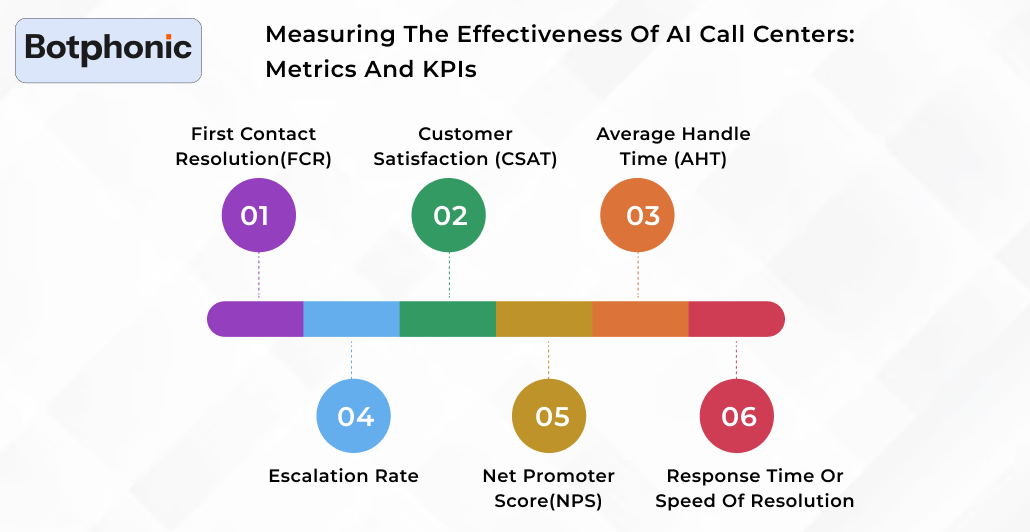
As businesses have continued to adopt AI-powered call centres, it has really become essential to assess its performance and effectiveness. Moreover, AI brings undeniable benefits like scalability, cost savings, and enhanced customer experience. Businesses need measurable metrics and Key Performance Indicators (KPIs) to ensure that their AI call centers are delivering expected results.
Let’s explore the most relevant metrics and KPIs that businesses can use to measure the effectiveness of AI-driven customer support systems.
1. First Contact Resolution(FCR)
First contact resolution measures the percent of client issues that have been solved on the first interaction, without even requiring follow-up. For AI call centers, this metric is particularly crucial because it directly relates to the efficiency of the AI call assistant in managing client’s queries.
2. Customer Satisfaction (CSAT)
Customer satisfaction is the most direct way to measure a client’s sentiment after an interaction. In an AI call center context, CSAT surveys can also be sent instantly following an AI-driven interaction. The systems that are tuned responsibly to acknowledge and answer responsibly to client’s queries with accuracy and empathy can enhance CSAT score effectively. Moreover, AI can also use sentiment analysis to detect dissatisfaction in real time and escalate to a human agent if required.
3. Average Handle Time (AHT)
Average handle time is usually referred to the average duration of an interaction between a client and the AI system. Meanwhile, it includes all the factors such as hold times, talking time, and after-call work as well. In AI call centers, AHT can even be significantly reduced to traditional human agents, as AI can process them at once and instantly, too. AI’s ability to handle and automate a high volume of calls without fatigue effectively reduces overall AHT.
4. Escalation Rate
The escalation rate estimates the percent of AI interactions that are directed to human agents. While AI can easily manage numerous queries, but complex or emotional issues might still need human intervention. A low escalation rate indicates that AI is easily managing all the customer interactions, essentially saving on the cost of human agents, whereas high escalation rate may indicate the opposite.
 PRO TIP
5. Net Promoter Score(NPS)
Net promotes score measures client loyalty and satisfaction by asking them how likely it is to recommend the service to others. It’s more like a long-term measure to how well AI is meeting customers’ expectations. If the AI systems is capable of providing fast, accuratem and empathetic responses to the client instantly, it will boost NPS significantly. Moreover, it also drives higher customer retention and word-of-mouth promotion.
6. Response Time or Speed of Resolution
Response time helps in measuring the time it took an AI system to respond to inquiry, whereas speed of resolution is focused on how quickly AI is able to resolve the query from start to finish. In call centers, speed is a critical aspect that ensures a assured customer experience. Moreover you should know AI excels at providing fast response to client’s queries by automating processes. For instance, answering FAQs, instructing them throughout troubleshooting steps, and even handling simple requests. Meanwhile, it leads to instant gratification for customers and reduced resolution times.
Test, Measure, and Optimize With Botphonic AI Today
Try Botphonic Demo Now!!Common Mistakes to Avoid
- Deploying AI without aligning it to business goals
- Automating everything on day one
- Ignoring customer feedback post-deployment
- Treating AI as a replacement instead of a multiplier
- Failing to update intents and responses regularly
If any of these sound familiar, pause. Fix the foundation first.
Conclusion
We have read about what is an AI call center and AI call center meaning is. Furthermore, we have also discussed how they have taken the center stage with their efficiency and speed. From enhancing operational efficiency to augmenting customer satisfaction, it has proven its value. Integration of smart innovations such as, natural language processing, and speech recognition enables AI systems to not only streamline operations but also deliver a personalized and responsive customer experience.
However, it’s also crucial to remember AI is not here to replace human agents but to complement them. By managing simple tasks and providing 2/7 availability, it frees them to focus on high-value tasks. AI’s role in personalizing customer service and predicting customer needs will only grow, further blurring the lines between automation and human empathy.