Summarize Content With:
Quick Summary
In this article, we are going to explore the essential elements of a productive-ready AI call center demo. It emphasizes how it should align with the real-world operations and challenges faced by call centers.
Moreover, it has also covered the importance of intelligent call routing, AI-powered automation, compliance and data security. We have highlighted the key performance metrics and explained that we should be involved in evaluating the demo to ensure it’s addressing both operational needs and business goals.
Introduction
To enhance customer service, call centers and businesses have started adopting AI-driven solutions. It has become a forefront for the transformation. However, to benefit from the AI technology, it is important to evaluate demos that go beyond flashy features and focus on real-world call center operations.
A production-ready AI call center demo should reflect the operational realities of the contact center, adapting to unpredictable call volumes, managing skill-based routing while ensuring compliance with industry regulations. AI call center is now actively being optimized by businesses for managing inbound and outbound call support but before committing one should know what they need to do, why a demo is required and what are the evaluation metrics.
How Call Centers Actually Work
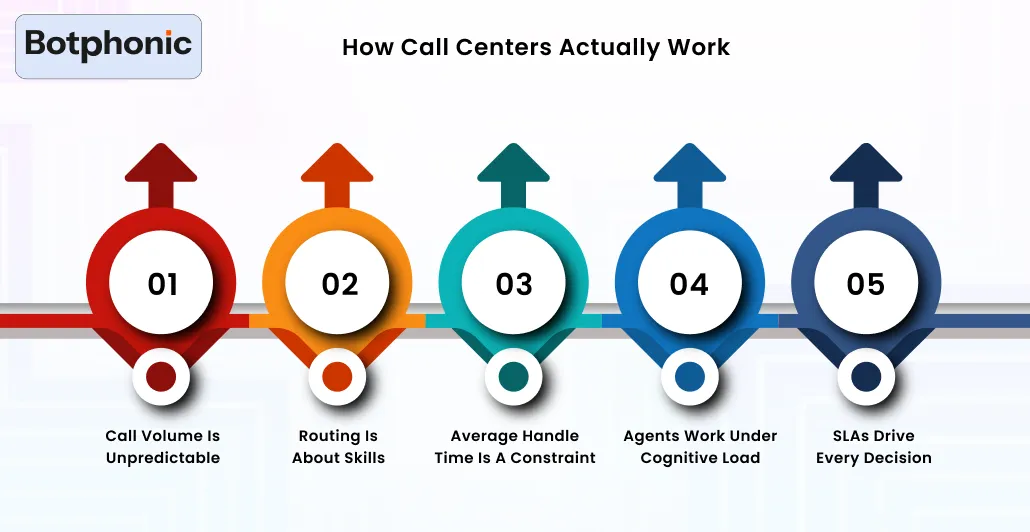
Call centers are operational machines which are built for consistency, cost control, and scale, not just experimentation. While modern tooling has evolved smartly, the foundational mechanics are remaining largely unchanged for one reason. An AI call center demo that ignores the mechanics is operationally irrelevant.
1. Call Volume Is Unpredictable
Inbound call demand fluctuates by hour, day, season, and also external events. Forecasting them can never be perfect, which only means that:
- Sudden queue spikes are normal
- Overstaffing is expensive
- Understaffing actively destroys SLAs and CX
And this is why workforce management systems, and overflow routing exist. AI voice assistant should be capable of adapting to volatility and not just assume smooth demand curves.
2. Routing Is About Skills
Calls are not routed randomly, but because of its pure availability. Most enterprise call centers rely on:
- Skill-based routing, such as language, product, compliance level, and more
- Priority queues for high-values or at-risk customers
- Tiered escalations paths, such as Tier 1 – Tier 2- Specialists
A competent AI call center software must integrate with this logic and not just flatten it with generic intent handling.
3. Average Handle Time Is a Constraint
AHT is often misunderstood by users. Shorter AHT isn’t always better but the main objective is to:
- Resolve the issue correctly
- Minimize re-contacts
- Protect downstream operations
And this is one of the main reasons why First Call Resolution (FCR) matters as much as speed. Any AI call center demo must show how automation improves outcomes without compressing those calls.
4. Agents Work Under Cognitive Load
Agents are juggling multiple systems such as CRM, billing, knowledge base, ticketing and more. Even compliance scripts and disclosures are hard to manage with emotional customers; it often leads to stressful interaction.
This environment explains why agent assist, real-time transcription, and automated summarization matter. AI that adds steps or friction can be rejected hastily.
5. SLAs Drive Every Decision
Everything in a call center rolls up to SLAs, like Service level, abandonment rate, compliance and audit readiness. If an AI call assistant is not aligning with SLA stability even temporarily, it’s not going to survive procurement. Respecting SLAs is table stakes for any contact center AI.
Core Components and What an AI Call Center Demo Should Prove
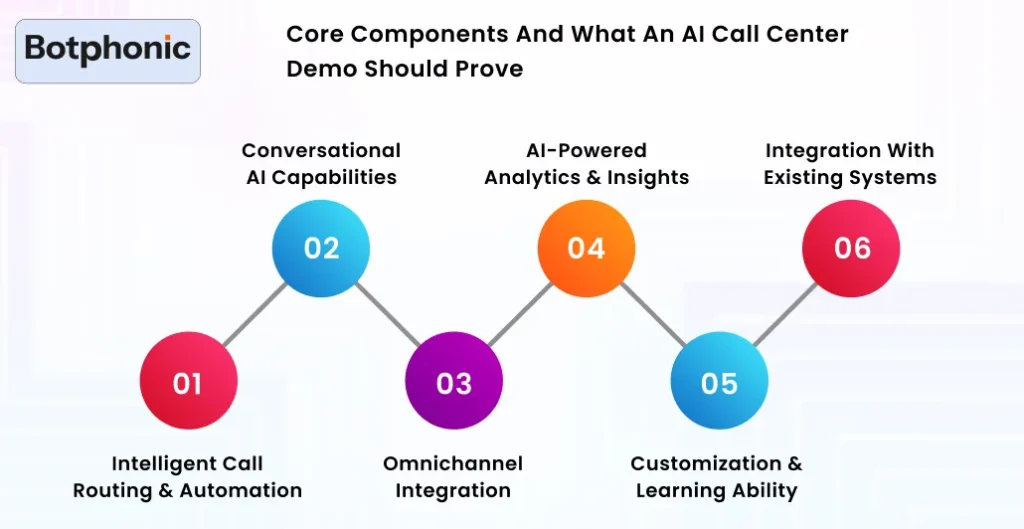
When evaluating AI call center software, a live demo is more than just a showcase, it becomes the proof that the platform can easily deliver measurable business outcomes. A well-executed demo should always be capable of answering key questions about automation, accuracy, scalability, and ROI.
Here’s what a high-quality AI call center demo should prove:
1. Intelligent Call Routing & Automation
The goal of showcasing intelligent call routing and automation should always be to present how accurately AI routes calls to the right agent or automated workflow. You should what to evaluate:
- Skill-based routing powered by AI intent detection
- Dynamic routing adjustments based on agent availability
- Reduced wait times and dropped calls
2. Conversational AI Capabilities
It helps in proving that the AI can easily handle real customer interactions naturally. The things you should evaluate are as follows:
- Accuracy of speech recognition
- Understanding and responding to complex queries using NLP comprehension
- Multi-turn conversations and context retention is shown
- Ability to escalate to a human agents effortlessly
3. Omnichannel Integration
Omnichannel integration helps us show how our AI Call Center Automation helps manage interactions on not just one platform but on numerous ones at once. Key evaluation metrics involve:
- Voice calls, chat, email, SMS, and social messaging support
- Unified conversation history for agents and AI
- Consistent response quality across channels
4. AI-Powered Analytics & Insights
It assists in showing that AI helps in adding actionable intelligence to customer interactions. You can also evaluate:
- Real-time sentiment and emotion analysis
- Call summaries and transcription accuracy
- Agent performance scoring and trend analysis
- Predictive insights for call volume and staffing needs
5. Customization & Learning Ability
It provides assistance in showing that AI can easily be tailored to your business needs. For evaluation, ensure to check:
- Training on company-specific language, terminology, or products
- Configurable AI workflows and scripts
- Ability to adapt to new customer queries over time
6. Integration with Existing Systems
It helps you show that the AI integrates smoothly with your tech stack. For evaluation, you can start with:
- CRM, ticketing, ERP, and knowledge base connectivity
- Data flow between AI and existing dashboards
- API and webhook support for custom automation
 PRO TIP
Data, Security, and Compliance: The Non-Negotiables
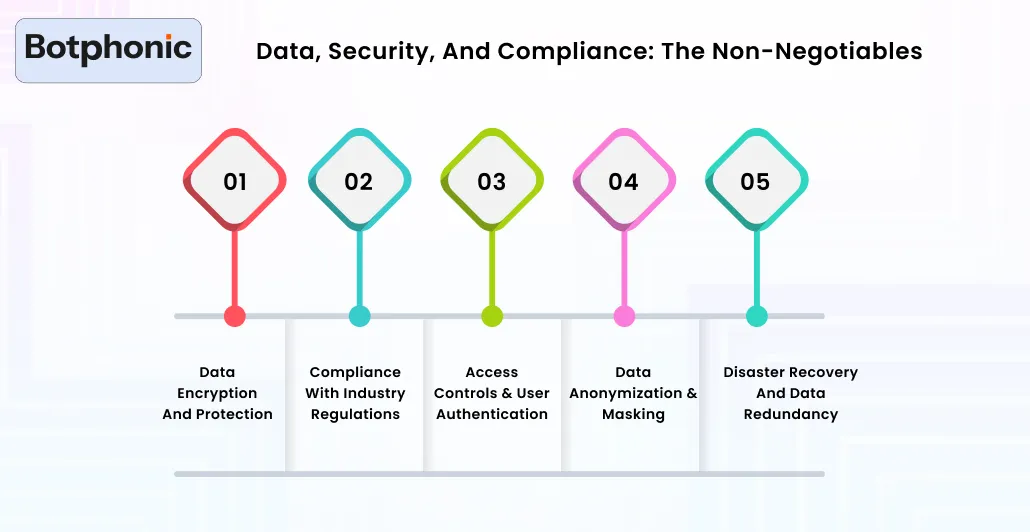
Modern customer service requires AI-powered call center solutions as mandatory operational standards because businesses need to protect their data while meeting compliance standards which have evolved into essential business requirements. The AI call center platform needs to be developed with data protection and regulatory compliance as its main elements because your organization handles three types of sensitive data which include customer information and regulatory compliance requirements and all other industry standards.
1. Data Encryption and Protection
The AI call center system needs strong data encryption because it processes valuable customer information which includes personal identifiable information and financial records and health data in order to defend against cyber threats.
Data becomes susceptible to interception by unauthorized parties when it travels through networks or rests in storage facilities without the protection of end-to-end encryption.
2. Compliance with Industry Regulations
Data privacy laws and industry-specific regulations require compliance because organizations must follow these requirements. AI call centers, especially those who manage sensitive customer data, need to comply with a range of local and global standards to avoid legal risks and penalties.
The organization faces major financial penalties and damage to its reputation and loss of public trust because it has failed to comply with regulations.
3. Access Controls & User Authentication
AI call centers usually provide access to multiple roles within the organization from agents and supervisors to administrators. The system uses granular access controls to protect sensitive data and critical configurations because only authorized users can access these areas.
4. Data Anonymization & Masking
Data anonymization and masking techniques serve as vital elements for AI systems which need to process sensitive information simultaneously. The AI model training process requires sensitive data to be masked or anonymized because it needs to protect sensitive information from being revealed.
5. Disaster Recovery and Data Redundancy
Server outages and cyberattacks and natural disasters and other unexpected events lead to data loss and service disruptions. The business will continue operating because there is a strong disaster recovery plan. The system enables customer data to remain secure and accessible during operational failures.
What You Need to Look For
1. End-to-End Data Encryption
Ensure that the platform is offering end-to-end encryption for data both during transmission and at rest, that actively protects sensitive customer information from unauthorized access or interception.
2. Compliance with Industry Regulations
Verify that the platform is adhering to industry standards such as GDPR, HIPAA, PCI DSS, and SOC 2, it ensures that customer data is managed in compliance with relevant data privacy laws and regulations.
3. Role-Based Access Control (RBAC) & Multi-Factor Authentication (MFA)
Check for RBAC to manage user permissions based on roles and MFA for additional protection of high-profile accounts, which ensures only authorized users can access sensitive data.
4. Continuous Security Monitoring & Vulnerability Management
Ensure to verify that the platform has real-time security monitoring, regular penetration testing, and automatic patch management to detect and respond to emerging security threats.
Performance Metrics That Matter in an AI Call Center Demo
The testing of AI call center software requires assessment of appropriate performance indicators which determine success in AI call center operations. The system demonstrates its fundamental function through its ongoing demonstration which assesses performance efficiency and operational effectiveness and customer contentment.
The main performance indicators show how effectively the AI system manages customer interactions and handles problem resolution and enhances complete business operations.
- First Call Resolution (FCR): FCR helps in knowing the percentage of client issues resolved during the first interaction with clients who require no escalation.
- Average Handle Time (AHT): AHR helps in representing the average amount of time the AI spends on each call which includes both speaking time and waiting time.
- Call Abandonment Rate: The metric tracks the percentage of calls that customers abandon before they get connected with either an AI system or a human representative.
- Customer Satisfaction Score (CSAT): CSAT is measured through customer feedback which requires customers to rate their level of satisfaction with AI help through surveys conducted after their interaction.
- Accuracy Rate (ASR/NLP): The AI system can correctly understand and interpret customer speech through ASR and customer written text through NLP.
- Sentiment Analysis Accuracy: It enables organizations to evaluate customer emotional states which include frustration and happiness and anger and several other feelings.
- Cost per Call: The total expenses for AI call processing include infrastructure costs and software costs and operational costs which are then compared against expenses for human agents.
- Call Volume Handled by AI: This metric shows the percentage of total call volume which AI has successfully managed without requiring human assistance.
The performance metrics function as essential benchmarks which evaluate how AI call center systems enhance customer interactions while improving business processes and minimizing financial expenditures. Companies can use these metrics to assess the financial returns and operational efficiency of an AI-powered call center system.
 NOTE
NOTE
Who This Type of AI Call Center Demo Is Actually For
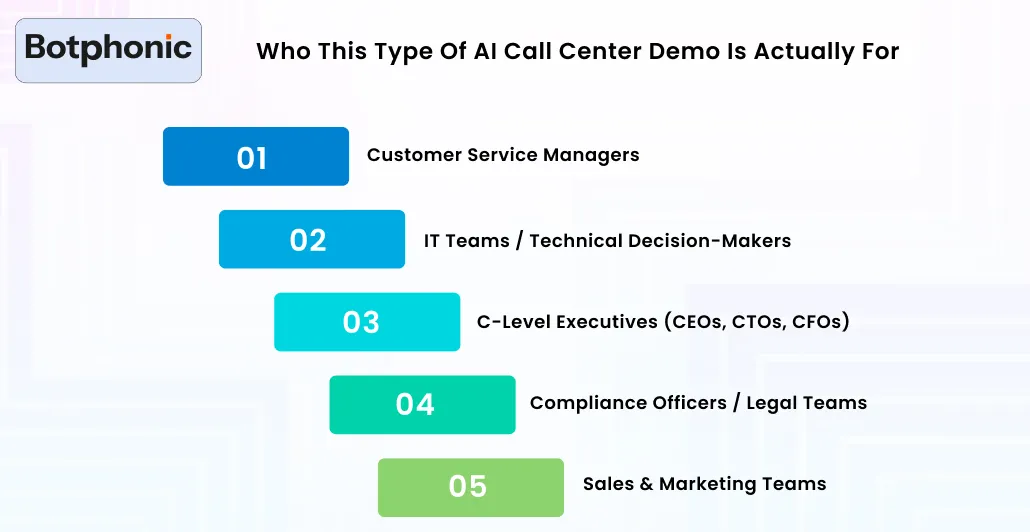
A production-ready AI call center demo isn’t just for tech experts but also for a wide range of stakeholders involved in decision-making and implementation processes. These demos are important for anyone who is looking to enhance customer service operations with AI. Here’s who should be part of the audience and how they benefit:
1. Customer Service Managers
Customer service managers are directly responsible for day-to-day operations of the call center. They need to assess how AI can streamline processes, reduce costs, and enhance customer satisfaction.
A demo helps managers in evaluating whether the AI solution can integrate seamlessly with existing workflows and support their team in meeting KPIs like First Call Resolution (FCR) and Average Handle Time (AHT).
2. IT Teams / Technical Decision-Makers
IT teams are usually responsible for ensuring that any new software solution integrates well with existing systems, such as CRMs, ticketing platforms, and communication tools. A demo offers them firsthand experience of system integration capabilities, scalability, and security features, ensuring the AI solution meets technical requirements.
3. Compliance Officers / Legal Teams
In highly regulated industries, such as healthcare, finance, and others, compliance officers are concerned with data privacy, security, and regulatory adherence. A demo allows them to verify whether the AI platform complies with GDPR, HIPAA, PCI-DSS and other relevant standards. Also, it helps them ensure that customer data is managed securely and legally.
4. Sales & Marketing Teams
Sales and marketing teams usually rely on custom interaction data to drive engagement and create personalized campaigns. By attending these demos, they can assess how the AI platform interacts with clients across multiple touchpoints. And it also gathers data via them and helps build better customer profiles. Even the ability to personalize customer experiences can improve both retention and conversion rates.
See how Botphonic works under real call volumes, real routing logics, and real compliance requirements.
Schedule Your Demo Today!!!Conclusion
The deployment of an AI-powered call center solution represents more than a simple technological improvement for customer service operations. The organization currently seeks a system which matches the actual requirements and daily operations of call centers. The demonstration of AI call center functions shows its system integration capability and real-time analytics delivery while providing agent support during mental workload situations.
An AI call center functions as an automation tool which improves efficiency through task automation while simultaneously transforming call center operations to deliver better customer and agent service.