Summarize Content With:
Quick Summary
AI call center architecture smartly modernizes customer service by changing rigid, agent-centric models with intelligent, software-defined systems smartly powered by conversational AI, machine learning, and real-time analytics. In this blog we’ll just deep dive into the technical components, architecture layers, integration strategies, and even future trends of AI call center systems.
Introduction
The customer service landscape has faced a long due shift in the adoption of AI-driven call center architectures. Traditional contact centers, were once reliant on human agents and static routing systems. But they are now actively getting replaced with intelligent and data-driven platforms. It uses machine learning, natural language processing, conversational AI, and predictive analytics.
These AI-powered systems or to put it simply, AI call centre is doing more than just handling routing queries. They work by actively optimizing interactions in real time, anticipate customer needs, and even deliver hyper-personalized experiences.
Understanding AI Call Center Architecture
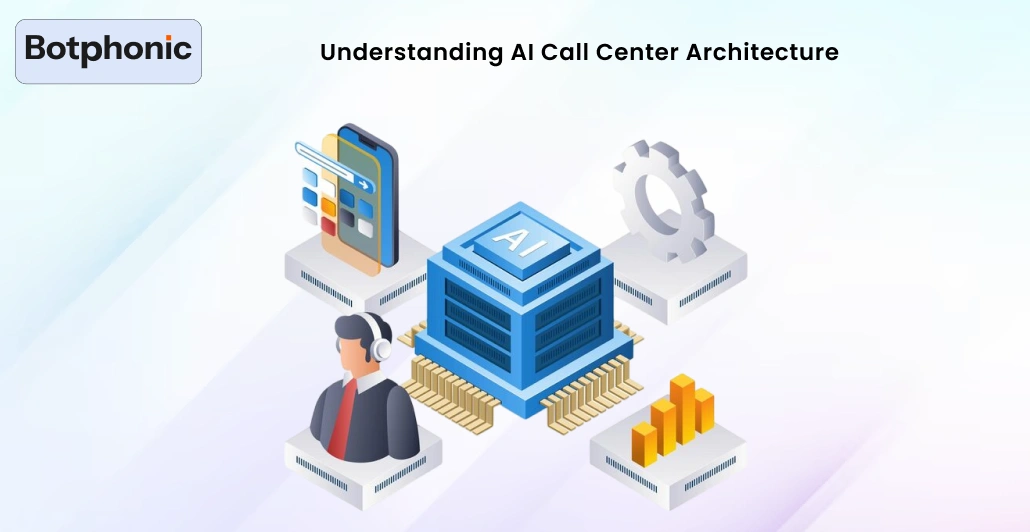
AI call center architecture is known as the end-to-end technical framework. It enables artificial intelligence systems to automate, analyze, manage, and even optimize customer interactions across all the channels, either voice or digital. Old contact center setups were built primarily based on telephony and human agents. Whereas, AI-driven architectures and software-defined, data-centric, and even intelligence-led.
At its core, AI call center architecture is usually integrated with speech technologies, machine learning models, and also real-time data pipelines, cloud infrastructure, and also enterprise systems to provide scalable, intelligent, and also context-aware customer engagement.
Learn more: What Is an AI Call Center? A Beginner’s Guide
Core Components of AI Call Center Architecture
The core components of AI call center architecture have always worked together to create a smart and intelligent automated interaction ecosystem. Speech recognition and NLP effectively form the foundation of conversational understanding, while AI-driven routing engines ensure that customer inquiries are managed smartly.
| Component | Description | Technical Role |
| Conversational AI | Voice bots and chatbots powered by NLP | Handles automated customer interactions |
| Speech Recognition (ASR) | Converts spoken language into text | Enables real-time understanding of voice calls |
| Natural Language Processing (NLP) | Interprets intent, entities, and context | Drives intelligent responses and routing |
| AI Routing Engine | Predictive call distribution system | Matches customers with optimal agents |
| Analytics & Insights Engine | Real-time and historical data analysis | Optimizes performance and customer experience |
| CRM Integration | Synchronizes customer data | Maintains unified customer profiles |
Architectural Layers in an AI Call Center System
AI call center architecture is usually designed into different layers that ensures scalability. The data layer ensures to capture and secure customer information, while the AI processing layer is applied to machine learning models. For effective speech recognition, intent detection, and sentiment analysis, it is used. AI call assistant usually works by using these layers:
| Layer | Function | Key Technologies |
| Data Layer | Stores and manages customer interaction data | Data lakes, CDPs, encrypted databases |
| AI Processing Layer | Performs real-time and batch AI inference | Machine learning models, GPUs, NLP engines |
| Application Layer | Interfaces with users and agents | IVR, chatbots, dashboards, APIs |
| Infrastructure Layer | Ensures scalability and reliability | Cloud platforms, Kubernetes, load balancers |
The application layer actively delivers AI capabilities through IVR systems, virtual agents, and also agent dashboards, all backed by just a cloud-based infrastructure layer used for performance and high availability.
 PRO TIP
AI Call Center Security and Compliance
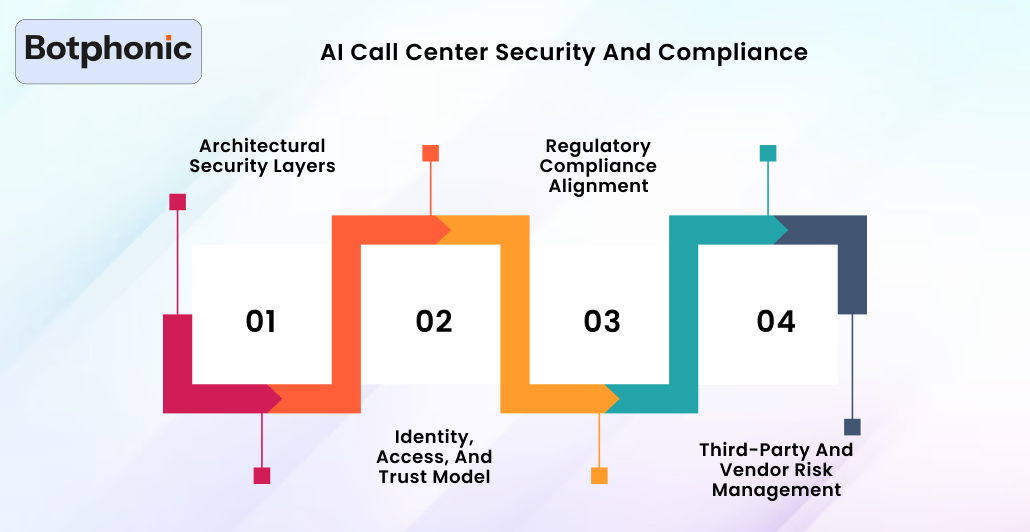
Security and compliance in an AI-driven call center are non-negotiable factors. For a smart AI call center, trust, privacy, and regulatory adherence are legitimate design inputs from day one along with latency, scalability, and cost.
1. Architectural Security Layers
The architects add security measures in each layer of the architecture. The system stops components from being left as unchecked attack vectors of influence. Each component isolates into its trust zones, such as voice channels, conversational AI services, orchestration engines, and data stores. The team defines and manages communication between these zones wisely.
Instead of a guesswork model, these architectures follow breaches, which limits lateral movement in the event of a breach. Thus, encryption, authentication, and authorization apply to all service boundaries. They provide the system with a layered security measure so that even if an attacker reaches one component, they protect the other components from adversaries and keep the whole system operational.
2. Identity, Access, and Trust Model
Identity is the spine of AI call center security. Each user, service, and agent acts as an identity with clearly scoped permissions. Role-based access is provided. Meanwhile, it ensures no identity can access more than needed to perform its task.
Organizations uniformly apply zero-trust by constantly authenticating and authorizing requests with or without an internal-controlled origin, thus mitigating possible credential misuse and insider threats while simultaneously providing easy evidence for audit during compliance.
3. Regulatory Compliance Alignment
The application of an architectural alignment meets compliance requirements. You can add common control patterns such as access logging, encryption, consent management, and retention policies.
By abstracting compliance into reusable architectural components, organizations can plug new regulations into their AI call center automation software without having to re-engineer core systems. Operational overhead are reduced, while compliance postings are consistently implemented.
4. Third-Party and Vendor Risk Management
Heavy reliance on third-party service providers exists within AI call centers, such as telecom carriers, speech recognition services, and AI platforms. Moreover, the architecture takes this dependency into account by demanding stringent limitations on third-party integrations.
The organization tightly manages vendor privileges. Moreover, with access control and auditing of vendor activities are access based on contract. Third-party breaches will not develop into enterprise incidents automatically.
 NOTE
NOTE
Benefits of AI Call Center Architecture
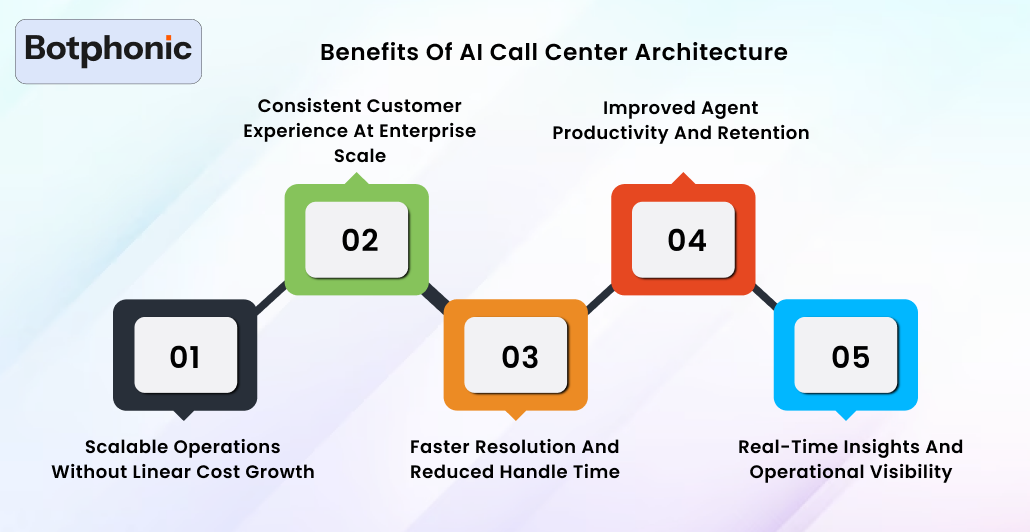
An AI call center architecture effectively delivers value. AI does not work by replacing humans but by smartly managing how people make conversations. When implemented with architectural discipline, it just becomes a durable operating advantage rather than a short-term automation experiment.
1. Scalable Operations Without Linear Cost Growth
Traditional call centers often scale by adding more agents, and requesting new space, while absorbing more overhead. AI call center software architectures disconnect the relation of customer demand from headcount growth. Automated intent recognition, virtual agents, and intelligent routing absorbs simple interactions, allowing human agents to focus on complex and high-value cases.
The result is predictable scaling. Call volumes can spike without triggering staffing crises or service degradation. From a financial point, it also converts a traditional variable cost model into one that is far more controlled and predictable.
2. Consistent Customer Experience at Enterprise Scale
Human-driven operations struggle with consistency. Tone, accuracy, and resolution quality usually vary by agent, shift, and region. AI-driven architectures smartly enforce standardized interaction logic while still enabling personalization.
By embedding compliance rules, policy, and best-practice workflows directly into call flows, organizations ensure that every client is receiving the same baseline quality of service.
3. Faster Resolution and Reduced Handle Time
AI architecture smartly reduces friction at every stage of the interaction. Real-time transcription, intent detection, and context retrieval eliminates the need for customers to repeat information and for agents to manually search systems during live calls.
Instead of relying on humans, decisions are now made automatically. Or they are just pre-qualified before reaching to an agent. The net effect is shorter calls, lesser escalations, and even faster resolution, without even rushing the customer.
4. Improved Agent Productivity and Retention
AI doesn’t replace great agents-it removes the worst aspects of their jobs. With the repetitive questions, data entry, and after-call documentation taken away, they can focus on solving problems and interacting with customers.
This makes them productive and, perhaps more importantly, less burned out-an underappreciated benefit in an industry known for losing people.
5. Real-Time Insights and Operational Visibility
AI call center architectures convert conversations into structured, analyzable data. Integrating AI call center software allows each interaction to generate insights into customer sentiment, product issues, process gaps, and agent performance.
With analysis occurring in near real-time, leadership can catch the emerging issues before they become systemic failures. This is the shift from reactive and fire-fighting to proactive optimization: a great leap for the operational maturity of the organization.
Explore how AI-driven call centers help you scale operations and improve customer satisfaction.
Contact Us Now!!Conclusion
AI call center architecture represents a smart shift from labor-driven customer service models to intelligence-led, software defined engagement platforms. By adding machine learning, conversational AI, real-time analytics, and also cloud-native infrastructure into the center of its contact center operations, companies are even moving beyond basic automation toward systems that smartly optimize the interactions, decisions, and outcomes. Routine workload of agents is expected to drop by about 1 hour, with smart AI call center architecture it’s definitely going to result positively.
A well-designed architecture balances innovation with discipline. Security, compliance, and also data governance are not just optional layers but they are structural elements that help enable trust, scalability, and regulatory confidence.