
Summarize Content With:
Summary
In this blog, we will explore that automation and voice AI aren’t the future anymore; they’re impacting how U.S. companies deal with customer phone calls. This blog details the latest statistics and trends. Moreover, we have discussed factors influencing the evolution of voice AI and the use of AI call assistants.
Introduction
Now imagine a world in which every customer call is answered promptly, accurately, and in your brand’s voice. That future is now a reality for U.S. businesses with the emergence of call automation and voice AI technologies. Moreover, including the growing adoption of an AI answering service across industries has helped significantly.
The most recent data is critical to business leaders, marketers, and customer experience managers. Smart data usage makes clear who is embracing voice AI, how quickly it’s growing, and where the real impact lies. Such insights enable organisations to make informed decisions and build successful customer service strategies. Moreover, it keep up in a market where demand for rapid, personalised service is increasing.
What Is Call Automation and Voice AI in Simple Terms
Call automation describes the process of software and technology taking care of phone calls and call-related activities. In its most basic form, call automation encompasses things such as Interactive Voice Response (IVR) and click-to-call routing. Including, smarter call queuing, and simple message playback.
Voice AI brings automation to a new level. Voice AI doesn’t just mechanically follow a script. Instead, it uses artificial intelligence to comprehend what the person calling says, respond accordingly, and execute tasks. For instance making appointments, answering frequently asked questions, or routing calls by intent. Voice AI relies on technologies like natural language processing and machine learning to sound more “human” and learn over time.
In essence:
- Automating calls accelerates the rest of our work.
- Voice AI is what gives those interactions a feeling of being natural and responsive.
 PRO TIP
Current State of Voice AI Adoption in the USA
The rate of Voice AI penetration has increased steadily in the US market. With many businesses now adopting AI as part of their business tools. The U.S. voice AI agents market, for instance, reached nearly $1.2 billion in 2024, with commensurately strong investments by companies looking to automate customer interactions and increase efficiency while preparing for the future of voice in U.S. customer support.
Meanwhile, the adoption of consumer voice assistants like Siri and Alexa has made folks more comfortable interacting with AI, which in turn will facilitate wider adoption in workplaces and customer service.
On top of which, workplace assimilation is on the rise. Around 12% of U.S. workers interact with AI in some way on a daily basis, while almost one-quarter use it multiple times per week.
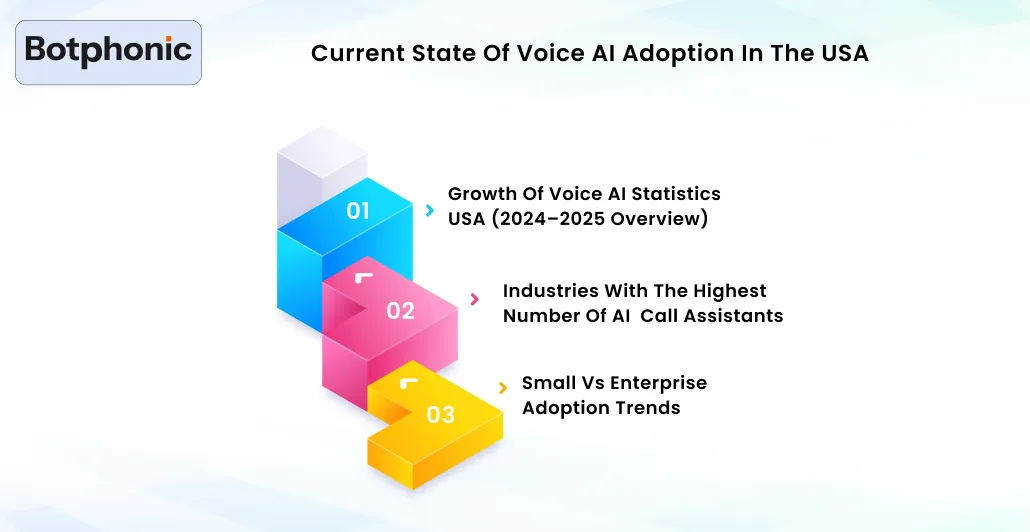
1. Growth of Voice AI Statistics USA (2024–2025 Overview)
The rise of voice AI: Adoption has been slow but steady in the U.S. (2024 to 2025). There will be 149.8 million adult users of voice assistants in 2024, increasing to 153.5 million in 2025, led by the spread of smart household devices and consumer comfort with AI-based encounters.
AI in call automation is also an expanding use case, from responding to basic customer inquiries all the way through setting appointments, lead qualification, and routing calls more effectively for businesses. That trend is indicative of a shift as AI goes from novelty to necessity, assisting companies in improving operational efficiency and providing faster, more accurate service.
2. Industries with the Highest Number of AI Call Assistants
Here are some U.S. industries that are using AI call assistant technology to great effect: AI in financial services . Financial institutions use AI in verifying accounts and handling customer inquiries, cutting waiting time, and bolstering security while meeting the growing need for AI compliance calls USA. Appointment reminders and follow-ups are automated, giving staff time to spend caring for patients.
Retail and e-commerce have availed themselves of artificial intelligence to manage order inquiries, returns, customer support, and telecom/customer service for managing high call volumes and quickly resolving issues. AI works best in industries with a lot of repetitive, high-volume calls to take, because it means companies can scale their operations without scaling up their personnel.
3. Small vs Enterprise Adoption Trends
There is a difference in adoption between the small businesses and the large ones. Organisations generally deploy AI call assistants at scale and integrate with CRMs and analytics systems to streamline operations and enhance understanding of customer interaction. SMBs have an eye for affordable tools to automate repetitive tasks such as confirming appointments, following up on missed calls, and providing simple client support.
<div class="learn-more-box-alt">
  <p>
    Learn more: <a href="https://botphonic.ai/botphonic-transforming-customer-support-usa/" target="_blank" rel="noopener">How Botphonic Is Transforming Customer Support in U.S. Small Businesses</a>
  </p>
</div>
Top Call Automation Statistics in the U.S. (2025–2026)
Call automation is not a nice-to-have feature that businesses can live without; it’s simply the new standard for any company looking to remain competitive in the U.S. market. By 2025, AI call assistants are expected to have penetrated the different industry sectors, providing support for organisations to manage thousands of calls quickly and improve overall service quality.
These are hard numbers that underscore the fact that AI is not just a fictional part of customer engagement and enterprise functioning.
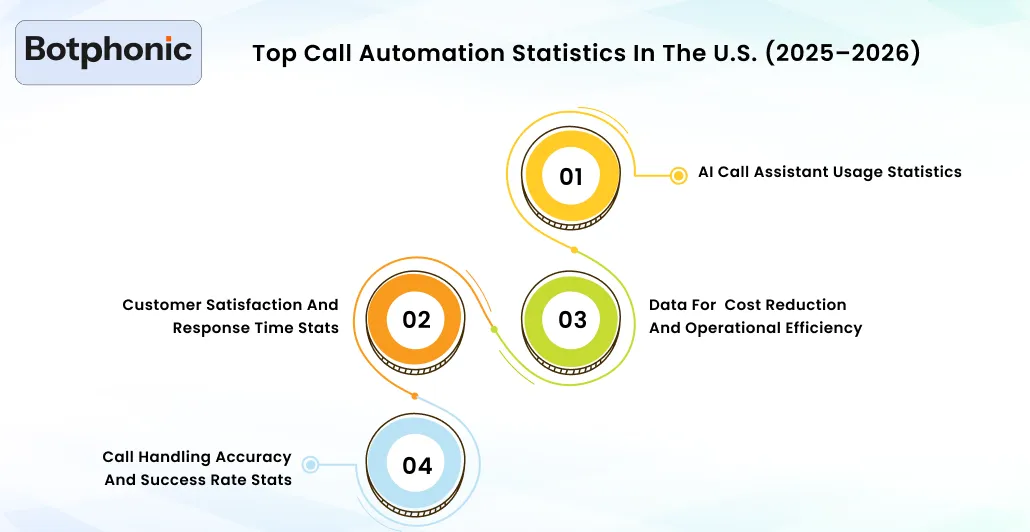
1. AI Call Assistant Usage Statistics
AI call assistants are quickly becoming a must-have for companies large and small. Latest data shows that by now, more than 40% of medium and large businesses in the U.S. are actively using AI call assistants to support customers and manage inbound calls internally. Companies are increasingly using these types of tools to manage routine calls, answer frequently asked questions, and route queries correctly. The adoption rate is increasing as NLU gets better, deployment times are faster (and easier), and it integrates easily with CRM systems.
2. Customer Satisfaction and Response Time Stats
Customer satisfaction is one of the biggest advantages of an AI call assistant. Companies that adopt voice AI are experiencing up to 30% reductions in average response times, ensuring callers can get the help they need without waiting on hold for long periods.
Customers who want a quick answer appreciate not having to wait, and those quick answers are associated with higher customer satisfaction scores. Furthermore, AI assistants can deliver answers that are consistently correct and eliminate frustration resulting from human error or conflicting information.
3. Data for Cost Reduction and Operational Efficiency
AI call automation also results in quantifiable savings. Businesses using AI call assistants see a 20-25% decrease in operational cost for call resolution of routine calls. By automating high-volume, routine inquiries, businesses can reallocate human agents to handle more complicated questions, ultimately minimising overall inefficiency. It also lessens training expenses. It takes virtually no one to train AI directly across a wide range of queries.
4. Call Handling Accuracy and Success Rate Stats
The accuracy with which Voice AI can read customer intent and execute calls has significantly improved. AI agents address 85-90% of calls on average. There are currently AI call assistants that can handle most of their calls without human intervention. The high success rate allows for that to happen, and the end result is that customers have an easy, reliable support system without putting more load on their shoulders. And as AI schedules have more experiences to learn from, the accuracy of AI call assistants continues to improve.
Upgrade to Botphonic AI and manage customer calls faster, smarter, and and on demand without staff increase. Begin automating your calls today and ensure that all of your callers get what they are anticipating.
Contact Us Today!How Voice AI Improves Customer Experience
Voice AI technology is revolutionising customer experience by delivering interactions that are faster, more reliable, and personable. Unlike traditional call systems, AI call assistants can multitask to fulfil several requests at once, they are available 24/7, and they continuously learn from past interactions to create customised responses.
1. Speedier Call Resolution via AI Call Assistants
AI call assistants expedite customer troubleshooting by deciphering the customer’s intent rapidly and providing accurate results. Companies respond with call resolution times of 25-30%, meaning customers have to wait less time for answers to their questions and are happier overall. Faster resolution not only leads to happier customers but also helps humans work on more complex, high-value calls.
2. 24/7 Call Availability Effect on US Prospects
One of the key benefits of AI call assistants is that they can work around the clock. Now customers don’t need to wait for business hours for support, which is particularly relevant in sectors such as healthcare, finance, and retail. Research proves that 24/7 availability even boosts customer satisfaction by more than 21% as users feel listened to and their issues responded to instantly.
3. Personalised Call Processing by Voice AI
Voice AI can also customise conversations based on past interactions, preferences, and account details. This kind of customisation generates engagement by allowing callers to feel heard and appreciated. Enterprises that use AI-based call assistants report higher return visit rates, as clients get answers and responses relevant to their previous activity and interests.
 NOTE
NOTE
Business Cost Savings Through AI Call Automation
In addition to enhancing customer experience, AI call automation offers a direct financial incentive to businesses in the United States. By automating routine calls, the administrative burden is reduced, processes are streamlined, and staff can be redirected to higher-value activities, making measuring ROI of call automation for U.S. a priority for decision-makers.
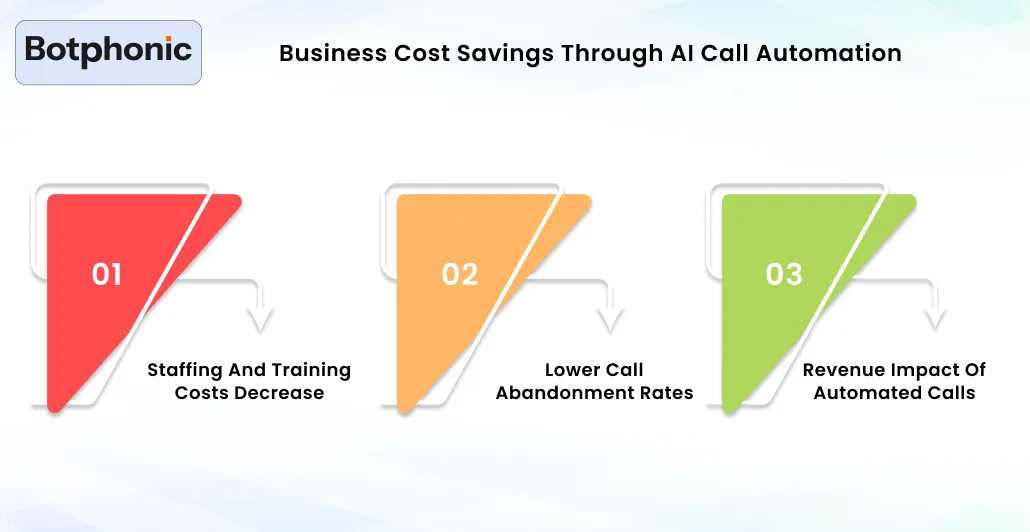
1. Staffing and Training Costs Decrease
AI call assistants eliminate the necessity for massive call centre teams, as they are able to perform a number of repeated tasks on their own. According to companies, staffing requirements have come down by as much as 25 per cent, leading to reduced expense in terms of salaries and training. Where this is especially useful for SMBs is that hiring more support staff can be a costly and time-consuming process.
2. Lower Call Abandonment Rates
According to data, companies utilising AI call assistants notice abandonment rates in the 15–20% range, and that means more customers receive help with fewer missed opportunities. Lower defection not only raises customer satisfaction but also enhances the total revenue potential.
3. Revenue Impact of Automated Calls
Automated calls (robocalls) can also generate real revenue. By providing faster answers, minimising mistakes, and improving lead follow-up, AI call bots enable businesses to convert incoming prospects while keeping existing customers. Organisations utilising AI in delivering customer service experience sales growth of 10–15 per cent, and those that employ it to assist contact centre employees realise increases of 5–10 per cent.
NOTE
Why Botphonic Is Built for U.S. Call Automation Needs
Botphonic is the only NLP provider in the U.S. that caters to the habits of U.S. businesses with intelligent call automation BOTs! Botphonic isn’t ”one-size-fits-all” – it is voice AI with a comprehensive understanding of American consumer demands. It guarantees the most realistic, authentic, and prompt replies so that callers get the same level of quality that comes from U.S. customer service.
1. Designed for American Customer Expectations
U.S. consumers assume that when they contact a company, someone will pick up the phone, respond to an email or chat, and do so relatively quickly, with facts at his or her fingertips and with a smile. Botphonic is designed to deliver in these areas through world-class speech recognition, natural language understanding, and a human-like conversational tone. Built for high volumes of calls, it can efficiently manage the call flow and give consistent answers on every call, ensuring that each interaction promotes trust and professionalism.
2. Industry-Ready Voice AI Models
Botphonic includes pre-trained industry-specific voice AI models for banking, retail, healthcare, and telecommunications. These models comprehend the language, workflow, and common questions across sectors so they can be deployed faster and handle more calls accurately. In the case you’re writing AI models from scratch, Botphonic’s pre-trained ones are invaluable and offer huge gains in accuracy too.
3. Long-Term Value for Businesses
Botphonic is an investment in more than just phone calls; it’s creating a system that will run as you scale. Enterprises using Botphonic realise a tangible Return on Investment (ROI) across many areas, such as staff intake and training, better customer service and satisfaction, and measurable revenue increase. Its AI is constantly learning from interactions, getting more accurate and efficient every moment, and providing consistent ROI.
Final Thoughts
New Voice AI Stats Prove: US Businesses Have Fully Embraced AI-Driven Call Automation. The latest voice AI statistics are in, and they show that businesses in the United States are adopting call automation powered by artificial intelligence (AI) at an unprecedented pace. Adoption is gaining traction across sectors with tangible outcomes around efficiency, cost savings, and customer satisfaction. Companies that are adopting AI call assistants are not just making their operational metrics stronger; they’re creating a more robust and dependable customer experience.
For U.S. business owners, this new data underscores a crucial realisation: AI call automation is no longer a “luxury” feature; it’s now vital for keeping pace in our fast-moving, customer-centric market, clearly reflecting ongoing AI call automation trends USA. Using tools such as Botphonic enables businesses to keep up with increasing consumer demands, scale effectively, and drive demonstrable business results – all while ensuring customers are happy.
