Summarize Content With:
“Hiring is no longer constrained by talent. It is constrained by time, communication breakdowns, and delayed screening. The AI call assistant reduces friction by replying promptly, automatically qualifying candidates, and keeping employment pipelines running without overburdening recruiting personnel.”
The process of hiring would begin with an easy question. Who is the most qualified to do the job? The question has quite a different appearance today. Get through the volume, how do we even get through that part?
In the morning, a recruiter opens the dashboard and notices hundreds of new applications in it. The human resource manager has a major interest in updates. Applicants do not want to wait days before getting a reply. Interviews made. Notes written. Reports shared. None of this is out of the order anymore. It is another day in contemporary recruiting.
However, here is the problem
The bulk of that work has got nothing to do with actual evaluation of talent. It is operational noise. Resume screening, follow ups, scheduling loops, documentation. Important tasks, yes. Strategic tasks, not really. However they take up most of the time of a recruiter.
Companies have been struggling to find a new solution to that pressure. Where the AI call assistant comes in the picture –
These are systems that become like functional partners within the recruitment process. They search through pools of applicants, sift resumes, interview applicants, recap interviews and maintain the work processes without supervision
Rather than busy in the administration, the recruiters majorly give their contribution in judgment, relationships, and ultimate hiring decisions.
The AI Recruitment Phase That Left The Traditional System
AI recruiting agents do not consist of mere automation scripts. Integrated independent aids within recruiting processes. Accumulate information, perform actions, and keep the processes going without the need to monitor them.
Consider them as talent team muscle.
They find applicants, filter resumes, arrange meetings, recap discussions, write up records and put red flags on any misfit before it costs you a recruitment. No fatigue and neither forgotten notes. Also, you won’t face any missed follow-ups.
Recruiters stay in control. The AI manages the gravitas of operation that pulls teams down.
This is important since the process of hiring is hectic nowadays. High application volume. Shorter candidate attention time. Organizations need to hire quicker. AI agents go even to the extent of stabilizing that chaos.
“They bring consistency.
And consistency wins”
The True Staffing Trap No One Speaks of
This is an inappropriate reality. The majority of recruiting delays do not pertain to shortage of talent. They concern the failure of processes. Resumes pile up. Recruiters triage manually. It takes days to get a response to hiring managers. Interviews reschedule. Candidates disappear.
“Divide that by dozens of jobs
Leaks all over your hiring funnel”
Artificial intelligence recruitment agents strike at those bottlenecks. They remove the slow parts. The repetitive parts. The management waste which consumes days. Remove friction impact on the hiring velocity. Not slightly. Dramatically.
Speed Is the New Employer Brand
Candidates will now demand instant participation. Not tomorrow. Not next week. Immediately.
When one is applying to a position, and does not expect to hear back, and 48 hours go by, then he assumes that you are poorly organized or that you are not interested. Many simply move on.
That is solved immediately when using AI in staffing industry
Applications initiate an outreach in minutes. Screening questions automatically occur. Interview slots do not have the standard calendar circus. Candidates feel momentum. Recruiters regain time. Everybody wins.
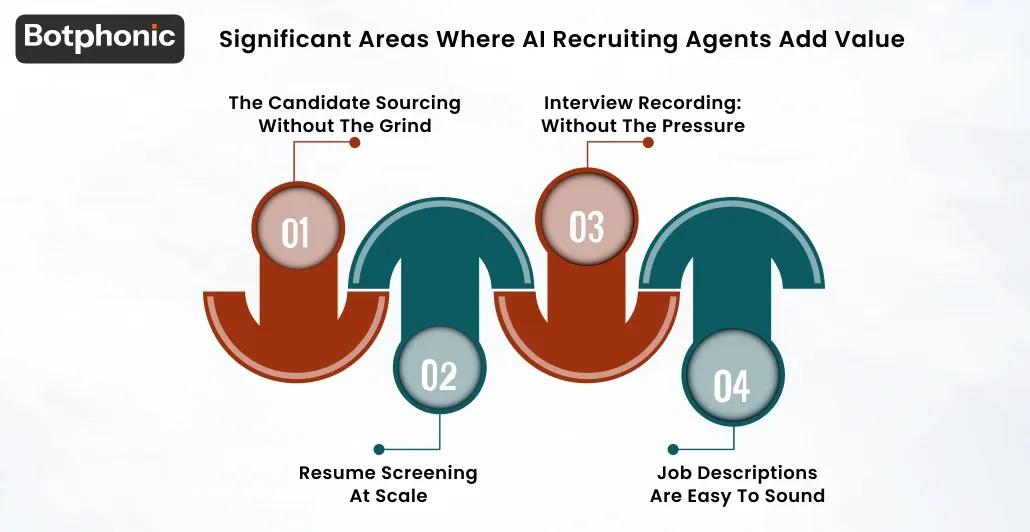
Significant Areas Where AI Recruiting Agents Add Value
Due to ambiguous promises being ubiquitous in HR tech.
1. The Candidate Sourcing Without the Grind
Conventional sourcing is fatiguing to recruiters. Endless searching. Copying profiles. Building lists manually. AI sourcing agents search a huge pool of talent and present candidates who meet the requirements of a role in real time. Skills, experience, indicators of fit. All processed in seconds.
On the morning of the day, the recruiters already have viable opportunities. Manual labor is substituted with momentum.
2. Resume Screening at Scale
The screening of human resumes fails when there is volume. Exhaustion creeps in. Suitable applicants are lost. The AI screening agents compare hundreds of resumes within seconds without being subjective to the same criteria.
No inconsistency. No exhaustion bias.
Recruiters also sort noise but only on qualified candidates.
3. Interview Recording: Without the Pressure
Interviewers make bad note takers. Not malicious. Just human.
Significant points are lost in the discussions. Feedback becomes vague. Hiring decisions suffer.
The AI voice assistant for recruitment records the whole discussion and transforms it into outline videos. Signals, competencies, key quotes, risks.
- Employing teams examine clean data rather than squibbling memory.
- Clarity replaces guesswork.
- Computerized Reporting that the Leadership Reads.
- Heightened Recruiting reports are normally hurried before the night before meetings.
- The numbers were drawn out of various systems. Formatting chaos. Half of the data is missing.
AI reporting agents form regular updates automatically. Funnel health and hire. hiring schedules.
Leaders are visionary rather than sightless. And recruiters recapture their evenings.
4. Job Descriptions Are Easy To Sound
Multiple stakeholders. Conflicting opinions. Endless revisions.
Highly inclusive AI converts intake notes to structured job postings in seconds. Messaging stays consistent. Requirements stay clear.Searches launch faster. And, quality applicants are found sooner in the funnel.
Use Botphonic for simplifying your hiring process – from interview scheduling, screening candidates, to find the right one.
Request a Free DemoAI Call Assistant Completely Modify The Candidate Engagement
Text automation helps. Chatbots help. However, the voice interaction alters the dynamics. The AI call assistant makes calls to the candidates, pose the screening questions, record the responses and arrange interviews automatically. This is enormous in high volume hiring systems. Call centers. Retail. logistics. healthcare. The AI makes thousands of calls at once, rather than the recruiters calling the applicants the whole day.
All the candidates are given attention. Immediately. Such kind of responsiveness would have demanded an army of coordinators. Now it requires software.
The Economics of AI Hiring
We should discuss numbers since executives are concerned not with features but results.
Companies that recruit with the help of AI have claimed significant efficiency. Resume screening time may reduce by 75 percent depending on a study conducted by Talent Board and Phenom.
The LinkedIn research indicates that companies that rely on AI-assisted recruiter messaging have a 9 percent greater probability of hiring quality candidates. There is a saving of approximately 36 percent of coordination time with interview scheduling automation.
And other staffing companies reduce time-to-hire by about 40 percent when conversational AI takes care of preliminary screening. Not that is incremental improvement. This is operational leverage. There are also new positions that recruiting teams have to do but without adding to the number of staff. Finance teams love that.
Learn more: AI Phone Interviews vs Traditional Screening
The Silent Problem : Which Most AI Recruitment Agents Have
It is at this point that things become messy. Marketing is everything as AI is not as such.
There are vendors who deal in the glorified automation under buzzwords. Machine learning as a pretense of rules-based workflows
In case a tool is unable to describe the way in which it measures candidates, it should raise red flags.
In the case of an AI call assistant , having patterns improves predictions on a long-term basis. Fake AI follows scripts. The difference is significant since the hiring decisions have legal and ethical implications. Accountable organizations require openness.
Algorithms Do Not Sometimes Solve Bias
Many people believe that the AI call assistant eliminates bias.
Such an assumption is risky. AI systems are trained on past information. In case that data has biased patterns, then the system is capable of replicating them.This has happened before.
Firms have discarded artificial intelligence recruitment applications after having realized that it favors certain profiles based on previous hiring patterns. The lesson is simple. Human supervision is still necessary. Not judgment, but aids to decisions should be made by AI.
In Recruitment – Compliant Is The Necessary One
Governments are listening to AI hiring systems.
Transparency, audits and notification of candidates are emerging as the regulations to be followed when automated tools are involved in hiring decisions. Indicatively, certain jurisdictions already mandate bias auditing of automated hiring instruments regularly (annually)
Organizations that do not comply risk being sued. Strategic adoption implies regulation, record keeping, and ownership. AI is powerful. But it is not a legal shield.
Recruiters Are Not Being Phased Out
Although it reads so, recruiters are not being replaced by AI recruiting agents.
The AI voice assistant for recruitment eliminates the working load that does not allow the recruiters to perform the job that really matters.
- Advising hiring managers.
- Establishing relationships with candidates.
- Closing offers.
- Strategic talent planning.
Recruiter influence can be improved when repetitive tasks are removed.
This is known to the best teams in a short time.
Reason – Why Early Adopters are Pulling Ahead
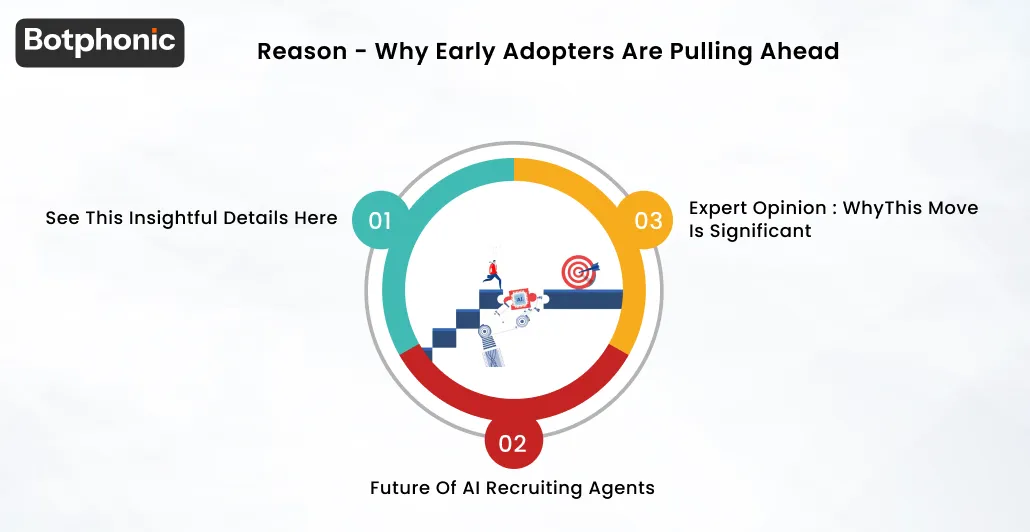
The effective gap of recruiting is increasing. Firms that employ an AI call assistant operate at a high speed. Communicate faster. Evaluate candidates faster. That speed compounds.
Applicants would like to work in responsive companies. Hiring managers rely on information rather than intuitions. Pipelines stay healthier.
In the meantime, slower organizations keep being overwhelmed by administrative work.
Technology can hardly change industries in a single day. It silently benefits the listening paying teams. Then, the gap becomes obvious.
See This Insightful Details Here
| What are the hurdles | Conventional Process | With AI Call Assistant | Real Impact on Hiring |
| High workload | Lot’s of duplicate work | Simplifies call management | Reserved time for strategic hiring |
| Schedule interview | Send emails and manage calendar | Automatically books appointment | Mitigates delays |
| Response Time | Answers after hours | Instant replies | Increase engagement rate |
| Candidate Ghosting | Candidate lose their interest | Quick interaction | Enhances conversion rate |
| Speed of Hiring | Takes weeks | Completed tasks within minutes | Minimizing hiring timing |
Future of AI Recruiting Agents
The capabilities of AI are developing fast.
Voice systems are approaching a more natural one. The language models comprehend the nuance more. The precision of the predictions of analytics engines gets higher. Recruiting agents of the future will probably deal with more intense candidate interaction, onboarding organization, and even internal mobility suggestions.
Still, the cultural change is the real one. Recruiting teams are beginning to work like the product teams. Data driven. Iterative. Where it is not automatic, it is automated. Human where it matters.
The organizations that strike the equilibrium in such forces will conquer talent markets. Other people will continue to remove jobs and question themselves why no one is responding. And at the same time of that insight, an AI appointment booking is able to filter 400 potential employees when the hiring team is still in a meeting.
Expert Opinion : WhyThis Move Is Significant
An AI call assistant does not replace recruiters; they simply eliminate repetitious work. When communication, screening, and scheduling are handled automatically, hiring teams can concentrate on judgement, culture fit, and decision-making. That is where better hiring occurs.
The AI call assistant are making significant contributions to resolving this issue, let’s see :
- Guarantee that applicants are not kept waiting for updates or acknowledgements by responding to them immediately.
- Swiftly determine whether a candidate satisfies the fundamental job requirements by asking them pre-formulated screening questions.
- By scheduling interviews automatically, they eliminate the back-and-forth correspondence that impedes the employment process.
- They facilitate recruiters’ efficient assessment of applications by organizing candidate information into structured data.
- Make sure all applicants go through the same evaluation procedures, maintaining uniformity throughout the recruiting process.